Department of Laboratory Medicine, State Key Laboratory of Complex Severe and Rare Diseases, Peking Union Medical College Hospital, Chinese Academy of Medical Sciences and Peking Union Medical College, Beijing, People's Republic of China.
Graduate School, Chinese Academy of Medical Sciences and Peking Union Medical College, Beijing, People's Republic of China.
Emerg Microbes Infect. 2022 Dec;11(1):1079-1089. doi: 10.1080/22221751.2022.2059402.
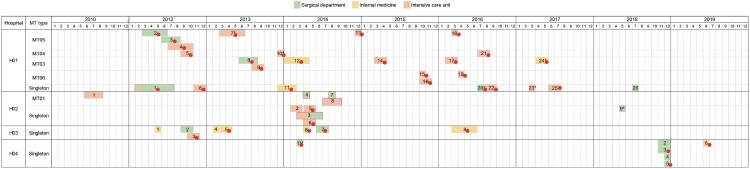
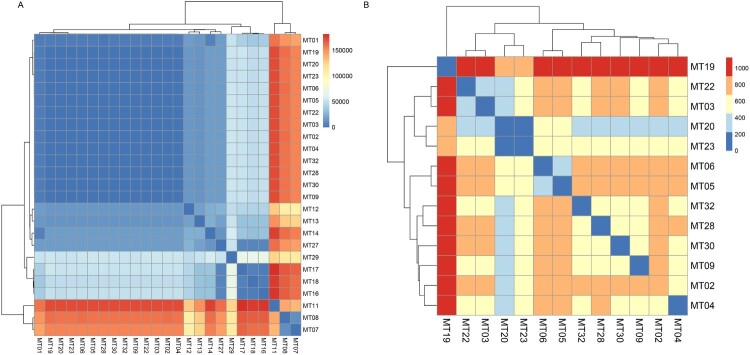
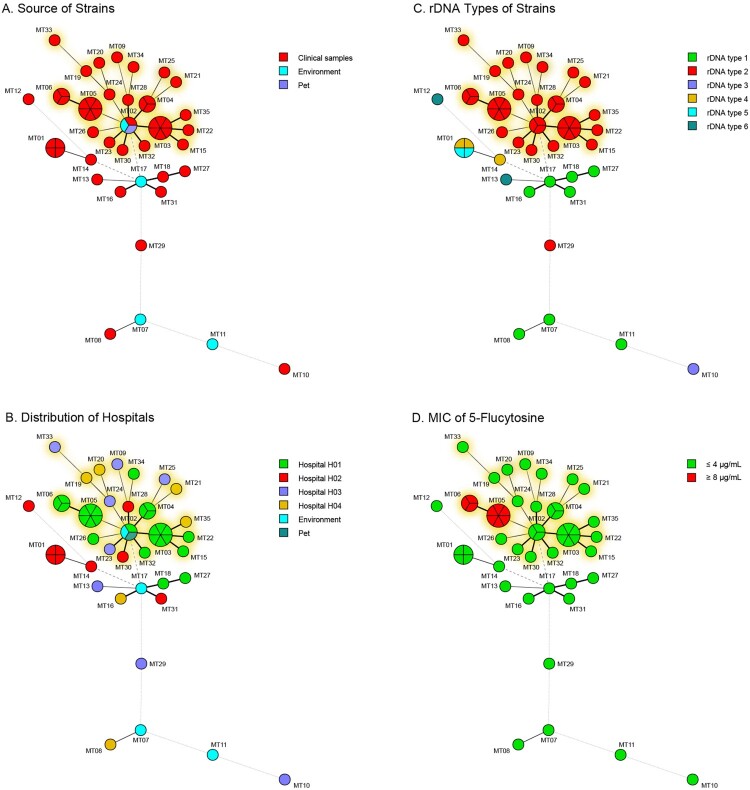
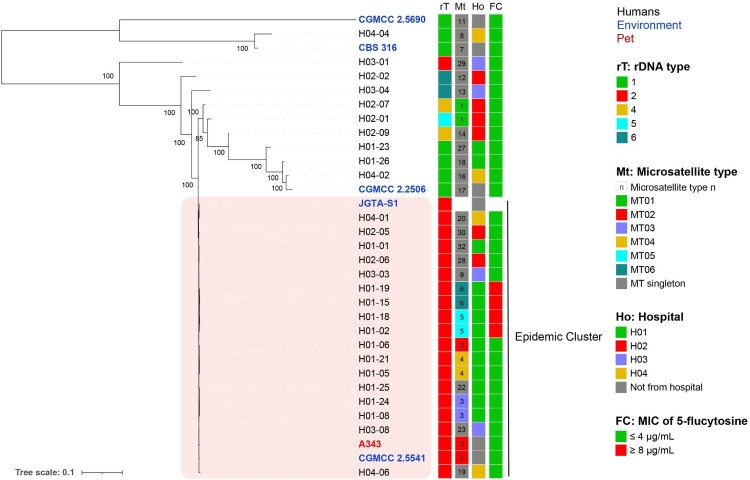
, an environmental yeast widely used in industry and agriculture, is also an opportunistic pathogen resistant to multi-antifungals. During the national surveillance in China, has been documented from various hospitals and regions. At present, the molecular epidemiology of invasive infections caused by and their resistance profiles to antifungals were unknown. Here we collected 49 strains from four hospitals located in different geographic regions from 2009 to 2019 in China, determined their genotypes using different molecular markers and quantified susceptibilities to various antifungals. Sequencing of ITS and D1/D2 regions in rDNA indicated that 73.5% (36/49) of clinical strains belong to same sequence type (rDNA type 2). Microsatellite (MT) genotyping with 15 (recently developed) tandem repeat loci identified 5 epidemic MT types, which accounted for 44.9% (22/49) of clinical strains, as well as 27 sporadic MT types. Microsatellite data indicated that the presence of an epidemic cluster including 35 strains (71.4%) repeatedly isolated in four hospitals for eight years. Single nucleotide variants (SNVs) from the whole genome sequence data also supported the clustering of these epidemic strains due to low pairwise distance. In addition, phylogenetic analysis of SNVs from these clinical strains, together with environmental and animal strains showed that the closely related epidemic cluster strains may be opportunistic, zoonotic pathogens. Also, molecular data indicated a possible clonal transmission of pan echinocandins-azoles-5-flucytosine resistant strains in hospital H01. Our study demonstrated that is a multi-drug resistant pathogen with the ability to cause nosocomial infection.
作为一种广泛应用于工农业的环境酵母, 也是一种对多种抗真菌药物具有耐药性的机会性病原体。在中国的国家监测中,已从不同医院和地区记录到 。目前,侵袭性感染的分子流行病学和它们对抗真菌药物的耐药谱尚不清楚。在这里,我们从 2009 年至 2019 年在中国四个地理位置不同的医院收集了 49 株 ,使用不同的分子标记物确定其基因型,并定量测定其对各种抗真菌药物的敏感性。rDNA 中 ITS 和 D1/D2 区的测序表明,73.5%(36/49)的临床菌株属于同一序列类型(rDNA 型 2)。使用 15 个(最近开发的)串联重复位点的微卫星(MT)基因分型鉴定出 5 种流行 MT 型,占临床菌株的 44.9%(22/49),以及 27 种散发性 MT 型。微卫星数据表明,存在一个流行的集群,包括 35 株(71.4%)在四年内在四所医院反复分离的菌株。全基因组序列数据的单核苷酸变异(SNV)也由于低对碱基差异支持这些流行株的聚类。此外,这些临床菌株的 SNV 的系统发育分析,以及与环境和动物菌株一起,表明密切相关的流行株集群菌株可能是机会性病原体,人畜共患病原体。此外,分子数据表明,在医院 H01 中,可能存在泛棘白菌素-唑类-5-氟胞嘧啶耐药 菌株的克隆传播。我们的研究表明, 是一种具有引起医院感染能力的多药耐药病原体。