Department of Prosthetic Dentistry, University Hospital, LMU Munich, Goethestrasse 70, 80336, Munich, Germany.
Clin Oral Investig. 2022 Jul;26(7):4885-4896. doi: 10.1007/s00784-022-04455-4. Epub 2022 Mar 28.
To investigate the chemical (degree of conversion (DC)) and mechanical properties (Martens hardness (HM), elastic indentation modulus (E), and biaxial flexural strength (BFS)) of four dual-polymerizing resin composite core build-up materials after light- and self-polymerization.
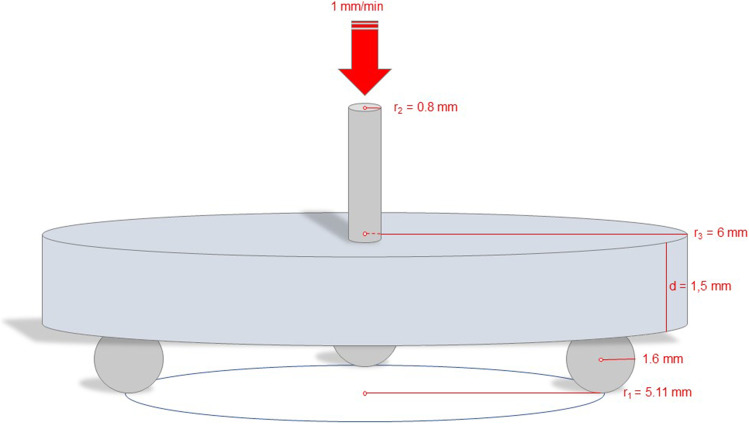
Round specimens with a diameter of 12 mm and a thickness of 1.5 mm were manufactured from CLEARFIL DC CORE PLUS (CLE; Kuraray), core·X flow (COR; Dentsply Sirona), MultiCore Flow (MUL; Ivoclar Vivadent), and Rebilda DC (REB; VOCO) (N = 96, n = 24/material). Half of the specimens were light-polymerized (Elipar DeepCure-S, 3 M), while the other half cured by self-polymerization (n = 12/group). Immediately after fabrication, the DC, HM, E, and BFS were determined. Data was analyzed using Kolmogorov-Smirnov, Mann-Whitney U, and Kruskal-Wallis tests, Spearman's correlation, and Weibull statistics (p < 0.05).
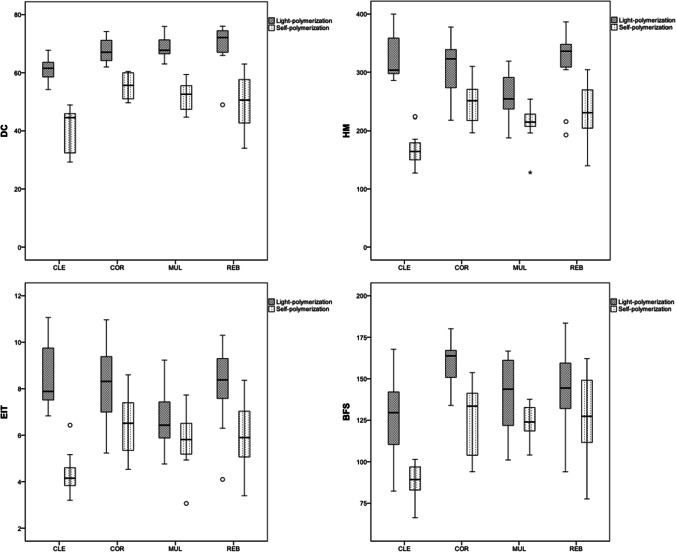
Light-polymerization either led to similar E (MUL; p = 0.119) and BFS (MUL and REB; p = 0.094-0.326) values or higher DC, HM, E, and BFS results (all other groups; p < 0.001-0.009). When compared with the other materials, COR showed a high DC (p < 0.001) and HM (p < 0.001) after self-polymerization and the highest BFS (p = 0.020) and Weibull modulus after light-polymerization. Positive correlations between all four tested parameters (R = 0.527-0.963, p < 0.001) were found.
For the tested resin composite core build-up materials, light-polymerization led to similar or superior values for the degree of conversion, Martens hardness, elastic indentation modulus, and biaxial flexural strength than observed after self-polymerization. Among the tested materials, COR should represent the resin composite core build-up material of choice due to its high chemical (degree of conversion) and mechanical (Martens hardness, elastic indentation modulus, and biaxial flexural strength) properties and its high reliability after light-polymerization. The examined chemical and mechanical properties showed a positive correlation.
The chemical and mechanical performance of dual-polymerizing resin composite core build-up materials is significantly affected by the chosen polymerization mode.
研究 4 种双固化树脂复合核修复材料在光固化和自固化后的化学(转化率(DC))和机械性能(马氏硬度(HM)、弹性压痕模量(E)和双轴弯曲强度(BFS))。
采用 CLEARFIL DC CORE PLUS(CLE;Kuraray)、core·X flow(COR;Dentsply Sirona)、MultiCore Flow(MUL;Ivoclar Vivadent)和 Rebilda DC(REB;VOCO)制作直径为 12mm、厚度为 1.5mm 的圆试件(N=96,n=24/材料)。一半试件经光固化(Elipar DeepCure-S,3M),另一半自固化(n=12/组)。制作后立即测定 DC、HM、E 和 BFS。采用 Kolmogorov-Smirnov、Mann-Whitney U 和 Kruskal-Wallis 检验、Spearman 相关分析和威布尔统计分析(p<0.05)。
光固化后 E(MUL;p=0.119)和 BFS(MUL 和 REB;p=0.094-0.326)值相似,或 DC、HM、E 和 BFS 结果更高(其他所有组;p<0.001-0.009)。与其他材料相比,COR 自固化后 DC(p<0.001)和 HM(p<0.001)较高,光固化后 BFS(p=0.020)和威布尔模量最高。四个测试参数之间呈正相关(R=0.527-0.963,p<0.001)。
对于所测试的树脂复合核修复材料,光固化后的转化率、马氏硬度、弹性压痕模量和双轴弯曲强度值优于自固化后的值。在测试的材料中,COR 由于其高化学(转化率)和机械(马氏硬度、弹性压痕模量和双轴弯曲强度)性能以及光固化后的高可靠性,应是首选的树脂复合核修复材料。所检查的化学和机械性能呈正相关。
双固化树脂复合核修复材料的化学和机械性能受所选聚合模式的显著影响。