Hurault Guillem, Stalder Jean François, Mery Sophie, Delarue Alain, Saint Aroman Markéta, Josse Gwendal, Tanaka Reiko J
Department of Bioengineering, Imperial College London, London, UK.
Clinique Dermatologique University Hospital, Nantes, France.
Clin Transl Allergy. 2022 Mar;12(3):e12140. doi: 10.1002/clt2.12140.
Atopic dermatitis (AD) is a chronic inflammatory skin disease leading to substantial quality of life impairment with heterogeneous treatment responses. People with AD would benefit from personalised treatment strategies, whose design requires predicting how AD severity evolves for each individual.
This study aims to develop a computational framework for personalised prediction of AD severity dynamics.
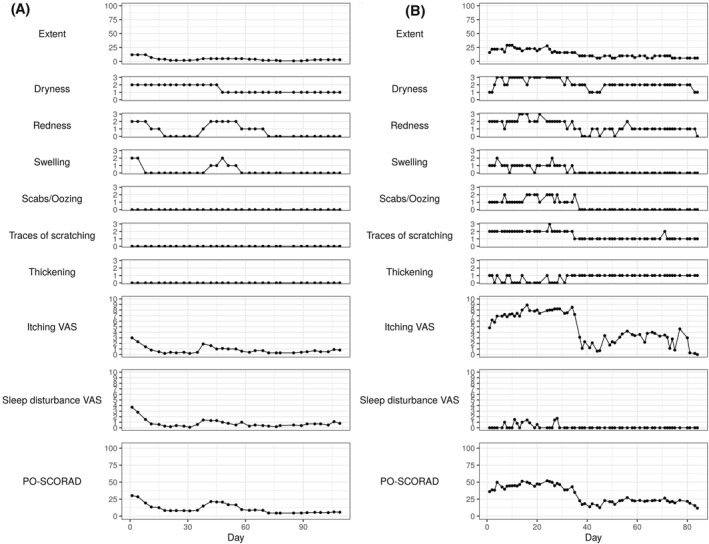
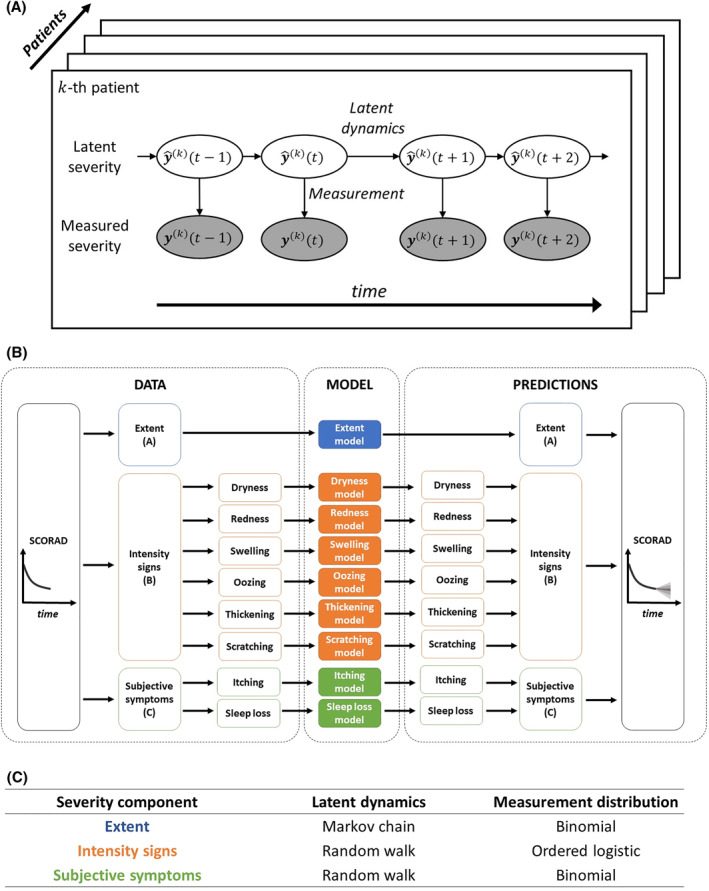
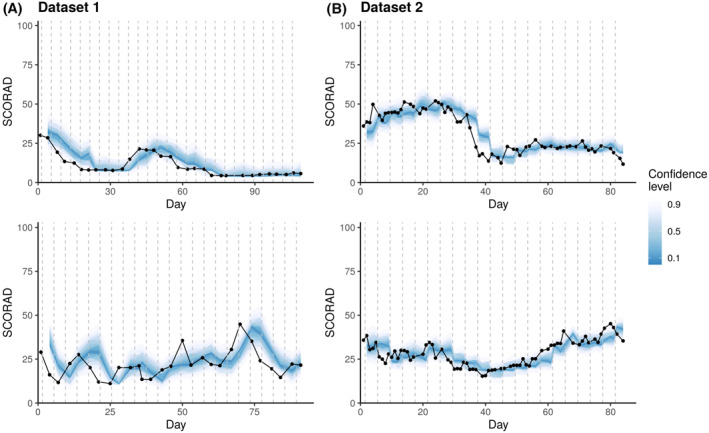
We introduced EczemaPred, a computational framework to predict patient-dependent dynamic evolution of AD severity using Bayesian state-space models that describe latent dynamics of AD severity items and how they are measured. We used EczemaPred to predict the dynamic evolution of validated patient-oriented scoring atopic dermatitis (PO-SCORAD) by combining predictions from the models for the nine severity items of PO-SCORAD (six intensity signs, extent of eczema, and two subjective symptoms). We validated this approach using longitudinal data from two independent studies: a published clinical study in which PO-SCORAD was measured twice weekly for 347 AD patients over 17 weeks, and another one in which PO-SCORAD was recorded daily by 16 AD patients for 12 weeks.
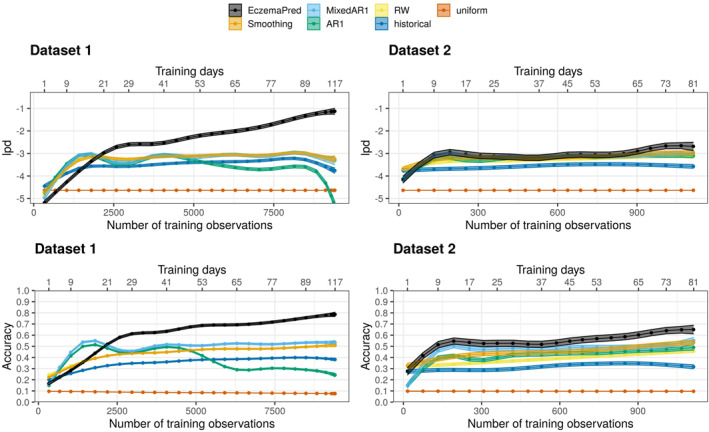
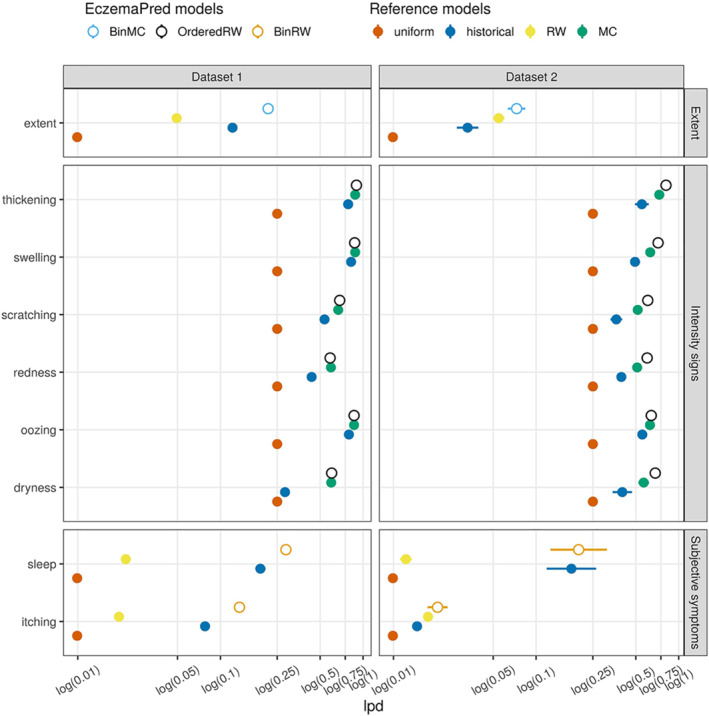
EczemaPred achieved good performance for personalised predictions of PO-SCORAD and its severity items daily to weekly. EczemaPred outperformed standard time-series forecasting models such as a mixed effect autoregressive model. The uncertainty in predicting PO-SCORAD was mainly attributed to that in predicting intensity signs (75% of the overall uncertainty).
EczemaPred serves as a computational framework to make a personalised prediction of AD severity dynamics relevant to clinical practice. EczemaPred is available as an R package.
特应性皮炎(AD)是一种慢性炎症性皮肤病,会严重损害生活质量,且治疗反应具有异质性。AD患者将从个性化治疗策略中受益,而个性化治疗策略的设计需要预测每个个体的AD严重程度如何演变。
本研究旨在开发一个用于个性化预测AD严重程度动态变化的计算框架。
我们引入了EczemaPred,这是一个计算框架,使用贝叶斯状态空间模型来预测AD严重程度的患者依赖性动态演变,该模型描述了AD严重程度项目的潜在动态及其测量方式。我们使用EczemaPred,通过结合PO-SCORAD九个严重程度项目(六个强度体征、湿疹范围和两个主观症状)模型的预测结果,来预测经过验证的以患者为导向的特应性皮炎评分(PO-SCORAD)的动态演变。我们使用来自两项独立研究的纵向数据对该方法进行了验证:一项已发表的临床研究,其中对347名AD患者在17周内每周测量两次PO-SCORAD;另一项研究中,16名AD患者每天记录PO-SCORAD,持续12周。
EczemaPred在每日至每周对PO-SCORAD及其严重程度项目进行个性化预测方面表现良好。EczemaPred优于标准时间序列预测模型,如混合效应自回归模型。预测PO-SCORAD的不确定性主要归因于预测强度体征时的不确定性(占总不确定性的75%)。
EczemaPred作为一个计算框架,可对与临床实践相关的AD严重程度动态变化进行个性化预测。EczemaPred以R包的形式提供。