The Oncologic and Reconstructive Surgery Clinic, Maria Sklodowska-Curie National Research Institute of Oncology, Gliwice Branch, Wybrzeze Armii Krajowej 15, 44-100, Gliwice, Poland.
BMC Gastroenterol. 2022 Mar 26;22(1):141. doi: 10.1186/s12876-022-02226-9.
Regional lymph node metastases are the main adverse prognostic factor in patients with rectal cancer without distant metastases. There are discrepancies, however, regarding additional risk factors in the group of ypN + M0 patients. The purpose of the study was to assess clinical and pathological factors affecting long-term oncological outcomes in the group of ypN + M0 patients after radical rectal anterior resection.
112 patients with ypN + M0 rectal cancer after neoadjuvant therapy and radical anterior resection were subject to a retrospective analysis. The effect of potential factors on survival was assessed with the use of Kaplan-Meier curves together with a log-rank test and multiple factor Cox proportional hazards model.
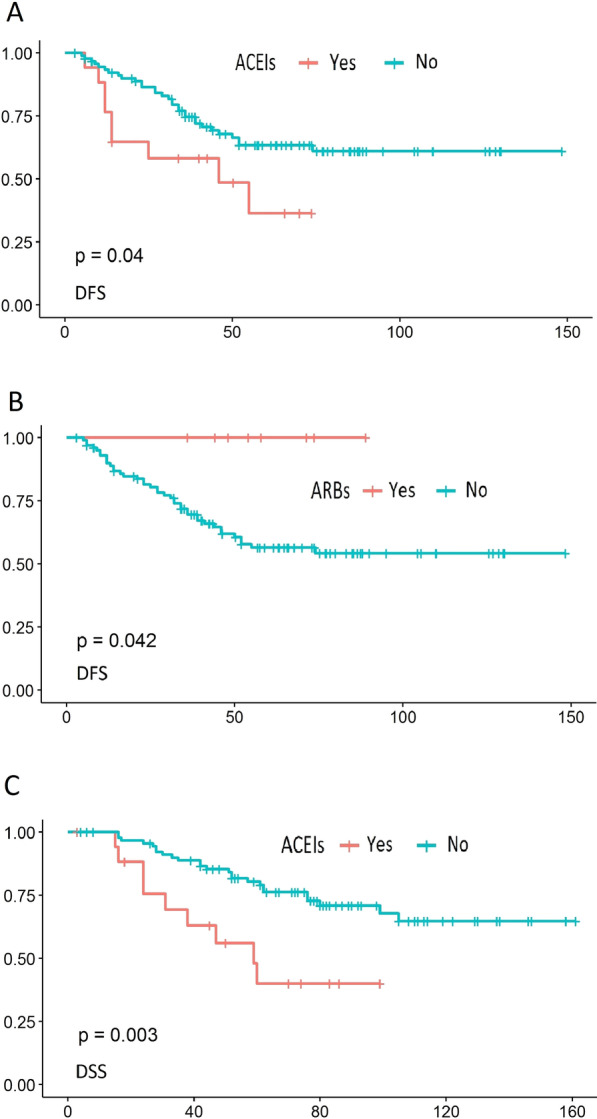
In the multiple factor Cox analysis, adverse factors affecting disease-free survival (DFS) were: the use of angiotensin-converting enzyme inhibitors (ACEIs) (hazard ratio HR: 3.11, 95% CI 1.01-9.56, p = 0.047), presence of perineural invasion (HR: 7.27, 95% CI 2.74-19.3, p < 0.001) and occurrence of postoperative complications (HR: 6.79, 95% CI 2.09-22.11, p = 0.001), while a positive factor was the negative lymph node (NLN) count > 7 (HR: 0.33, 95% CI 0.12-0.88, p = 0.026). In the disease-specific survival (DSS) analysis, an adverse factor was the use of ACEIs (HR: 4.275, 95% CI 1.44-12.694, p = 0.009), while a positive effect was caused by NLN > 5 (HR: 0.22, 95% CI 0.082-0.586, p = 0.002).
The use of ACEIs may have a negative effect on long-term treatment outcomes in patients with ypN + M0 rectal cancer. In this group of patients, the NLN count seems to be an important prognostic factor, as well.
无远处转移的直肠癌患者,区域淋巴结转移是主要的不良预后因素。然而,在 ypN+M0 患者中,关于其他危险因素存在差异。本研究的目的是评估新辅助治疗后接受直肠前切除术的 ypN+M0 患者中影响长期肿瘤学结局的临床和病理因素。
对 112 例接受新辅助治疗和根治性直肠前切除术的 ypN+M0 直肠癌患者进行回顾性分析。使用 Kaplan-Meier 曲线结合对数秩检验和多因素 Cox 比例风险模型评估潜在因素对生存的影响。
多因素 Cox 分析显示,影响无病生存(DFS)的不良因素有:血管紧张素转换酶抑制剂(ACEI)的使用(HR:3.11,95%CI 1.01-9.56,p=0.047)、神经周围侵犯(HR:7.27,95%CI 2.74-19.3,p<0.001)和术后并发症的发生(HR:6.79,95%CI 2.09-22.11,p=0.001),而阳性因素是阴性淋巴结(NLN)计数>7(HR:0.33,95%CI 0.12-0.88,p=0.026)。在疾病特异性生存(DSS)分析中,不良因素是 ACEI 的使用(HR:4.275,95%CI 1.44-12.694,p=0.009),而 NLN>5 具有积极影响(HR:0.22,95%CI 0.082-0.586,p=0.002)。
ACEI 的使用可能对 ypN+M0 直肠癌患者的长期治疗结果产生负面影响。在这组患者中,NLN 计数似乎也是一个重要的预后因素。