Institute for Immunity, Transplantation and Infection, School of Medicine, Stanford University, CA, Stanford, USA.
Cancer Biology Graduate Program, School of Medicine, Stanford University, CA, Stanford, USA.
Genome Med. 2022 Mar 29;14(1):33. doi: 10.1186/s13073-022-01034-w.
Each year 3-6 million people develop life-threatening severe dengue (SD). Clinical warning signs for SD manifest late in the disease course and are nonspecific, leading to missed cases and excess hospital burden. Better SD prognostics are urgently needed.
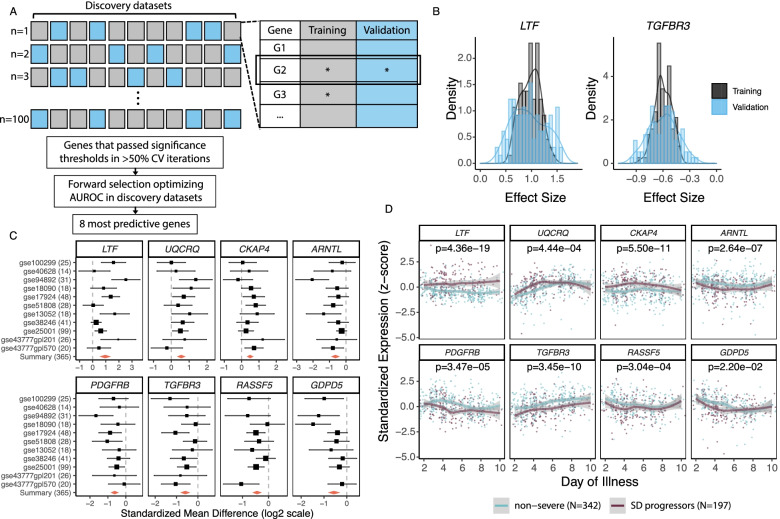
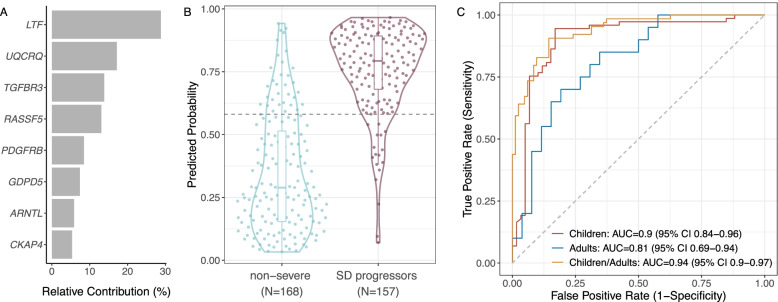
We integrated 11 public datasets profiling the blood transcriptome of 365 dengue patients of all ages and from seven countries, encompassing biological, clinical, and technical heterogeneity. We performed an iterative multi-cohort analysis to identify differentially expressed genes (DEGs) between non-severe patients and SD progressors. Using only these DEGs, we trained an XGBoost machine learning model on public data to predict progression to SD. All model parameters were "locked" prior to validation in an independent, prospectively enrolled cohort of 377 dengue patients in Colombia. We measured expression of the DEGs in whole blood samples collected upon presentation, prior to SD progression. We then compared the accuracy of the locked XGBoost model and clinical warning signs in predicting SD.
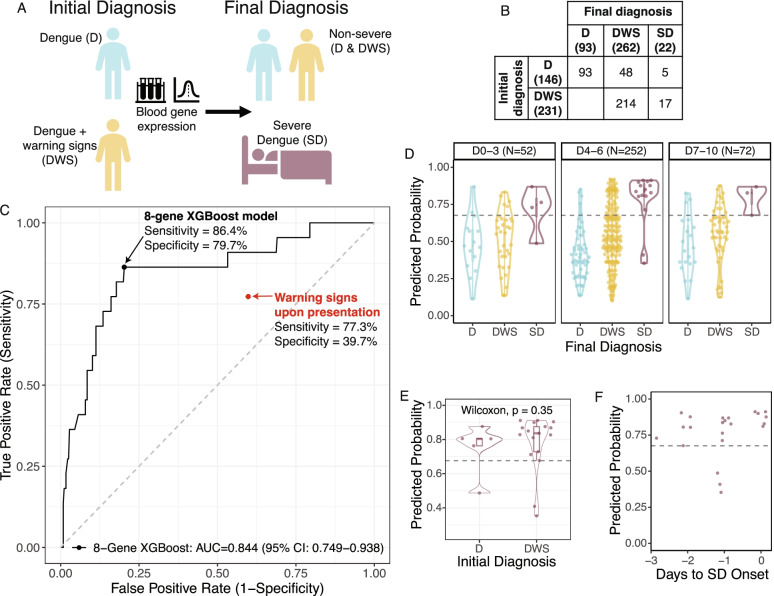
We identified eight SD-associated DEGs in the public datasets and built an 8-gene XGBoost model that accurately predicted SD progression in the independent validation cohort with 86.4% (95% CI 68.2-100) sensitivity and 79.7% (95% CI 75.5-83.9) specificity. Given the 5.8% proportion of SD cases in this cohort, the 8-gene model had a positive and negative predictive value (PPV and NPV) of 20.9% (95% CI 16.7-25.6) and 99.0% (95% CI 97.7-100.0), respectively. Compared to clinical warning signs at presentation, which had 77.3% (95% CI 58.3-94.1) sensitivity and 39.7% (95% CI 34.7-44.9) specificity, the 8-gene model led to an 80% reduction in the number needed to predict (NNP) from 25.4 to 5.0. Importantly, the 8-gene model accurately predicted subsequent SD in the first three days post-fever onset and up to three days prior to SD progression.
The 8-gene XGBoost model, trained on heterogeneous public datasets, accurately predicted progression to SD in a large, independent, prospective cohort, including during the early febrile stage when SD prediction remains clinically difficult. The model has potential to be translated to a point-of-care prognostic assay to reduce dengue morbidity and mortality without overwhelming limited healthcare resources.
每年有 300 万至 600 万人患上危及生命的严重登革热(SD)。SD 的临床预警信号在疾病过程后期出现,且不具有特异性,导致漏诊和医院负担过重。目前迫切需要更好的 SD 预后预测方法。
我们整合了 11 个公共数据集,这些数据集对来自 7 个国家的 365 名不同年龄的登革热患者的血液转录组进行了分析,涵盖了生物学、临床和技术异质性。我们进行了迭代多队列分析,以确定非严重患者和 SD 进展患者之间差异表达的基因(DEGs)。我们仅使用这些 DEGs,在哥伦比亚的一个前瞻性纳入的 377 名登革热患者的独立队列中使用 XGBoost 机器学习模型进行训练,以预测进展为 SD。在验证之前,所有模型参数都“锁定”。我们测量了在出现 SD 之前收集的全血样本中 DEGs 的表达水平。然后,我们比较了锁定的 XGBoost 模型和临床预警信号在预测 SD 方面的准确性。
我们在公共数据集中确定了 8 个与 SD 相关的 DEGs,并构建了一个 8 基因 XGBoost 模型,该模型在独立验证队列中准确预测了 SD 进展,敏感性为 86.4%(95%CI 68.2-100),特异性为 79.7%(95%CI 75.5-83.9)。鉴于该队列中 SD 病例的比例为 5.8%,8 基因模型的阳性预测值(PPV)和阴性预测值(NPV)分别为 20.9%(95%CI 16.7-25.6)和 99.0%(95%CI 97.7-100.0)。与出现 SD 时的临床预警信号相比,其敏感性为 77.3%(95%CI 58.3-94.1),特异性为 39.7%(95%CI 34.7-44.9),8 基因模型将预测值从 25.4 降低到 5.0,减少了 80%。重要的是,该模型在发热后最初三天内甚至在 SD 进展前三天就能够准确预测随后的 SD。
该 XGBoost 模型是在异质的公共数据集上训练的,可准确预测大型独立前瞻性队列中 SD 的进展,包括在临床预测仍然困难的发热早期阶段。该模型具有转化为床边预后检测的潜力,可以降低登革热的发病率和死亡率,而不会给有限的医疗资源带来过重负担。