• 文献检索
  • 文档翻译
  • 深度研究
  • 学术资讯
  • Suppr Zotero 插件Zotero 插件
  • 邀请有礼
  • 套餐&价格
  • 历史记录
应用&插件
Suppr Zotero 插件Zotero 插件浏览器插件Mac 客户端Windows 客户端微信小程序
定价
高级版会员购买积分包购买API积分包
服务
文献检索文档翻译深度研究API 文档MCP 服务
关于我们
关于 Suppr公司介绍联系我们用户协议隐私条款
关注我们

Suppr 超能文献

核心技术专利:CN118964589B侵权必究
粤ICP备2023148730 号-1Suppr @ 2026

文献检索

告别复杂PubMed语法,用中文像聊天一样搜索,搜遍4000万医学文献。AI智能推荐,让科研检索更轻松。

立即免费搜索

文件翻译

保留排版,准确专业,支持PDF/Word/PPT等文件格式,支持 12+语言互译。

免费翻译文档

深度研究

AI帮你快速写综述,25分钟生成高质量综述,智能提取关键信息,辅助科研写作。

立即免费体验

预测性精神病学时代的数据共享:青少年视角。

Data sharing in the age of predictive psychiatry: an adolescent perspective.

机构信息

Department of Psychiatry, University of Oxford, Oxford, UK.

Wellcome Centre for Ethics and Humanities, University of Oxford, Oxford, Oxfordshire, UK.

出版信息

Evid Based Ment Health. 2022 May;25(2):69-76. doi: 10.1136/ebmental-2021-300329. Epub 2022 Mar 28.

DOI:10.1136/ebmental-2021-300329
PMID:35346984
原文链接:https://pmc.ncbi.nlm.nih.gov/articles/PMC9046833/
Abstract

BACKGROUND

Advances in genetics and digital phenotyping in psychiatry have given rise to testing services targeting young people, which claim to predict psychiatric outcomes before difficulties emerge. These services raise several ethical challenges surrounding data sharing and information privacy.

OBJECTIVES

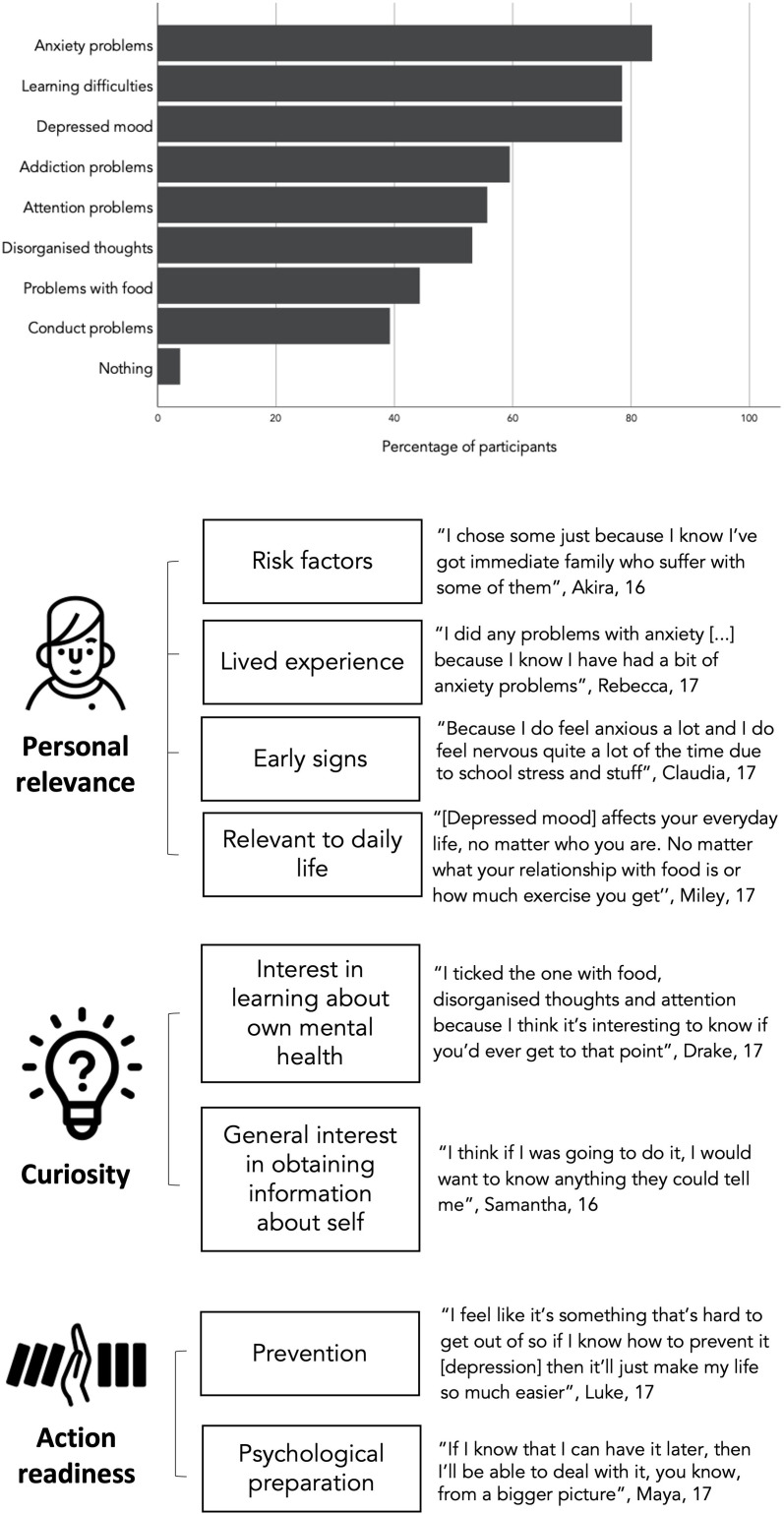
This study aimed to investigate young people's interest in predictive testing for mental health challenges and their attitudes towards sharing biological, psychosocial and digital data for such purpose.

METHODS

Eighty UK adolescents aged 16-18 years took part in a digital role-play where they played the role of clients of a fictional predictive psychiatry company and chose what sources of personal data they wished to provide for a risk assessment. After the role-play, participants reflected on their choices during a peer-led interview.

FINDINGS

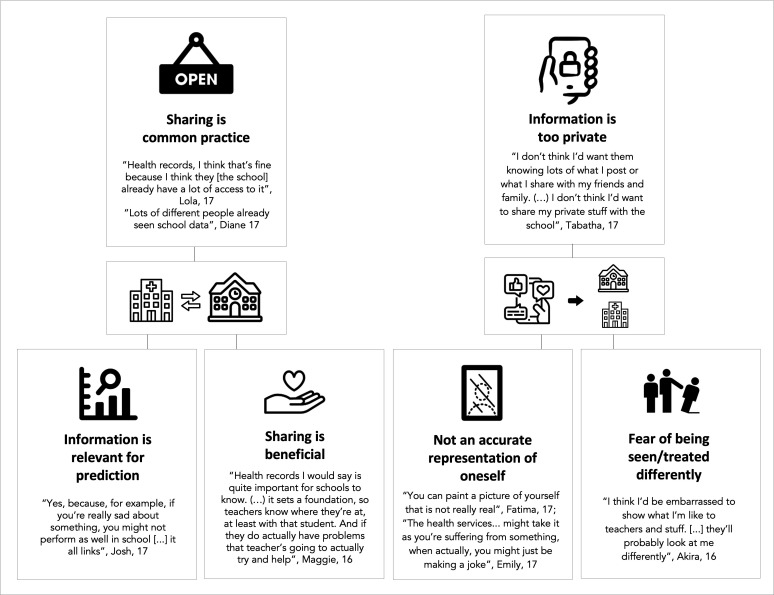
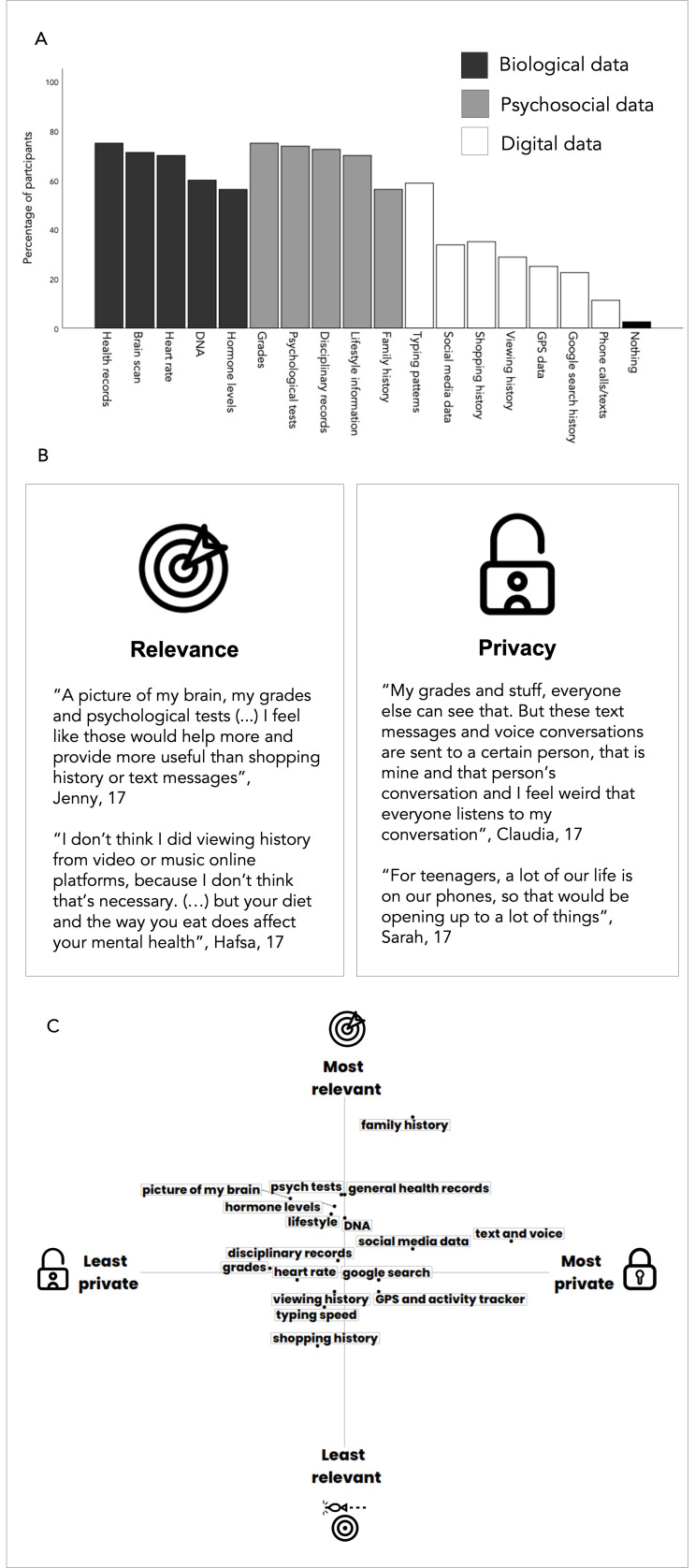
Participants saw multiple benefits in predictive testing services, but were highly selective with regard to the type of data they were willing to share. Largely due to privacy concerns, digital data sources such as social media or Google search history were less likely to be shared than psychosocial and biological data, including school grades and one's DNA. Participants were particularly reluctant to share social media data with schools (but less so with health systems).

CONCLUSIONS

Emerging predictive psychiatric services are valued by young people; however, these services must consider privacy versus utility trade-offs from the perspective of different stakeholders, including adolescents.

CLINICAL IMPLICATIONS

Respecting adolescents' need for transparency, privacy and choice in the age of digital phenotyping is critical to the responsible implementation of predictive psychiatric services.

摘要

背景

精神病学中的遗传学和数字表型研究的进步催生了针对年轻人的测试服务,这些服务声称可以在出现困难之前预测精神健康结果。这些服务引发了围绕数据共享和信息隐私的若干伦理挑战。

目的

本研究旨在调查年轻人对心理健康挑战预测测试的兴趣,以及他们对为此目的共享生物、心理社会和数字数据的态度。

方法

80 名年龄在 16 至 18 岁的英国青少年参与了一项数字角色扮演活动,他们在其中扮演一家虚构的预测精神病学公司的客户,并选择他们希望提供哪些个人数据来源进行风险评估。角色扮演结束后,参与者在同伴主导的访谈中反思他们的选择。

结果

参与者看到预测测试服务有多种好处,但对于他们愿意共享的数据类型非常挑剔。主要由于隐私问题,数字数据源(如社交媒体或谷歌搜索历史记录)比心理社会和生物数据(包括学校成绩和 DNA)更不可能被共享,参与者特别不愿意与学校(而不是与卫生系统)共享社交媒体数据。

结论

新兴的预测性精神病学服务受到年轻人的重视;然而,这些服务必须从不同利益相关者(包括青少年)的角度考虑隐私与效用权衡。

临床意义

在数字表型学时代,尊重青少年在透明度、隐私和选择方面的需求对于负责任地实施预测性精神病学服务至关重要。
https://cdn.ncbi.nlm.nih.gov/pmc/blobs/92b7/10231516/2baf859f9773/ebmental-2021-300329f03.jpg
https://cdn.ncbi.nlm.nih.gov/pmc/blobs/92b7/10231516/90e5fd3a4978/ebmental-2021-300329f01.jpg
https://cdn.ncbi.nlm.nih.gov/pmc/blobs/92b7/10231516/89090db1d6b1/ebmental-2021-300329f02.jpg
https://cdn.ncbi.nlm.nih.gov/pmc/blobs/92b7/10231516/2baf859f9773/ebmental-2021-300329f03.jpg
https://cdn.ncbi.nlm.nih.gov/pmc/blobs/92b7/10231516/90e5fd3a4978/ebmental-2021-300329f01.jpg
https://cdn.ncbi.nlm.nih.gov/pmc/blobs/92b7/10231516/89090db1d6b1/ebmental-2021-300329f02.jpg
https://cdn.ncbi.nlm.nih.gov/pmc/blobs/92b7/10231516/2baf859f9773/ebmental-2021-300329f03.jpg

相似文献

1
Data sharing in the age of predictive psychiatry: an adolescent perspective.预测性精神病学时代的数据共享:青少年视角。
Evid Based Ment Health. 2022 May;25(2):69-76. doi: 10.1136/ebmental-2021-300329. Epub 2022 Mar 28.
2
Tracing Tomorrow: young people's preferences and values related to use of personal sensing to predict mental health, using a digital game methodology.追踪未来:利用数字游戏方法研究年轻人对使用个人感知预测心理健康的偏好和价值观。
BMJ Ment Health. 2024 Mar 20;27(1):e300897. doi: 10.1136/bmjment-2023-300897.
3
Ethical Development of Digital Phenotyping Tools for Mental Health Applications: Delphi Study.数字表型工具在精神健康应用中的伦理发展:德尔菲研究。
JMIR Mhealth Uhealth. 2021 Jul 28;9(7):e27343. doi: 10.2196/27343.
4
Privacy, Trust, and Data Sharing in Web-Based and Mobile Research: Participant Perspectives in a Large Nationwide Sample of Men Who Have Sex With Men in the United States.基于网络和移动设备的研究中的隐私、信任与数据共享:美国全国范围内大量男男性行为者样本中的参与者观点
J Med Internet Res. 2018 Jul 4;20(7):e233. doi: 10.2196/jmir.9019.
5
Professional Ethics for Digital Age Psychiatry: Boundaries, Privacy, and Communication.数字时代精神病学的职业道德:边界、隐私与沟通
Curr Psychiatry Rep. 2017 Sep;19(9):55. doi: 10.1007/s11920-017-0815-5.
6
Children's Privacy in the Big Data Era: Research Opportunities.大数据时代的儿童隐私:研究机遇
Pediatrics. 2017 Nov;140(Suppl 2):S117-S121. doi: 10.1542/peds.2016-1758O.
7
Right care, first time: a highly personalised and measurement-based care model to manage youth mental health.精准医疗,首次就诊:高度个性化和基于评估的青少年心理健康管理医疗模式。
Med J Aust. 2019 Nov;211 Suppl 9:S3-S46. doi: 10.5694/mja2.50383.
8
An Ethics Checklist for Digital Health Research in Psychiatry: Viewpoint.精神科数字健康研究的伦理学清单:观点。
J Med Internet Res. 2022 Feb 9;24(2):e31146. doi: 10.2196/31146.
9
An Assessment of Perspectives and Concerns Among Research Participants of Childbearing Age Regarding the Health-Relatedness of Data, Online Data Privacy, and Donating Data to Researchers: Survey Study.一项针对育龄研究参与者的观点和关注点的评估,这些参与者关注数据与健康的相关性、在线数据隐私以及向研究人员捐赠数据的问题:调查研究。
J Med Internet Res. 2023 Mar 10;25:e41937. doi: 10.2196/41937.
10
Comparing Attitudes About Genomic Privacy and Data Sharing in Adolescents and Parents of Children Enrolled in a Genomic Research Repository.比较参与基因组研究存储库的青少年及其家长对基因组隐私和数据共享的态度。
AJOB Empir Bioeth. 2024;15(1):33-40. doi: 10.1080/23294515.2023.2232780. Epub 2023 Jul 24.

引用本文的文献

1
Ethical and social issues in prediction of risk of severe mental illness: a scoping review and thematic analysis.严重精神疾病风险预测中的伦理和社会问题:一项范围综述与主题分析
BMC Psychiatry. 2025 May 19;25(1):501. doi: 10.1186/s12888-025-06949-3.
2
Factors that affect clinical youth engagement in digital mental health research: a qualitative sub-study nested within a prospective cohort study.影响青少年参与数字心理健康研究的临床因素:一项嵌套在前瞻性队列研究中的定性子研究。
BMC Med Res Methodol. 2025 Apr 30;25(1):118. doi: 10.1186/s12874-025-02571-9.
3
The comprehensive clinical benefits of digital phenotyping: from broad adoption to full impact.

本文引用的文献

1
Population modeling with machine learning can enhance measures of mental health.利用机器学习进行人口建模可以增强心理健康的衡量标准。
Gigascience. 2021 Oct 13;10(10). doi: 10.1093/gigascience/giab071.
2
Ethical Development of Digital Phenotyping Tools for Mental Health Applications: Delphi Study.数字表型工具在精神健康应用中的伦理发展:德尔菲研究。
JMIR Mhealth Uhealth. 2021 Jul 28;9(7):e27343. doi: 10.2196/27343.
3
Digital Phenotyping of Emotion Dysregulation Across Lifespan Transitions to Better Understand Psychopathology Risk.
数字表型分析的综合临床益处:从广泛应用到全面影响。
NPJ Digit Med. 2025 Apr 8;8(1):196. doi: 10.1038/s41746-025-01602-5.
4
Parent attitudes towards data sharing in developmental science.父母对发育科学中数据共享的态度。
Open Res Eur. 2024 Jun 3;3:182. doi: 10.12688/openreseurope.16516.2. eCollection 2023.
5
Tracing Tomorrow: young people's preferences and values related to use of personal sensing to predict mental health, using a digital game methodology.追踪未来:利用数字游戏方法研究年轻人对使用个人感知预测心理健康的偏好和价值观。
BMJ Ment Health. 2024 Mar 20;27(1):e300897. doi: 10.1136/bmjment-2023-300897.
6
A collaborative realist review of remote measurement technologies for depression in young people.青少年抑郁症远程测量技术的协同现实主义评价研究
Nat Hum Behav. 2024 Mar;8(3):480-492. doi: 10.1038/s41562-023-01793-5. Epub 2024 Jan 15.
7
Comparing Attitudes About Genomic Privacy and Data Sharing in Adolescents and Parents of Children Enrolled in a Genomic Research Repository.比较参与基因组研究存储库的青少年及其家长对基因组隐私和数据共享的态度。
AJOB Empir Bioeth. 2024;15(1):33-40. doi: 10.1080/23294515.2023.2232780. Epub 2023 Jul 24.
8
Carpe diem.及时行乐。
Evid Based Ment Health. 2022 Nov;25(4):143-144. doi: 10.1136/ebmental-2022-300608.
跨生命周期转变的情绪失调数字表型分析,以更好地理解精神病理学风险。
Front Psychiatry. 2021 May 24;12:618442. doi: 10.3389/fpsyt.2021.618442. eCollection 2021.
4
Young people's moral attitudes and motivations towards direct-to-consumer genetic testing for inherited risk of Alzheimer disease.年轻人对阿尔茨海默病遗传风险直接面向消费者的基因检测的道德态度和动机。
Eur J Med Genet. 2021 Jun;64(6):104180. doi: 10.1016/j.ejmg.2021.104180. Epub 2021 Mar 26.
5
Ethical limitations of algorithmic fairness solutions in health care machine learning.医疗保健机器学习中算法公平性解决方案的伦理局限性
Lancet Digit Health. 2020 May;2(5):e221-e223. doi: 10.1016/S2589-7500(20)30065-0.
6
Polygenic risk score as clinical utility in psychiatry: a clinical viewpoint.多基因风险评分在精神病学中的临床应用:临床观点。
J Hum Genet. 2021 Jan;66(1):53-60. doi: 10.1038/s10038-020-0814-y. Epub 2020 Aug 7.
7
Parental consent: A potential barrier for underage teens' participation in an mHealth mental health intervention.父母同意:未成年青少年参与移动健康心理健康干预的一个潜在障碍。
Internet Interv. 2020 May 20;21:100328. doi: 10.1016/j.invent.2020.100328. eCollection 2020 Sep.
8
Five models for child and adolescent data linkage in the UK: a review of existing and proposed methods.英国儿童和青少年数据链接的五种模式:对现有和拟议方法的综述。
Evid Based Ment Health. 2020 Feb;23(1):39-44. doi: 10.1136/ebmental-2019-300140.
9
Mapping the rise of digital mental health technologies: Emerging issues for law and society.绘制数字心理健康技术的兴起:法律和社会的新问题。
Int J Law Psychiatry. 2019 Nov-Dec;67:101498. doi: 10.1016/j.ijlp.2019.101498. Epub 2019 Oct 15.
10
Digital phenotyping: hype or hope?数字表型分析:炒作还是希望?
Lancet Psychiatry. 2020 Apr;7(4):297-299. doi: 10.1016/S2215-0366(19)30380-3. Epub 2019 Oct 18.