Department of Cardiology, Leiden University Medical Center, Albinusdreef 2, 2300 RC Leiden, The Netherlands.
Department of Cardiology, Jessa Hospital, Stadsomvaart 11, 3500 Hasselt, Belgium.
Europace. 2022 Sep 1;24(8):1291-1299. doi: 10.1093/europace/euac034.
Tricuspid regurgitation (TR) is common in patients with heart failure (HF) and is associated with worse outcome. This study investigated the effect of cardiac resynchronization therapy (CRT) on TR severity and long-term outcome.
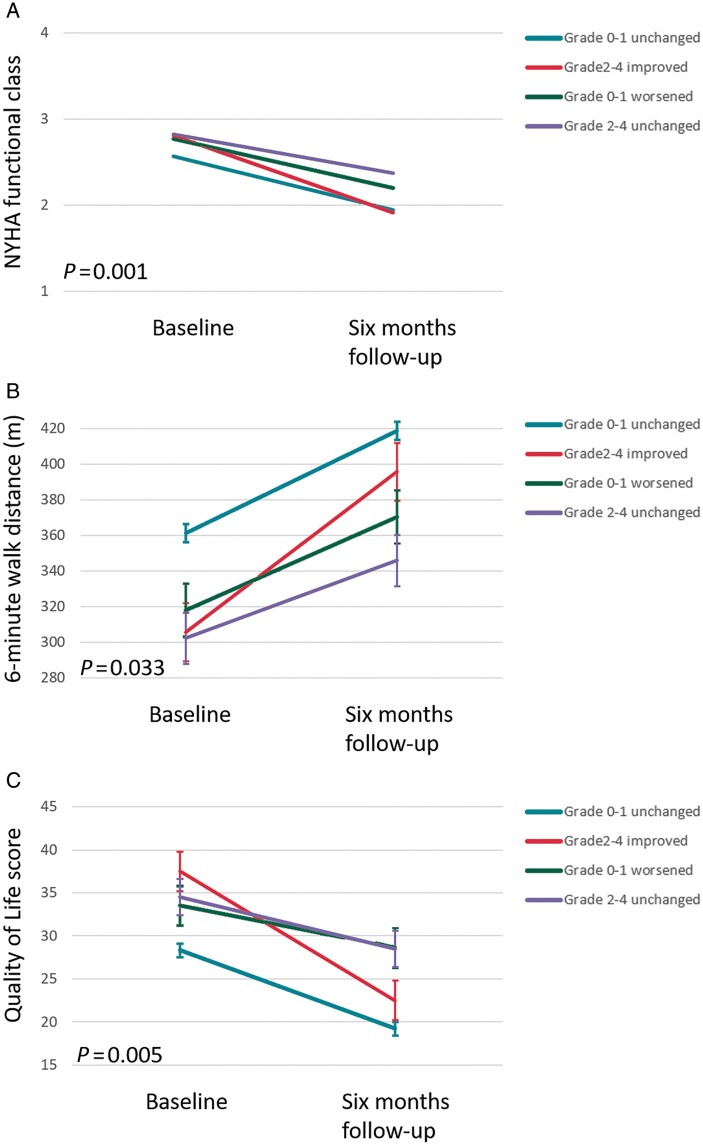
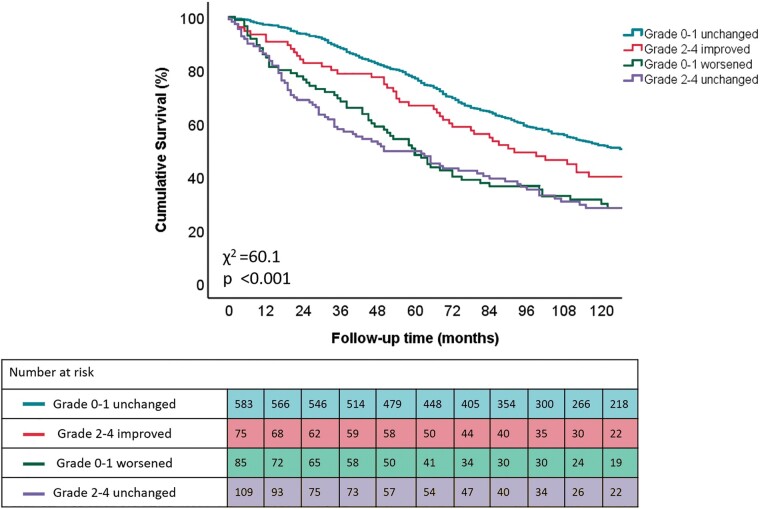
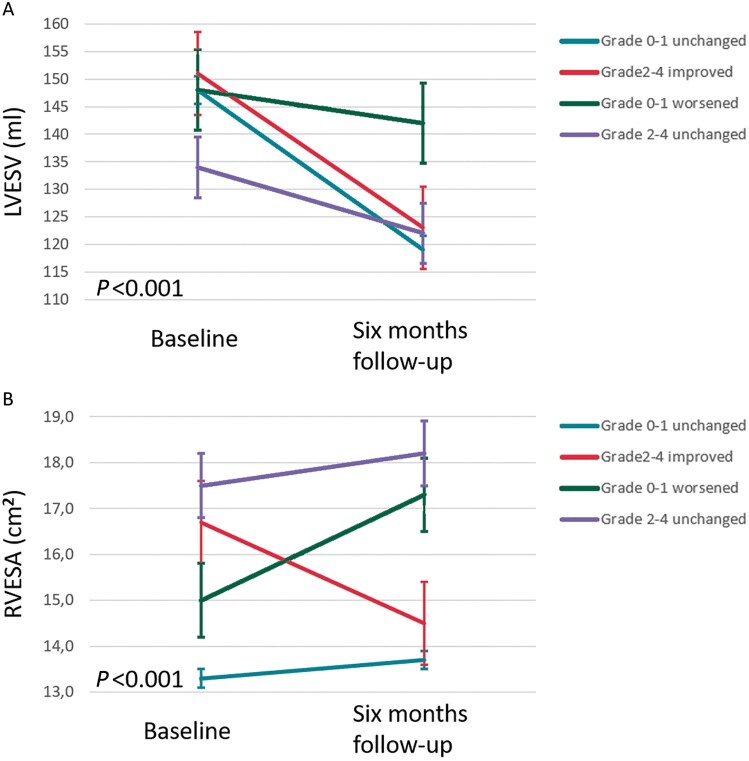
Tricuspid regurgitation severity was assessed at baseline and 6 months after CRT implantation, using a multiparametric approach. Patients were divided into four groups: (i) no or mild TR without progression; (ii) no or mild TR with progression to significant (moderate-severe) TR; (iii) significant TR with improvement to no or mild TR; and (iv) significant TR without improvement. The primary endpoint was all-cause mortality. A total of 852 patients (mean age 65 ± 11 years, 77% male) were included. At baseline, 184 (22%) patients had significant TR, with 75 (41%) showing significant improvement at 6-month follow-up. After a median follow-up of 92 (50-137) months, 494 (58%) patients died. Patients with significant TR showing improvement at follow-up had better outcomes than those showing no improvement (P = 0.016). On multivariable analysis, no or mild TR progressing to significant TR [hazard ratio (HR) 1.745; 95% confidence interval (CI): 1.287-2.366; P < 0.001] and significant TR without improvement (HR 1.572; 95% CI: 1.198-2.063; P = 0.001) were independently associated with all-cause mortality, whereas significant TR with improvement at follow-up was not (HR: 1.153; 95% CI: 0.814-1.633; P = 0.424).
Improvement of significant TR after CRT is observed in a substantial proportion of patients, highlighting the potential benefit of CRT for patients with HF having significant TR. Significant TR at 6 months after CRT is independently associated with increased long-term mortality.
三尖瓣反流(TR)在心力衰竭(HF)患者中很常见,与预后不良相关。本研究旨在探讨心脏再同步治疗(CRT)对 TR 严重程度和长期预后的影响。
使用多参数方法在 CRT 植入后基线和 6 个月时评估 TR 严重程度。患者分为四组:(i)无或轻度 TR 且无进展;(ii)无或轻度 TR 进展为中重度 TR;(iii)中重度 TR 改善至无或轻度 TR;和(iv)中重度 TR 无改善。主要终点是全因死亡率。共纳入 852 例患者(平均年龄 65±11 岁,77%为男性)。基线时有 184 例(22%)患者存在中重度 TR,其中 75 例(41%)在 6 个月随访时显著改善。中位随访 92(50-137)个月后,494 例(58%)患者死亡。随访时中重度 TR 改善的患者预后优于无改善的患者(P=0.016)。多变量分析显示,随访时无或轻度 TR 进展为中重度 TR(HR 1.745;95%CI:1.287-2.366;P<0.001)和中重度 TR 无改善(HR 1.572;95%CI:1.198-2.063;P=0.001)与全因死亡率独立相关,而随访时中重度 TR 改善者则无相关性(HR:1.153;95%CI:0.814-1.633;P=0.424)。
CRT 后相当一部分患者的中重度 TR 得到改善,提示 CRT 对伴有中重度 TR 的 HF 患者有益。CRT 后 6 个月时的中重度 TR 与长期死亡率增加独立相关。