Department of Cardio-Thoracic Surgery, Maastricht University Medical Center, Maastricht, The Netherlands.
Cardiovascular Research Institute Maastricht (CARIM), Maastricht University, Maastricht, The Netherlands.
Europace. 2022 Jul 15;24(6):1015-1024. doi: 10.1093/europace/euac026.
Although in persistent atrial fibrillation (AF) a complex AF substrate characterized by a high incidence of conduction block has been reported, relatively little is known about AF complexity in paroxysmal AF (pAF). Also, the relative contribution of various aspects of structural alterations to conduction disturbances is not clear. In particular, the contribution of endomysial fibrosis to conduction disturbances during progression of AF has not been studied yet.
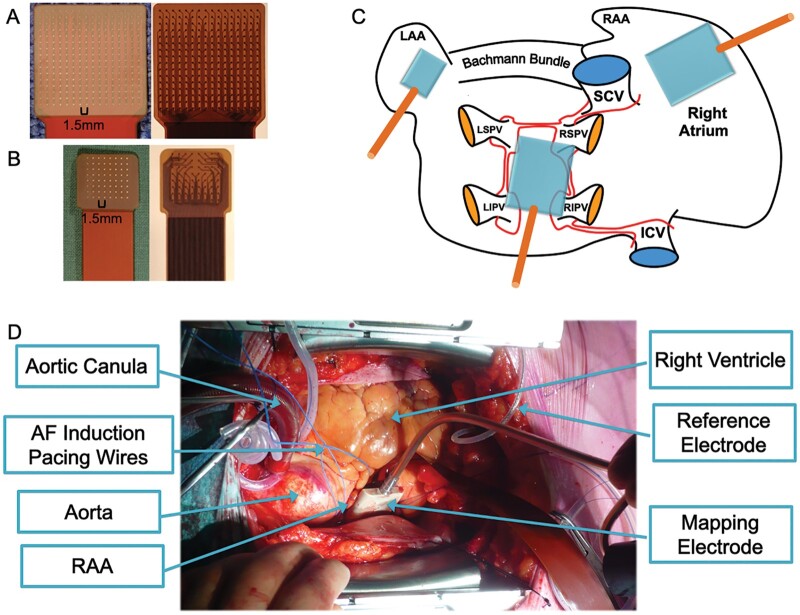
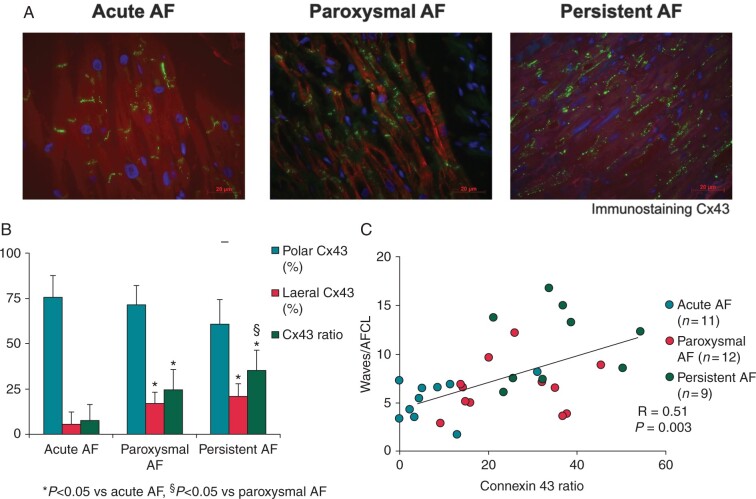
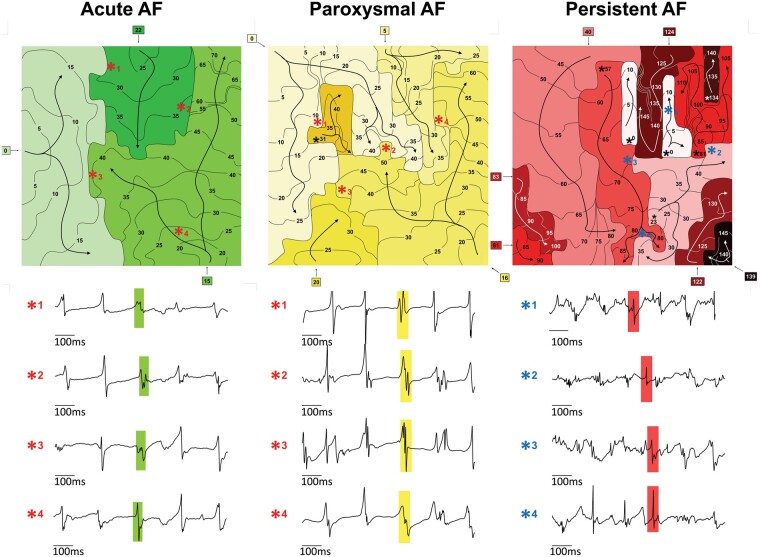
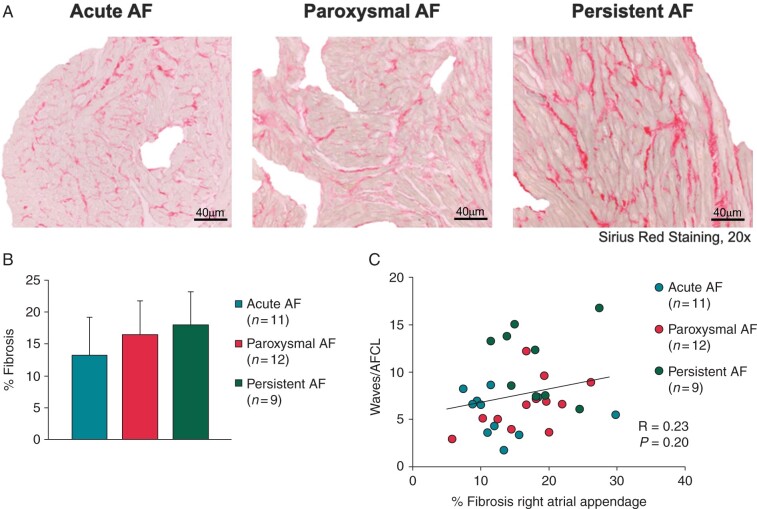
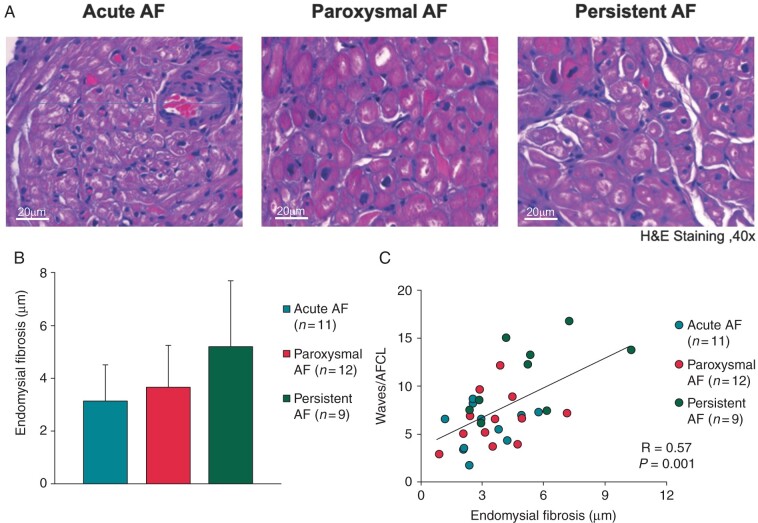
During cardiac surgery, epicardial high-density mapping was performed in patients with acutely induced (aAF, n = 11), pAF (n = 12), and longstanding persistent AF (persAF, n = 9) on the right atrial (RA) wall, the posterior left atrial wall (pLA) and the LA appendage (LAA). In RA appendages, overall and endomysial (myocyte-to-myocyte distances) fibrosis and connexin 43 (Cx43) distribution were quantified. Unipolar AF electrogram analysis showed a more complex pattern with a larger number of narrower waves, more breakthroughs and a higher fractionation index (FI) in persAF compared with aAF and pAF, with no differences between aAF and pAF. The FI was consistently higher at the pLA compared with the RA. Structurally, Cx43 lateralization increased with AF progression (aAF = 7.5 ± 8.9%, pAF = 24.7 ± 11.1%, persAF = 35.1 ± 11.4%, P < 0.001). Endomysial but not overall fibrosis correlated with AF complexity (r = 0.57, P = 0.001; r = 0.23, P = 0.20; respectively).
Atrial fibrillation complexity is highly variable in patients with pAF, but not significantly higher than in patients with acutely induced AF, while in patients with persistent AF complexity is higher. Among the structural alterations studied, endomysial fibrosis, but not overall fibrosis, is the strongest determinant of AF complexity.
尽管在持续性心房颤动(AF)中,已经报道了一种以传导阻滞发生率高为特征的复杂 AF 基质,但关于阵发性 AF(pAF)中 AF 复杂性的了解相对较少。此外,各种结构改变方面对传导障碍的相对贡献尚不清楚。特别是,在 AF 进展过程中心内肌纤维化对传导障碍的贡献尚未得到研究。
在心脏手术期间,对 11 例急性诱发的心房颤动(aAF)、12 例阵发性 AF(pAF)和 9 例持续性持久性 AF(persAF)患者的右心房(RA)壁、左心房后壁(pLA)和左心耳(LAA)进行了心外膜高密度映射。在 RA 心耳中,量化了整体和心内膜(心肌细胞到心肌细胞的距离)纤维化和连接蛋白 43(Cx43)分布。单极 AF 电图分析显示,与 aAF 和 pAF 相比,persAF 具有更复杂的模式,具有更多狭窄的波、更多突破和更高的分数化指数(FI),而 aAF 和 pAF 之间没有差异。与 RA 相比,pLA 的 FI 始终更高。结构上,随着 AF 的进展,Cx43 侧向化增加(aAF = 7.5 ± 8.9%,pAF = 24.7 ± 11.1%,persAF = 35.1 ± 11.4%,P < 0.001)。心内膜但不是整体纤维化与 AF 复杂性相关(r = 0.57,P = 0.001;r = 0.23,P = 0.20;分别)。
pAF 患者的 AF 复杂性差异很大,但与急性诱发的 AF 相比并不明显更高,而持续性 AF 患者的复杂性更高。在所研究的结构改变中,心内膜纤维化而不是整体纤维化是 AF 复杂性的最强决定因素。