Department of Critical Care Medicine, Ruijin Hospital, Shanghai Jiao Tong University School of Medicine, Shanghai, China.
Tuberculosis and Respiratory Department, Wuhan Infectious Disease Hospital, Wuhan, China.
Immun Inflamm Dis. 2022 Apr;10(4):e597. doi: 10.1002/iid3.597.
Systemic reactivation of Epstein-Barr virus (EBV) may occur in novel coronavirus disease 2019 (COVID-19) caused by the severe acute respiratory syndrome coronavirus-2 (SARS-CoV-2). However, the clinical consequences of EBV reactivation remain uncertain.
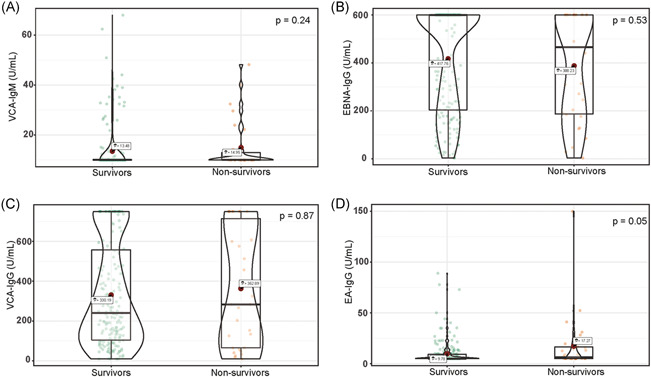
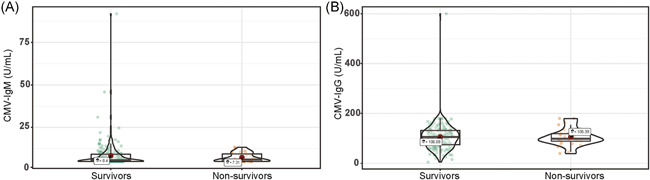
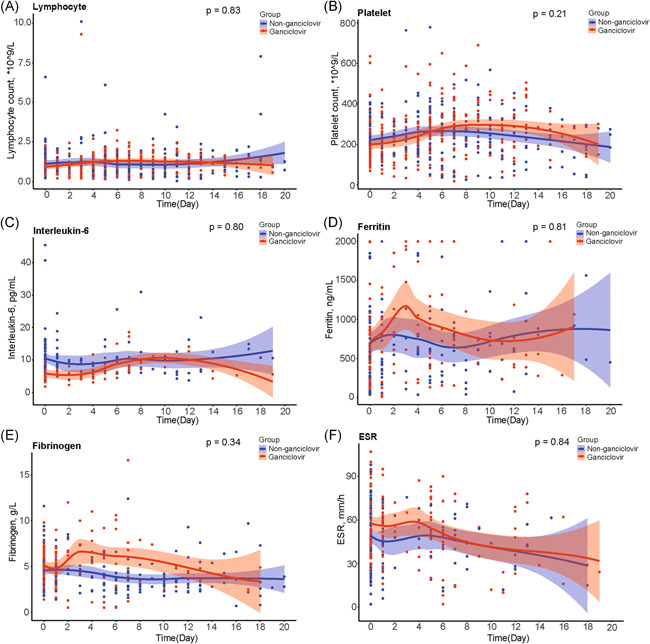
In this retrospective study, we screened 1314 patients with confirmed COVID-19 who died or were discharged between January 1, 2020 and March 12, 2020, in Wuhan Infectious Disease Hospital, Wuhan, China. Patients who had complete data for EBV serology and cytomegalovirus (CMV) serology were eligible. Serum levels of viral capsid antigen (VCA)-immunoglobulin G (IgG), Epstein-Barr nuclear antigen-IgG, VCA-IgM, early antigen (EA)-IgG, CMV-IgG, and CMV-IgM were compared between survivors and nonsurvivors. Dynamic changes of laboratory tests and outcomes were compared in patients with and without ganciclovir treatment. We used 1:1 matching based on age, gender, and illness severity to balance baseline characteristics.
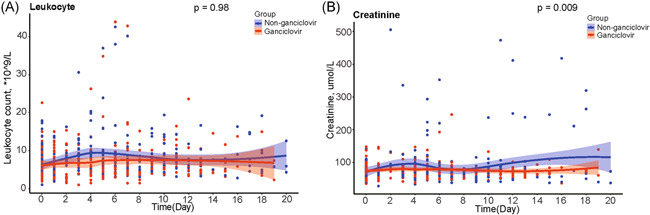
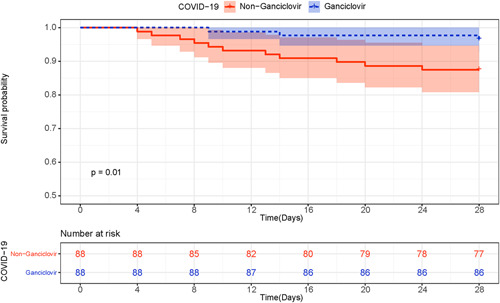
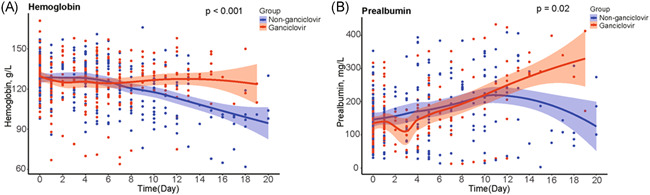
EBV reactivation was present in 55 of 217 patients. EBV reactivation was associated with age (57.91 [13.19] vs. 50.28 [12.66] years, p < .001), female gender (31 [56%] vs. 60 [37%], p = .02). Patients with EBV reactivation have statistically nonsignificant higher mortality rate (12 [22%] vs. 18 [11%], p = .08). EA-IgG levels were significantly higher in nonsurvivors than in survivors (median difference: -0.00005, 95% confidence interval, CI [-3.10, 0.00], p = .05). As compared to patients with COVID-19 who did not receive ganciclovir therapy, ganciclovir-treated patients had improved survival rate (0.98, 95% CI [0.95, 1.00] vs. 0.88, 95% CI [0.81, 0.95], p = .01). Hemoglobin (p < .001) and prealbumin (p = .02) levels were significantly higher in ganciclovir-treated patients.
A high proportion of COVID-19 patients had EBV reactivation that may be associated with an increased risk of death. Whether treatment with ganciclovir may decrease the mortality of COVID-19 patients complicated with EBV reactivation warrants to be addressed in a placebo-controlled randomized trial in the future.
新型冠状病毒病 2019(COVID-19)由严重急性呼吸综合征冠状病毒-2(SARS-CoV-2)引起,可能导致 EBV 全身再激活。然而,EBV 再激活的临床后果仍不确定。
在这项回顾性研究中,我们筛选了 2020 年 1 月 1 日至 3 月 12 日期间在中国武汉传染病医院确诊 COVID-19 死亡或出院的 1314 例患者。符合 EBV 血清学和巨细胞病毒(CMV)血清学完整数据的患者入选。比较幸存者和非幸存者之间病毒衣壳抗原(VCA)-免疫球蛋白 G(IgG)、EBV 核抗原-IgG、VCA-IgM、早期抗原(EA)-IgG、CMV-IgG 和 CMV-IgM 的血清水平。比较有无更昔洛韦治疗患者的实验室检查和结局的动态变化。我们使用基于年龄、性别和疾病严重程度的 1:1 匹配来平衡基线特征。
217 例患者中有 55 例出现 EBV 再激活。EBV 再激活与年龄(57.91[13.19] vs. 50.28[12.66]岁,p<0.001)、女性(31[56%] vs. 60[37%],p=0.02)有关。有 EBV 再激活的患者死亡率统计学上无显著升高(12[22%] vs. 18[11%],p=0.08)。与幸存者相比,非幸存者的 EA-IgG 水平显著升高(中位数差异:-0.00005,95%置信区间,CI[-3.10,0.00],p=0.05)。与未接受更昔洛韦治疗的 COVID-19 患者相比,接受更昔洛韦治疗的患者生存率提高(0.98,95%CI[0.95,1.00] vs. 0.88,95%CI[0.81,0.95],p=0.01)。与未接受更昔洛韦治疗的患者相比,接受更昔洛韦治疗的患者血红蛋白(p<0.001)和前白蛋白(p=0.02)水平显著升高。
COVID-19 患者中有相当高比例的 EBV 再激活,这可能与死亡风险增加有关。更昔洛韦治疗是否能降低 COVID-19 患者合并 EBV 再激活的死亡率,有待未来在安慰剂对照随机试验中解决。