School of Business, Jiangnan University, Wuxi, Jiangsu, 214122, PR China.
BMC Geriatr. 2022 Mar 29;22(1):259. doi: 10.1186/s12877-022-02947-2.
Smartphones provide a cost-effective avenue for gait assessment among older adults in the community. The purpose of this study is to explore the impact of walking state, self-reported daily walking amount, and age on gait quality, using a smartphone application.
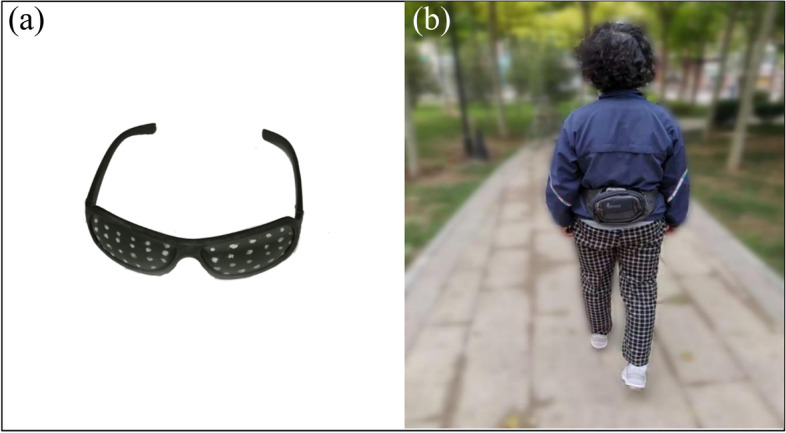
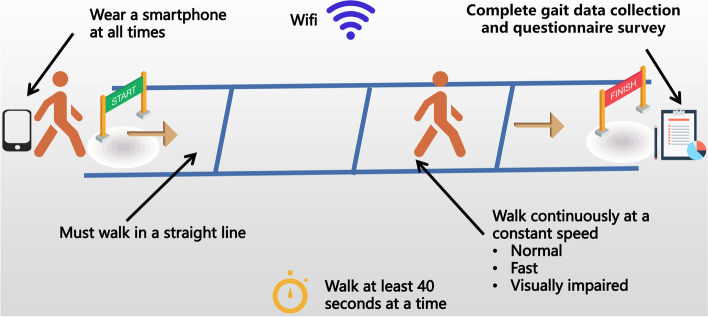
One hundred older adult individuals from North China, aged 73.0 ± 7.7 years, voluntarily participated in this study. They performed three walking tests: normal walking, fast walking, and visually impaired walking. Three-dimensional acceleration data for gait were obtained using the smartphone app Pocket Gait. This study used multivariate analysis of variance (MANOVA) to explore the effects of the walking state, self-reported daily walking amount, and age on the step frequency, root mean square (RMS) acceleration, step time variability, regularity, and symmetry.
The walking state, self-reported daily walking amount, and age had statistically significant effects on gait quality. Compared with normal walking, the step frequency, RMS acceleration, variability, and regularity were greater in the fast-walking state, and simulated visually impaired walking did not significantly affect gait quality. Relatively older individuals had a significant decline in gait quality compared to (relatively) younger older adult individuals. Compared with older adults who walked less than 1 km a day, older adults who walked more had better gait quality.
The walking state, self-reported daily walking amount, and age have a significant effect on the gait quality of older adults. Walking with pigmented sunglasses can be used as a training intervention to improve gait performance. Older adult people who walk less than 1 km/day have worse gait quality compared with their counterparts.
智能手机为社区中老年人的步态评估提供了一种具有成本效益的途径。本研究旨在探讨使用智能手机应用程序,行走状态、自我报告的日常行走量和年龄对步态质量的影响。
100 名来自华北地区的年龄在 73.0±7.7 岁的老年志愿者参与了本研究。他们进行了三种行走测试:正常行走、快速行走和模拟视障行走。使用智能手机应用程序 Pocket Gait 获得步态的三维加速度数据。本研究采用多元方差分析(MANOVA)来探讨行走状态、自我报告的日常行走量和年龄对步频、均方根(RMS)加速度、步时变异性、规律性和对称性的影响。
行走状态、自我报告的日常行走量和年龄对步态质量有统计学显著影响。与正常行走相比,快速行走时步频、RMS 加速度、变异性和规律性更大,模拟视障行走对步态质量没有显著影响。相对较老的个体与(相对)年轻的老年个体相比,步态质量明显下降。与每天行走少于 1 公里的老年人相比,每天行走较多的老年人步态质量更好。
行走状态、自我报告的日常行走量和年龄对老年人的步态质量有显著影响。佩戴有色太阳镜行走可以作为一种训练干预措施来改善步态表现。每天行走少于 1 公里的老年人的步态质量比同龄人差。