Department of Biostatistics and Epidemiology, Faculty of Health, Golestan University of Medica Science, Gorgan, Iran.
Department of Electrical Engineering, Faculty of Engineering, Golestan University, Gorgan, Iran.
BMC Med Inform Decis Mak. 2022 Mar 29;22(1):85. doi: 10.1186/s12911-022-01823-8.
Coronary artery disease (CAD) is one of the most significant cardiovascular diseases that requires accurate angiography to diagnose. Angiography is an invasive approach involving risks like death, heart attack, and stroke. An appropriate alternative for diagnosis of the disease is to use statistical or data mining methods. The purpose of the study was to predict CAD by using discriminant analysis and compared with the logistic regression.
This cross-sectional study included 758 cases admitted to Fatemeh Zahra Teaching Hospital (Sari, Iran) for examination and coronary angiography for evaluation of CAD in 2019. A logistics discriminant, Quadratic Discriminant Analysis (QDA) and Linear Discriminant Analysis (LDA) model and K-Nearest Neighbor (KNN) were fitted for prognosis of CAD with the help of clinical and laboratory information of patients.
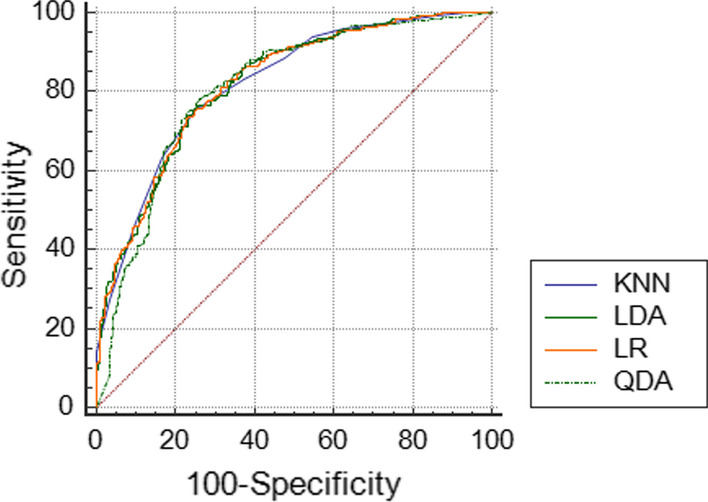
Out of the 758 examined cases, 250 (32.98%) cases were non-CAD and 508 (67.22%) were diagnosed with CAD disease. The results indicated that the indices of accuracy, sensitivity, specificity and area under the ROC curve (AUC) in the linear discriminant analysis (LDA) were 78.6, 81.3, 71.3, and 81.9%, respectively. The results obtained by the quadratic discriminant analysis were respectively 64.6, 88.2, 47.9, and 81%. The values of the metrics in K-nearest neighbor method were 74, 77.5, 63.7, and 82%, respectively. Finally, the logistic regression reached 77, 87.6, 55.6, and 82%, respectively for the evaluation metrics.
The LDA method is superior to the Quadratic Discriminant Analysis (QDA), K-Nearest Neighbor (KNN) and Logistic Regression (LR) methods in differentiating CAD patients. Therefore, in addition to common non-invasive diagnostic methods, LDA technique is recommended as a predictive model with acceptable accuracy, sensitivity, and specificity for the diagnosis of CAD. However, given that the differences between the models are small, it is recommended to use each model to predict CAD disease.
冠心病(CAD)是最严重的心血管疾病之一,需要准确的血管造影来诊断。血管造影是一种有创的方法,涉及死亡、心脏病发作和中风等风险。诊断这种疾病的适当替代方法是使用统计或数据挖掘方法。本研究的目的是使用判别分析进行 CAD 预测,并与逻辑回归进行比较。
这项横断面研究纳入了 2019 年在 Fatemeh Zahra 教学医院(伊朗沙里)因检查和冠状动脉造影而接受检查并诊断为 CAD 的 758 例患者。使用患者的临床和实验室信息,为预测 CAD 拟合了逻辑判别、二次判别分析(QDA)、线性判别分析(LDA)和 K-最近邻(KNN)模型。
在 758 例检查的病例中,250 例(32.98%)为非 CAD 病例,508 例(67.22%)诊断为 CAD 疾病。结果表明,线性判别分析(LDA)的准确性、敏感性、特异性和 ROC 曲线下面积(AUC)指数分别为 78.6%、81.3%、71.3%和 81.9%。二次判别分析的结果分别为 64.6%、88.2%、47.9%和 81%。K-最近邻法的指标值分别为 74、77.5、63.7 和 82%。最后,逻辑回归在评价指标上分别达到了 77%、87.6%、55.6%和 82%。
LDA 方法优于二次判别分析(QDA)、K-最近邻(KNN)和逻辑回归(LR)方法,可区分 CAD 患者。因此,除了常用的非侵入性诊断方法外,LDA 技术作为一种具有可接受的准确性、敏感性和特异性的预测模型,推荐用于 CAD 的诊断。然而,由于模型之间的差异较小,建议使用每种模型来预测 CAD 疾病。