Cognitive Brain Research Unit, Department of Psychology and Logopedics, Faculty of Medicine, University of Helsinki, Turku, Finland.
School of Health and Rehabilitation Sciences, Queensland Aphasia Research Centre and UQ Centre for Clinical Research, The University of Queensland, Brisbane, Australia.
Brain Imaging Behav. 2022 Aug;16(4):1813-1822. doi: 10.1007/s11682-022-00661-6. Epub 2022 Mar 29.
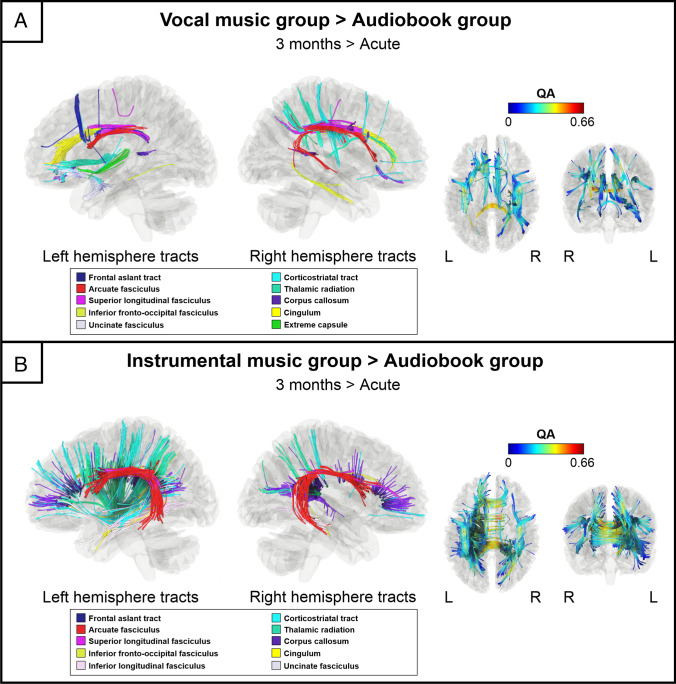
Post-stroke neuroplasticity and cognitive recovery can be enhanced by multimodal stimulation via environmental enrichment. In this vein, recent studies have shown that enriched sound environment (i.e., listening to music) during the subacute post-stroke stage improves cognitive outcomes compared to standard care. The beneficial effects of post-stroke music listening are further pronounced when listening to music containing singing, which enhances language recovery coupled with structural and functional connectivity changes within the language network. However, outside the language network, virtually nothing is known about the effects of enriched sound environment on the structural connectome of the recovering post-stroke brain. Here, we report secondary outcomes from a single-blind randomized controlled trial (NCT01749709) in patients with ischaemic or haemorrhagic stroke (N = 38) who were randomly assigned to listen to vocal music, instrumental music, or audiobooks during the first 3 post-stroke months. Utilizing the longitudinal diffusion-weighted MRI data of the trial, the present study aimed to determine whether the music listening interventions induce changes on structural white matter connectome compared to the control audiobook intervention. Both vocal and instrumental music groups increased quantitative anisotropy longitudinally in multiple left dorsal and ventral tracts as well as in the corpus callosum, and also in the right hemisphere compared to the audiobook group. Audiobook group did not show increased structural connectivity changes compared to both vocal and instrumental music groups. This study shows that listening to music, either vocal or instrumental promotes wide-spread structural connectivity changes in the post-stroke brain, providing a fertile ground for functional restoration.
卒中后的神经可塑性和认知恢复可以通过环境丰富的多模态刺激来增强。最近的研究表明,在亚急性期卒中后,与标准护理相比,丰富的声音环境(即听音乐)可以改善认知结果。当听包含唱歌的音乐时,卒中后听音乐的有益效果更为明显,因为唱歌可以增强语言恢复,同时还伴随着语言网络内的结构和功能连接变化。然而,在语言网络之外,几乎没有关于丰富声音环境对恢复性卒中后大脑结构连接组的影响的信息。在这里,我们报告了一项单盲随机对照试验(NCT01749709)的次要结果,该试验纳入了缺血性或出血性卒中患者(N=38),他们在卒中后 3 个月内被随机分配听声乐音乐、器乐音乐或有声读物。利用试验的纵向弥散加权 MRI 数据,本研究旨在确定与对照组有声读物干预相比,音乐干预是否会引起结构白质连接组的变化。声乐和器乐组在多个左侧背侧和腹侧束以及胼胝体以及右侧半球中,纵向定量各向异性均增加,而有声读物组则没有。与声乐和器乐组相比,有声读物组的结构连接变化没有增加。这项研究表明,听音乐,无论是声乐还是器乐,都可以促进卒中后大脑的广泛结构连接变化,为功能恢复提供了肥沃的土壤。