NMR Laboratory, Neuromuscular Investigation Center, Institute of Myology, Paris, France.
NMR laboratory, CEA, DRF, IBFJ, Paris, France.
NMR Biomed. 2022 Oct;35(10):e4735. doi: 10.1002/nbm.4735. Epub 2022 Apr 27.
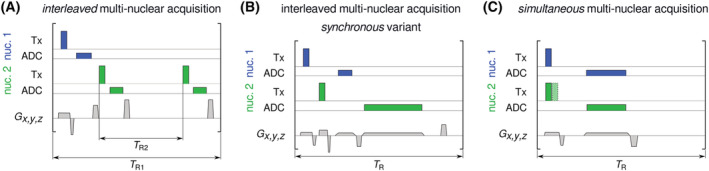
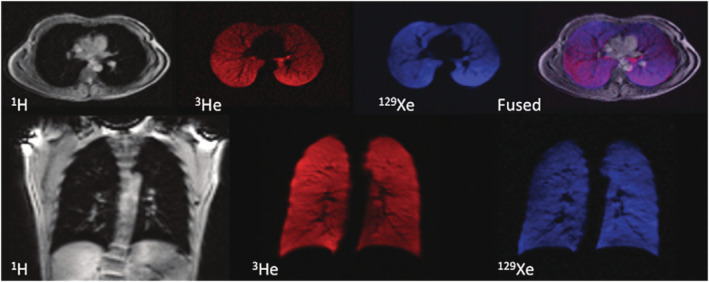
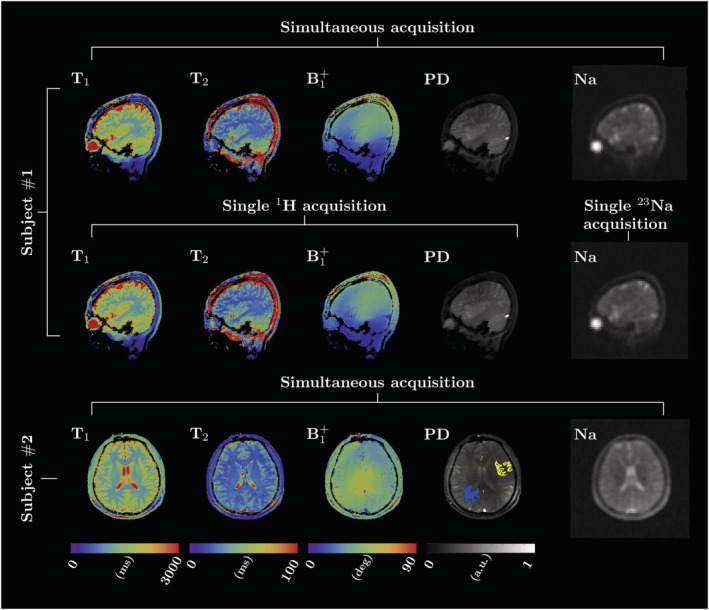
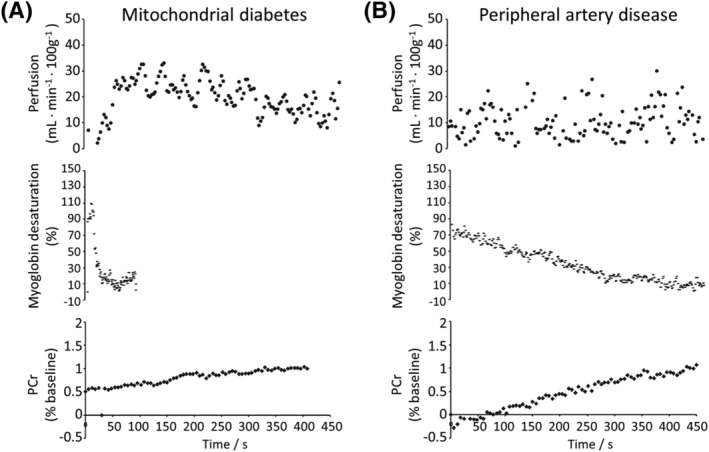
Magnetic resonance signals from different nuclei can be excited or received at the same time,rendering simultaneous or rapidly interleaved multi-nuclear acquisitions feasible. The advan-tages are a reduction of total scan time compared to sequential multi-nuclear acquisitions or that additional information from heteronuclear data is obtained at thesame time and anatomical position. Information content can be qualitatively increased by delivering a more comprehensive MR-based picture of a transient state (such as an exercise bout). Also, combiningnon-proton MR acquisitions with Hinformation (e.g., dynamic shim updates and motion correction) can be used to improve data quality during long scans and benefits image coregistration. This work reviews the literature on interleaved and simultaneous multi-nuclear MRI and MRS in vivo. Prominent use cases for this methodology in clinical and research applications are brain and muscle, but studies have also been carried out in other targets, including the lung, knee, breast and heart. Simultaneous multi-nuclear measurements in the liver and kidney have also been performed, but exclusively in rodents. In this review, a consistent nomenclature is proposed, to help clarify the terminology used for this principle throughout the literature on in-vivo MR. An overview covers the basic principles, the technical requirements on the MR scanner and the implementations realised either by MR system vendors or research groups, from the early days until today. Considerations regarding the multi-tuned RF coils required and heteronuclear polarisation interactions are briefly discussed, and fields for future in-vivo applications for interleaved multi-nuclear MR pulse sequences are identified.
不同核的磁共振信号可以同时被激发或接收,从而实现同时或快速交替的多核采集。与顺序多核采集相比,其优势在于总扫描时间的减少,或者在相同的解剖位置获得来自异核数据的额外信息。通过提供瞬态状态(如运动过程)更全面的基于磁共振的图像,可以定性地增加信息量。此外,将非质子磁共振采集与 H 信息(例如,动态匀场更新和运动校正)相结合,可用于改善长扫描期间的数据质量,并有利于图像配准。本文综述了体内交替和同时多核磁共振成像和磁共振波谱的文献。这种方法在临床和研究应用中的突出应用案例是大脑和肌肉,但也在其他靶标(包括肺、膝盖、乳房和心脏)中进行了研究。同时还在肝脏和肾脏中进行了多核测量,但仅在啮齿动物中进行。在本综述中,提出了一个一致的命名法,以帮助阐明文献中用于体内磁共振的这一原理的术语。概述了基本原理、磁共振扫描仪的技术要求以及由磁共振系统供应商或研究小组实现的实现,从早期到现在。简要讨论了所需的多调谐 RF 线圈和异核极化相互作用的考虑因素,并确定了用于体内交替多核磁共振脉冲序列的未来应用领域。