School of Educational Psychology and Counselling, Faculty of Education, Monash University, Victoria, Clayton, Australia.
Centre for Wellbeing Science, Melbourne Graduate School of Education, University of Melbourne, Melbourne, Victoria, Australia.
J Adolesc. 2022 Feb;94(2):176-190. doi: 10.1002/jad.12016. Epub 2022 Feb 9.
Coronavirus disease 2019 (COVID-19) has changed the way families live, interact, and connect with others, resulting in higher levels of stress for many teenagers who struggle with the ongoing uncertainty and disrupted school and family life. The current study examined the psychosocial factors that influence the capacity of adolescents to grow through the stress of the COVID-19 pandemic.
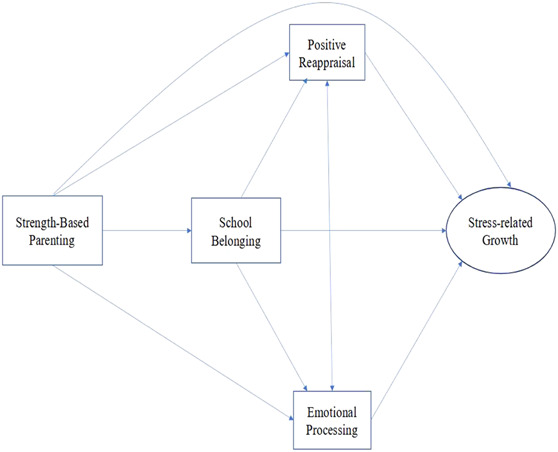
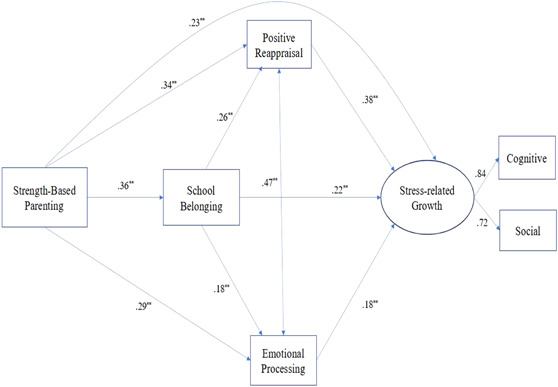
The sample included 404 secondary school students ranging in age from 11 to 18 (M = 14.75, SD = 1.59; 50.2% female, 46.8% male, and 3% non-/other gendered or declined to answer) from an independent high school in Australia. Data were collected from a battery of questionnaires that assessed strength-based parenting (SBP) and the effect of three psychosocial factors (positive reappraisal, emotional processing, and school belonging) on stress-related growth.
Structural equation modeling showed that (SBP) was significantly associated with stress-related growth (SRG). Positive reappraisal and emotional processing were also positively and significantly associated with SRG and mediated the effect of SBP on SRG. Moreover, school belonging was positively linked to positive coping, emotional processing, and SRG, as well as mediating the association of SBP with positive reappraisal, emotional processing, and SRG in adolescents during the pandemic.
The results show that teenagers can experience SRG during the COVID-19 pandemic, and adolescents adapting by engaging in constructive coping responses such as positive reappraisal and emotional processing is positively related to SRG.
2019 年冠状病毒病(COVID-19)改变了家庭的生活、互动和与他人的联系方式,导致许多青少年感到压力更大,他们在应对持续的不确定性和中断的学校和家庭生活方面遇到了困难。本研究考察了影响青少年在 COVID-19 大流行压力下成长能力的心理社会因素。
该样本包括来自澳大利亚一所独立高中的 404 名年龄在 11 至 18 岁之间的中学生(M = 14.75,SD = 1.59;50.2%女性,46.8%男性,3%非性别/其他性别或拒绝回答)。数据来自一系列问卷,评估了基于力量的养育(SBP)以及三个心理社会因素(积极的重新评估、情绪处理和学校归属感)对与压力相关的成长的影响。
结构方程模型表明,(SBP)与与压力相关的成长(SRG)显著相关。积极的重新评估和情绪处理也与 SRG 呈正相关且显著相关,并介导了 SBP 对 SRG 的影响。此外,学校归属感与积极应对、情绪处理和 SRG 呈正相关,并且在大流行期间,中介了 SBP 与积极重新评估、情绪处理和 SRG 与青少年之间的关联。
结果表明,青少年在 COVID-19 大流行期间可以体验到 SRG,并且青少年通过参与积极的应对方式(如积极的重新评估和情绪处理)进行适应与 SRG 呈正相关。