Department of Grassland Science, Guizhou University, Guiyang, 550025, China.
Sichuan Academy of Grassland Science, Chengdu, 611731, China.
BMC Microbiol. 2022 Mar 30;22(1):83. doi: 10.1186/s12866-022-02499-w.
This study aimed to investigate the effect of phenyllactic acid as an additive on silage fermentation and bacterial community of reed canary grass (RCG, Phalaris arundinacea L.) on the Qinghai Tibetan Plateau. At the heading stage, RCG was harvested, chopped and ensiled in small bag silos. The silage was treated without (control, 1.0 g/mL sterile water, on a fresh matter basis (FM)) or with phenyllactic acid (PLA, 3 mg/mL, FM), antimicrobial additive (PSB, a mixture of potassium sorbate and sodium benzoate, 2%, FM), lactic acid bacteria inoculant (LABi, L. plantarum + L. curvatus, 1 × 10 cfu/g, FM) and PLA + LABi, and then stored in a dark room at the ambient temperature (5 ~ 15 °C) for 60 days.
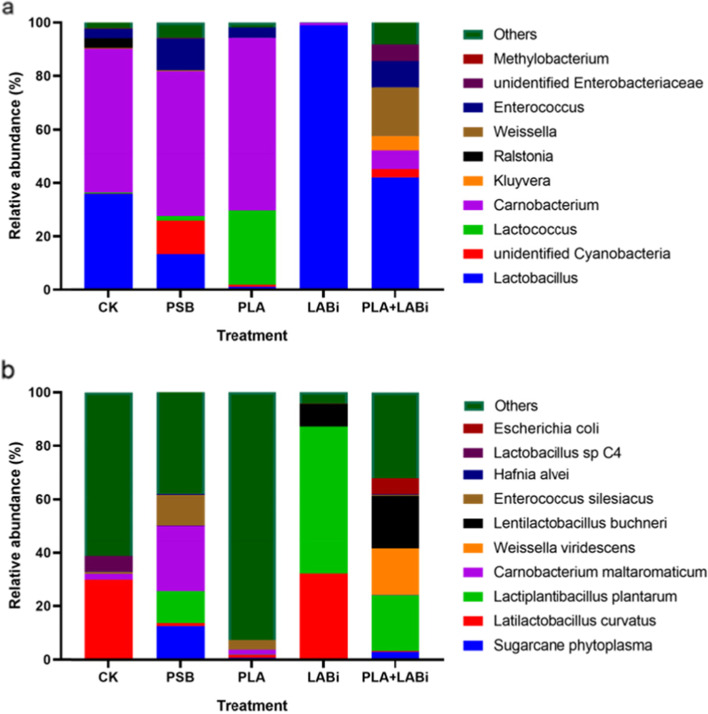
Compared with control, PLA decreased lactic acid, acetic acid and ammonia-N contents, and subsequently increased CP content of RCG silage. PLA enhanced the growth of lactic acid bacteria and reduced the count of yeasts (P < 0.05) in RCG silage, with reduced bacterial richness index (Chao1), observed operational taxonomic units and diversity index (Simpson). In relative to control, moreover, PLA and PLA + LABi increased the relative abundance of Lactococcus in RCG silage by 27.73 and 16.93%, respectively.
Therefore, phenyllactic acid at ensiling improved nutritional quality of RCG silage by advancing the disappearance of yeasts and the dominance of Lactococcus.
本研究旨在探讨苯乳酸作为添加剂对青藏高原芦苇(Phalaris arundinacea L.)青贮发酵和细菌群落的影响。在抽穗期,收获、切碎芦苇并在小袋青贮窖中青贮。青贮处理方式为不添加(对照,1.0 g/mL 无菌水,基于新鲜物质基础(FM))或添加苯乳酸(PLA,3 mg/mL,FM)、抗菌添加剂(PSB,山梨酸钾和苯甲酸钠混合物,2%,FM)、乳酸菌接种剂(LABi,L. plantarum+L. curvatus,1×10 cfu/g,FM)和 PLA+LABi,然后在室温(5~15°C)的黑暗房间中储存 60 天。
与对照相比,PLA 降低了芦苇青贮中乳酸、乙酸和氨态氮的含量,随后提高了 CP 含量。PLA 促进了乳酸菌的生长,降低了芦苇青贮中酵母的数量(P<0.05),降低了细菌丰富度指数(Chao1)、观察到的操作分类单元和多样性指数(Simpson)。此外,与对照相比,PLA 和 PLA+LABi 分别使芦苇青贮中乳球菌的相对丰度增加了 27.73%和 16.93%。
因此,青贮时添加苯乳酸可通过促进酵母的消失和乳球菌的优势地位来提高芦苇青贮的营养价值。