Department of Pharmacology & Experimental Therapeutics, Thomas Jefferson University, Philadelphia, PA, United States.
Sidney Kimmel Cancer Center, Philadelphia, PA, United States.
Front Immunol. 2022 Mar 9;13:855759. doi: 10.3389/fimmu.2022.855759. eCollection 2022.
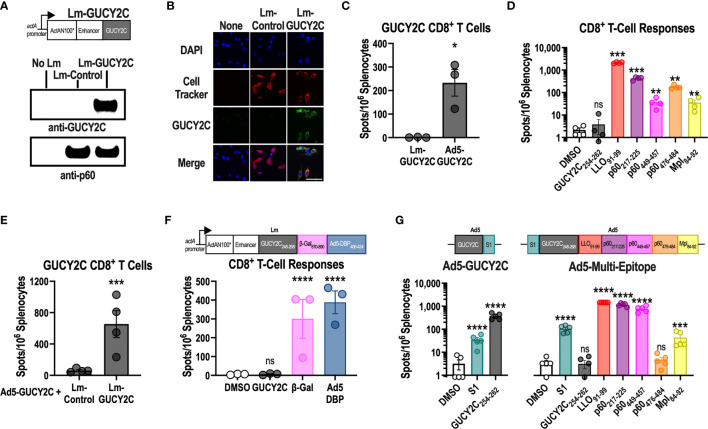
The Gram-positive bacterium (Lm) is an emerging platform for cancer immunotherapy. To date, over 30 clinical trials have been initiated testing Lm cancer vaccines across a wide variety of cancers, including lung, cervical, colorectal, and pancreatic. Here, we assessed the immunogenicity of an Lm vaccine against the colorectal tumor antigen GUCY2C (Lm-GUCY2C). Surprisingly, Lm-GUCY2C vaccination did not prime naïve GUCY2C-specific CD8 T-cell responses towards the dominant H-2K-restricted epitope, GUCY2C. However, Lm-GUCY2C produced robust CD8 T-cell responses towards Lm-derived peptides suggesting that GUCY2C peptide may be subdominant to Lm-derived peptides. Indeed, incorporating immunogenic Lm peptides into an adenovirus-based GUCY2C vaccine previously shown to induce robust GUCY2C immunity completely suppressed GUCY2C responses. Comparison of immunogenic Lm-derived peptides to GUCY2C revealed that Lm-derived peptides form highly stable peptide-MHC complexes with H-2K compared to GUCY2C peptide. Moreover, amino acid substitution at a critical anchoring residue for H-2K binding, producing GUCY2C, significantly improved stability with H-2K and rescued GUCY2C immunogenicity in the context of Lm vaccination. Collectively, these studies suggest that Lm antigens may compete with and suppress the immunogenicity of target vaccine antigens and that use of altered peptide ligands with enhanced peptide-MHC stability may be necessary to elicit robust immune responses. These studies suggest that optimizing target antigen competitiveness with Lm antigens or alternative immunization regimen strategies, such as prime-boost, may be required to maximize the clinical utility of Lm-based vaccines.
革兰氏阳性菌(Lm)是癌症免疫治疗的新兴平台。迄今为止,已经启动了 30 多项临床试验,测试了针对多种癌症(包括肺癌、宫颈癌、结直肠癌和胰腺癌)的 Lm 癌症疫苗。在这里,我们评估了针对结直肠肿瘤抗原 GUCY2C(Lm-GUCY2C)的 Lm 疫苗的免疫原性。令人惊讶的是,Lm-GUCY2C 疫苗接种并没有对主要的 H-2K 限制性表位 GUCY2C 引发幼稚 GUCY2C 特异性 CD8 T 细胞反应。然而,Lm-GUCY2C 产生了针对 Lm 衍生肽的强烈 CD8 T 细胞反应,表明 GUCY2C 肽可能次于 Lm 衍生肽。事实上,将免疫原性 Lm 肽掺入先前显示可诱导强烈 GUCY2C 免疫的基于腺病毒的 GUCY2C 疫苗中,完全抑制了 GUCY2C 反应。将免疫原性 Lm 衍生肽与 GUCY2C 进行比较表明,与 GUCY2C 肽相比,Lm 衍生肽与 H-2K 形成高度稳定的肽-MHC 复合物。此外,在产生 GUCY2C 的关键锚定残基处进行氨基酸取代,可显著提高与 H-2K 的稳定性,并在 Lm 接种的情况下挽救 GUCY2C 的免疫原性。总的来说,这些研究表明 Lm 抗原可能与靶疫苗抗原竞争并抑制其免疫原性,并且使用增强肽-MHC 稳定性的改变肽配体可能是引发强烈免疫反应所必需的。这些研究表明,可能需要优化靶抗原与 Lm 抗原的竞争力或替代免疫方案策略(如初次免疫-加强免疫),以最大限度地发挥基于 Lm 的疫苗的临床效用。