Bush Nicholas J, Schick Melissa R, Spillane Nichea S, Boissoneault Jeff
Department of Psychology, University of Rhode Island, Kingston, RI, USA.
Department of Clinical and Health Psychology, University of Florida, Gainesville, FL, USA.
J Pain Res. 2022 Mar 23;15:757-766. doi: 10.2147/JPR.S351837. eCollection 2022.
Alcohol use in young adults is highly prevalent and associated with numerous consequences, including academic difficulties and motor vehicle accidents. Pain is one factor that has been increasingly shown to be associated with higher rates of alcohol consumption and riskier patterns of drinking among undergraduate students. Although pain has traditionally been viewed as a lesser concern for young adults, current research demonstrates that pain may be more prevalent in younger populations than originally thought. However, little is known about how common psychosocial factors, such as stress and subjective social status (SSS), influence the association between pain and alcohol consumption in college students.
The study's goal was to examine the effect of stress and SSS on the relationship between pain and alcohol consumption.
Participants (N = 445, 39.3% women, = 22.98) were 18- to 25-year-old college students who completed an online questionnaire.
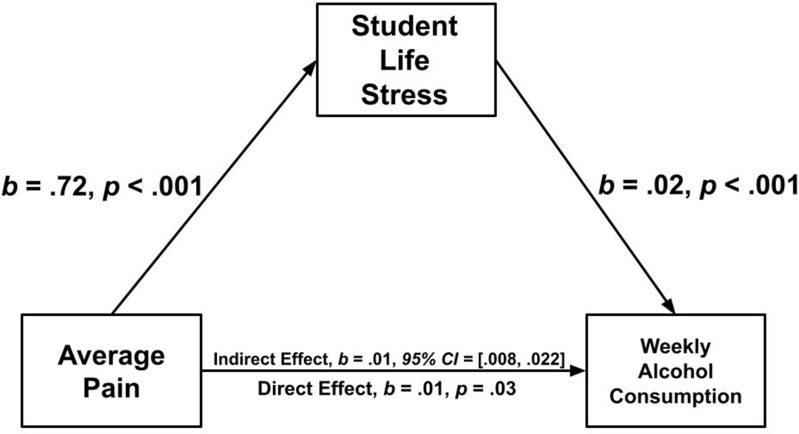
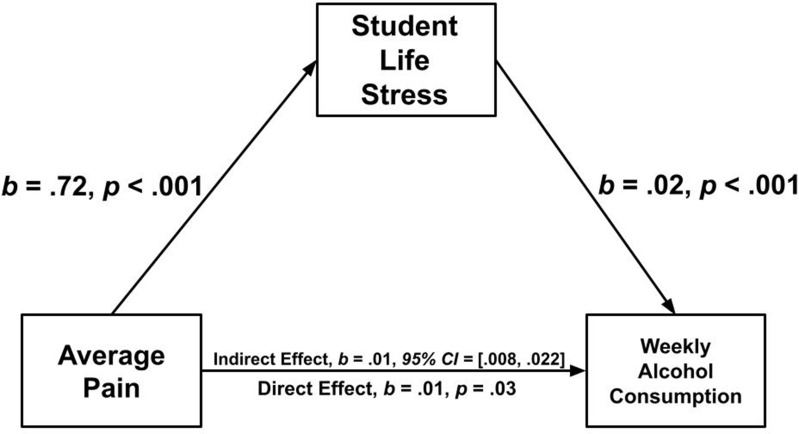
Pain was significantly associated with total weekly alcohol consumption (r(445) = .22, p < 0.001); this association was significantly mediated by stress ( = 0.15, = 0.04, 95% CI = [.07,0.23]). SSS was significantly positively associated with alcohol consumption (r(445) = .22, < 0.001) but was not found to significantly moderate the relationship between stress and alcohol use.
Results suggest that efforts to reduce college student alcohol use should include assessment of pain and stress given their association with alcohol consumption. Further, findings suggest that future studies are warranted to prospectively examine pain as an antecedent for alcohol use and to examine the utility of incorporating stress management techniques in pain-focused interventions to indirectly target alcohol use.
年轻人饮酒现象极为普遍,且会引发诸多后果,包括学业困难和机动车事故。疼痛是一个越来越多地被证明与大学生饮酒率升高及更危险饮酒模式相关的因素。尽管传统上疼痛被认为在年轻人中不太受关注,但当前研究表明,疼痛在年轻人群体中的普遍程度可能比最初想象的更高。然而,对于压力和主观社会地位(SSS)等社会心理因素如何影响大学生疼痛与饮酒之间的关联,人们知之甚少。
本研究的目标是考察压力和SSS对疼痛与饮酒之间关系的影响。
参与者(N = 445,女性占39.3%,平均年龄 = 22.98岁)为18至25岁的大学生,他们完成了一份在线问卷。
疼痛与每周饮酒总量显著相关(r(445) = 0.22,p < 0.001);这种关联通过压力显著介导(β = 0.15,SE = 0.04,95%CI = [0.07, 0.23])。SSS与饮酒量显著正相关(r(445) = 0.22,p < 0.001),但未发现其显著调节压力与饮酒之间的关系。
结果表明,鉴于疼痛和压力与饮酒的关联,减少大学生饮酒的努力应包括对疼痛和压力的评估。此外,研究结果表明,未来有必要进行前瞻性研究,将疼痛作为饮酒的一个先决条件进行考察,并考察在以疼痛为重点的干预措施中纳入压力管理技术以间接针对饮酒行为的效用。