Shin Jisu, Zhou Xuan, Tan Joanne T M, Hyppönen Elina, Benyamin Beben, Lee S Hong
Australian Centre for Precision Health, University of South Australia Cancer Research Institute, University of South Australia, Adelaide, SA, Australia.
UniSA Allied Health and Human Performance, University of South Australia, Adelaide, SA, Australia.
Front Genet. 2022 Mar 9;13:759309. doi: 10.3389/fgene.2022.759309. eCollection 2022.
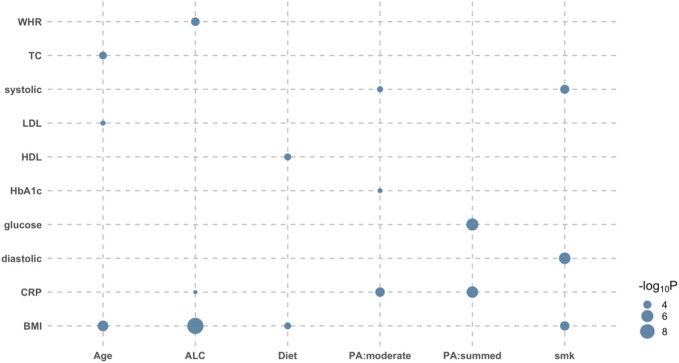
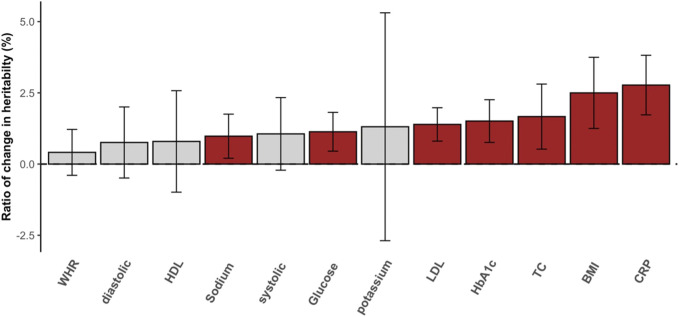
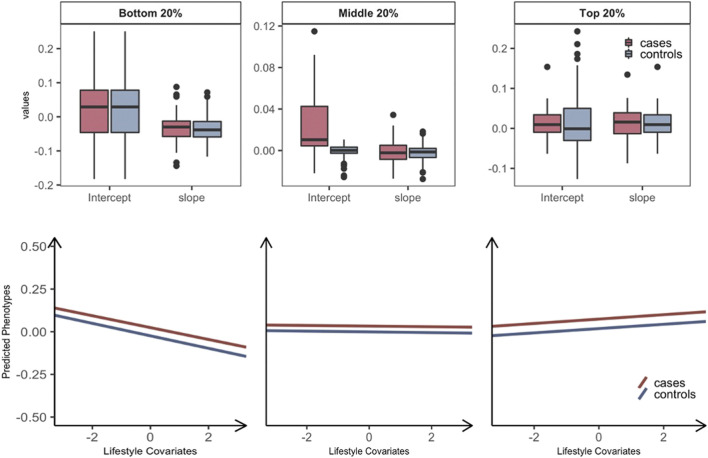
Metabolic syndrome is a group of heritable metabolic traits that are highly associated with type 2 diabetes (T2DM). Classical interventions to T2DM include individual self-management of environmental risk factors, such as improving diet quality, increasing physical activity, and reducing smoking and alcohol consumption, which decreases the risk of developing metabolic syndrome. However, it is poorly understood how the phenotypes of diabetes-related metabolic traits change with respect to lifestyle modifications at the individual level. In the analysis, we used 12 diabetes-related metabolic traits and eight lifestyle covariates from the UK Biobank comprising 288,837 white British participants genotyped for 1,133,273 genome-wide single nucleotide polymorphisms. We found 16 GxE interactions. Modulation of genetic effects by physical activity was seen for four traits (glucose, HbA1c, C-reactive protein, systolic blood pressure) and by alcohol and smoking for three (BMI, glucose, waist-hip ratio and BMI and diastolic and systolic blood pressure, respectively). We also found a number of significant phenotypic modulations by the lifestyle covariates, which were not attributed to the genetic effects in the model. Overall, modulation in the metabolic risk in response to the level of lifestyle covariates was clearly observed, and its direction and magnitude were varied depending on individual differences. We also showed that the metabolic risk inferred by our model was notably higher in T2DM prospective cases than controls. Our findings highlight the importance of individual genetic differences in the prevention and management of diabetes and suggest that the one-size-fits-all approach may not benefit all.
代谢综合征是一组与2型糖尿病(T2DM)高度相关的可遗传代谢特征。针对T2DM的经典干预措施包括个人对环境风险因素的自我管理,如改善饮食质量、增加身体活动以及减少吸烟和饮酒,这些措施可降低患代谢综合征的风险。然而,对于与糖尿病相关的代谢特征的表型如何随个体层面的生活方式改变而变化,人们了解甚少。在分析中,我们使用了英国生物银行的12个与糖尿病相关的代谢特征和8个生活方式协变量,该生物银行包含288,837名英国白人参与者,他们针对1,133,273个全基因组单核苷酸多态性进行了基因分型。我们发现了16种基因-环境相互作用。身体活动对4种特征(血糖、糖化血红蛋白、C反应蛋白、收缩压)的遗传效应有调节作用,酒精和吸烟分别对3种特征(体重指数、血糖、腰臀比以及体重指数与舒张压和收缩压)的遗传效应有调节作用。我们还发现生活方式协变量对许多表型有显著调节作用,而这些调节作用并非归因于模型中的遗传效应。总体而言,明显观察到代谢风险随生活方式协变量水平的变化而调节,其方向和幅度因个体差异而异。我们还表明,我们的模型推断出的代谢风险在T2DM前瞻性病例中明显高于对照组。我们的研究结果突出了个体遗传差异在糖尿病预防和管理中的重要性,并表明一刀切的方法可能并非对所有人都有益。