Wei Junhong, Fei Zhihui, Pan Guoqing, Weiss Louis M, Zhou Zeyang
State Key Laboratory of Silkworm Genome Biology, Southwest University, Chongqing, China.
Chongqing Key Laboratory of Microsporidia Infection and Control, Southwest University, Chongqing, China.
Front Microbiol. 2022 Mar 9;13:835390. doi: 10.3389/fmicb.2022.835390. eCollection 2022.
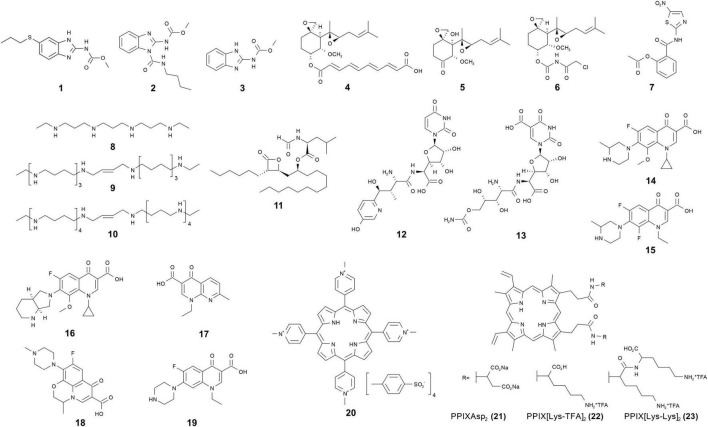
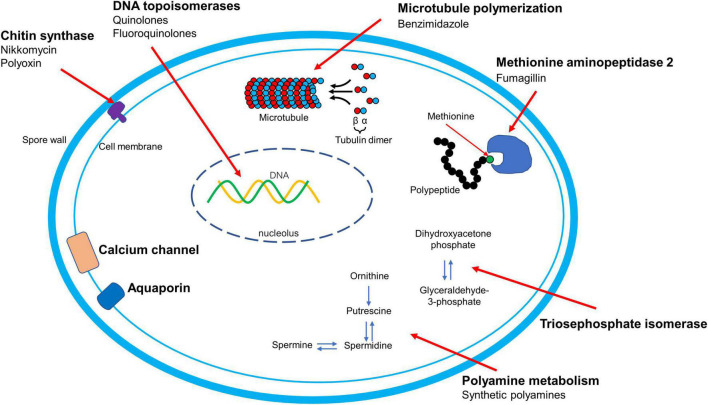
Microsporidia are obligate intracellular, spore-forming parasitic fungi which are grouped with the Cryptomycota. They are both opportunistic pathogens in humans and emerging veterinary pathogens. In humans, they cause chronic diarrhea in immune-compromised patients and infection is associated with increased mortality. Besides their role in pébrine in sericulture, which was described in 1865, the prevalence and severity of microsporidiosis in beekeeping and aquaculture has increased markedly in recent decades. Therapy for these pathogens in medicine, veterinary, and agriculture has become a recent focus of attention. Currently, there are only a few commercially available antimicrosporidial drugs. New therapeutic agents are needed for these infections and this is an active area of investigation. In this article we provide a comprehensive summary of the current as well as several promising new agents for the treatment of microsporidiosis including: albendazole, fumagillin, nikkomycin, orlistat, synthetic polyamines, and quinolones. Therapeutic targets which could be utilized for the design of new drugs are also discussed including: tubulin, type 2 methionine aminopeptidase, polyamines, chitin synthases, topoisomerase IV, triosephosphate isomerase, and lipase. We also summarize reports on the utility of complementary and alternative medicine strategies including herbal extracts, propolis, and probiotics. This review should help facilitate drug development for combating microsporidiosis.
微孢子虫是专性细胞内、形成孢子的寄生真菌,与隐真菌门归为一类。它们既是人类的机会性病原体,也是新出现的兽医病原体。在人类中,它们会导致免疫功能低下患者出现慢性腹泻,且感染与死亡率增加有关。除了在1865年被描述的在蚕业中引起微粒子病的作用外,近几十年来,微孢子虫病在养蜂业和水产养殖中的流行率和严重程度显著增加。医学、兽医学和农业中针对这些病原体的治疗已成为近期关注的焦点。目前,仅有少数几种抗微孢子虫的药物可供商业使用。这些感染需要新的治疗药物,这是一个活跃的研究领域。在本文中,我们全面总结了目前以及几种有前景的治疗微孢子虫病的新药物,包括:阿苯达唑、烟曲霉素、多氧霉素、奥利司他、合成多胺和喹诺酮类。还讨论了可用于设计新药的治疗靶点,包括:微管蛋白、2型甲硫氨酸氨肽酶、多胺、几丁质合成酶、拓扑异构酶IV、磷酸丙糖异构酶和脂肪酶。我们还总结了关于补充和替代医学策略实用性的报告,包括草药提取物、蜂胶和益生菌。这篇综述应有助于促进对抗微孢子虫病的药物研发。