Key Laboratory of Carcinogenesis and Translational Research (Ministry of Education), Department of GI Medical Oncology, Peking University School of Oncology, Beijing Cancer Hospital & Institute, Beijing, China.
Aistarfish Technology Co, Ltd, Zhejiang, China.
JAMA Netw Open. 2022 Mar 1;5(3):e224427. doi: 10.1001/jamanetworkopen.2022.4427.
Cancer immunotherapy causes a wide range of immune-related adverse events (irAEs) that require close and timely follow-up.
To compare the efficiency between electronic patient-reported outcomes (ePRO) and traditional follow-up models in cancer immunotherapy.
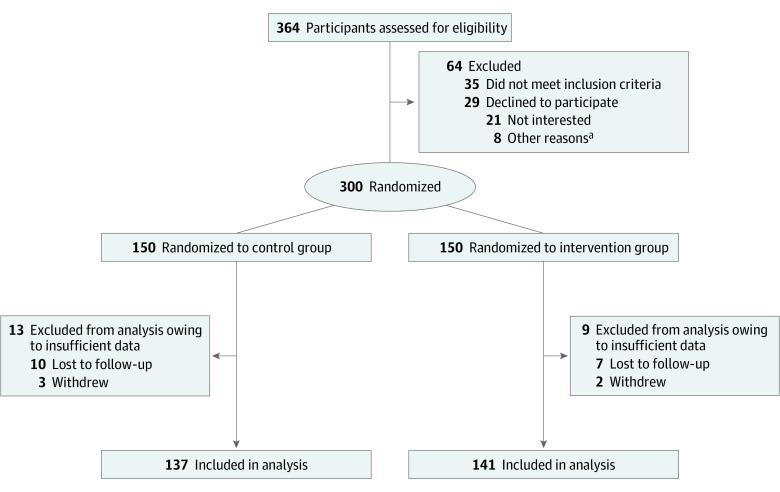
DESIGN, SETTING, AND PARTICIPANTS: This open-label randomized clinical trial was performed from September 1, 2019, to March 31, 2021. Patients were randomized to the ePRO model intervention or a control group by a computer system. A total of 28 Chinese tertiary care hospitals participated. Patients who were receiving cancer immunotherapy and could use smartphones or computers were eligible. A total of 300 patients were screened and 278 (92.7%) were enrolled.
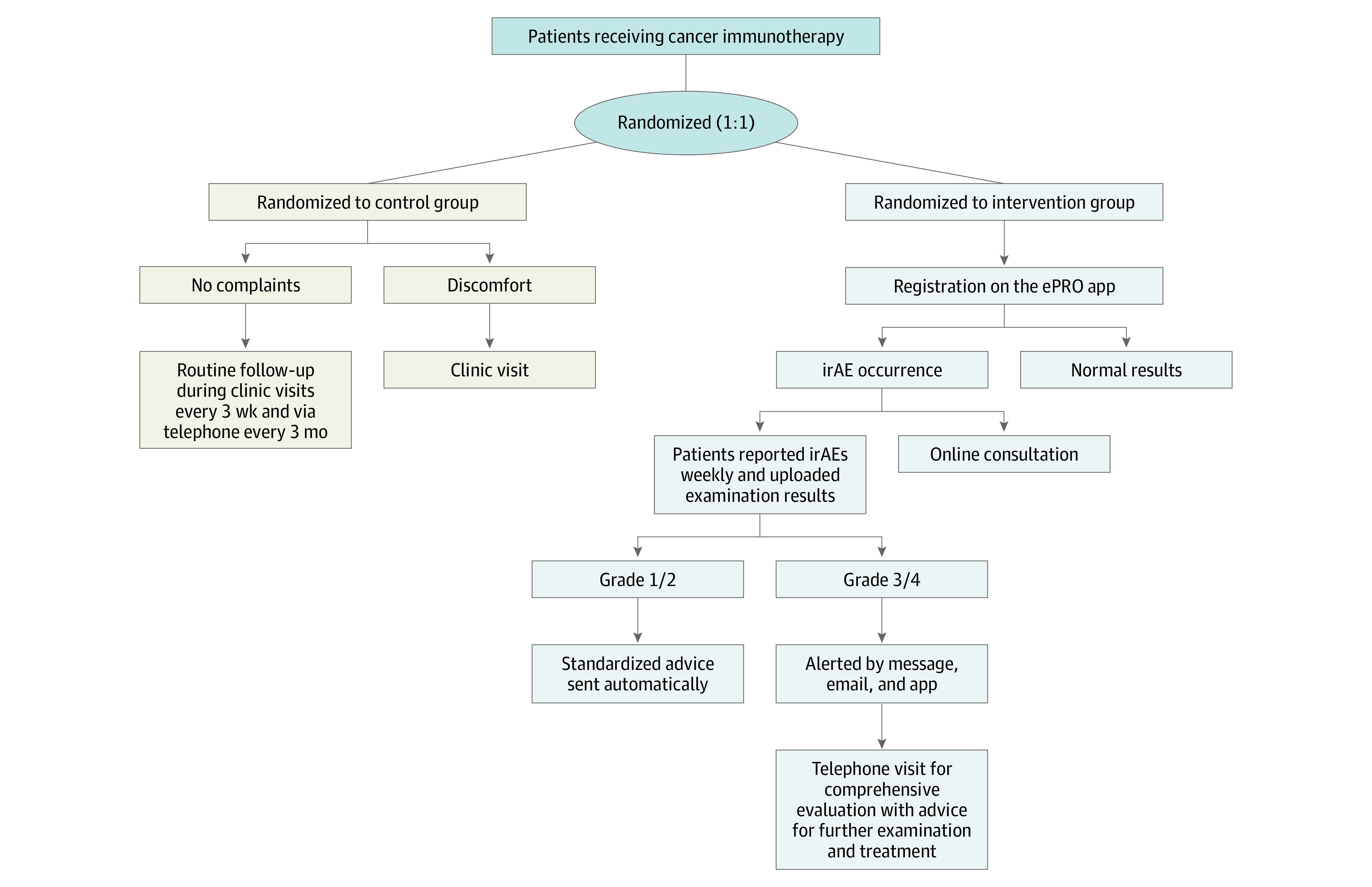
The control group was followed up using traditional methods, including clinic visits every 21 days and telephone follow-up every 3 months. In the intervention group, the ePRO follow-up model included a questionnaire of common symptoms and an image recognition function to evaluate grades of typical irAEs. Patients completed questionnaires weekly and uploaded pictures of results between visits. When grade 1 or 2 irAEs occurred, standardized advice was sent automatically. If grade 3 or 4 irAEs were reported, the model alerted the health care team for assessment and intervention immediately. All patients were followed up for 6 months or until treatment completion.
Incidence of serious (grades 3 to 4) irAEs, emergency department (ED) visits, quality of life (QOL), time spent implementing the ePRO model, rate of treatment discontinuation, and death were compared between groups post intervention.
A total of 278 patients (mean [SD] age, 58.8 [12.7 (range, 27-78)] years; 206 men [74.1%]) were included in the analysis, consisting of 141 in the intervention group and 137 in the control group. At the postintervention evaluation, the intervention group showed a reduced incidence of serious irAEs (29 of 141 [20.6%] vs 46 of 137 [33.6%]; hazard ratio [HR], 0.51 [95% CI, 0.30-0.88]; P = .01), fewer ED visits (23 of 141 [16.3%] vs 41 of 137 [29.9%]; HR, 0.46 [95% CI, 0.26-0.81]; P = .01), a lower rate of treatment discontinuation (5 of 141 [3.6%] vs 15 of 137 [11.0%]; HR, 0.30 [95% CI, 0.11-0.85]; P = .02), a higher QOL level (mean [SD] score, 74.2 [15.1; 95% CI, 71.7-76.9] vs 64.7 [28.5; 95% CI, 61.0-68.4]; P = .001), and less time implementing follow-up (mean [SD], 8.2 [3.9; 95% CI, 5.0-10.6] minutes vs 36.1 [15.3; 95% CI, 33.6-38.8] minutes; P < .001). However, there were no significant differences between groups in death rates (2 of 141 [1.4%] vs 5 of 137 [3.6%]; HR, 0.38 [95% CI, 0.07-1.99]; P = .28).
This randomized clinical trial found that the ePRO follow-up model can improve safety and QOL of patients receiving cancer immunotherapy as well as reduce time spent monitoring. This model may provide reliable information and management recommendations.
Chinese Clinical Trial Registry Identifier: ChiCTR2100052819.
癌症免疫疗法会引起广泛的免疫相关不良事件(irAEs),需要密切和及时的随访。
比较电子患者报告结局(ePRO)和传统随访模型在癌症免疫疗法中的效率。
设计、设置和参与者:这项开放标签的随机临床试验于 2019 年 9 月 1 日至 2021 年 3 月 31 日进行。患者通过计算机系统被随机分配到 ePRO 模型干预组或对照组。共有 28 家中国三级保健医院参与。符合条件的患者正在接受癌症免疫治疗,并且可以使用智能手机或计算机。共有 300 名患者接受了筛查,其中 278 名(92.7%)被纳入研究。
对照组采用传统方法进行随访,包括每 21 天就诊一次和每 3 个月电话随访一次。在干预组中,ePRO 随访模型包括常见症状问卷和图像识别功能,以评估典型 irAEs 的严重程度。患者每周完成问卷并在就诊之间上传结果图片。当发生 1 级或 2 级 irAEs 时,自动发送标准化建议。如果报告了 3 级或 4 级 irAEs,则模型会立即提醒医疗团队进行评估和干预。所有患者均随访 6 个月或直至治疗完成。
比较干预后严重(3 至 4 级)irAEs、急诊就诊、生活质量(QOL)、实施 ePRO 模型的时间、治疗中断率和死亡率。
共有 278 名患者(平均[标准差]年龄,58.8[12.7(范围,27-78)]岁;206 名男性[74.1%])被纳入分析,其中 141 名在干预组,137 名在对照组。在干预后评估中,干预组严重 irAEs 的发生率降低(29/141[20.6%] vs 46/137[33.6%];风险比[HR],0.51[95%CI,0.30-0.88];P=0.01),急诊就诊次数减少(23/141[16.3%] vs 41/137[29.9%];HR,0.46[95%CI,0.26-0.81];P=0.01),治疗中断率降低(5/141[3.6%] vs 15/137[11.0%];HR,0.30[95%CI,0.11-0.85];P=0.02),QOL 水平更高(平均[标准差]评分,74.2[15.1;95%CI,71.7-76.9] vs 64.7[28.5;95%CI,61.0-68.4];P=0.001),随访实施时间更少(平均[标准差],8.2[3.9;95%CI,5.0-10.6]分钟 vs 36.1[15.3;95%CI,33.6-38.8]分钟;P<0.001)。然而,两组死亡率无显著差异(2/141[1.4%] vs 5/137[3.6%];HR,0.38[95%CI,0.07-1.99];P=0.28)。
这项随机临床试验发现,ePRO 随访模型可以提高接受癌症免疫治疗患者的安全性和 QOL,同时减少监测时间。该模型可能提供可靠的信息和管理建议。
中国临床试验注册中心标识符:ChiCTR2100052819。