Zhong Xiongdong, Yu Xianchang, Chang Hao
Department of Cardiothoracic Surgery, Zhuhai People's Hospital (Zhuhai Hospital Affiliated with Jinan University), Zhuhai, China.
Department of Protein Modification and Cancer Research, Hanyu Biomed Center Beijing, Beijing, China.
Front Oncol. 2022 Mar 10;12:830362. doi: 10.3389/fonc.2022.830362. eCollection 2022.
The initiation and progression of tumors were due to variations of gene sets rather than individual genes. This study aimed to identify novel biomarkers based on gene set variation analysis (GSVA) in hepatocellular carcinoma.
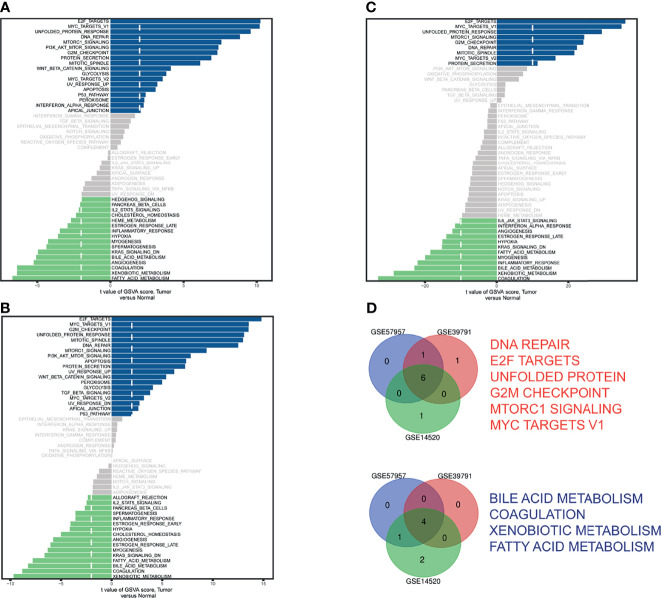
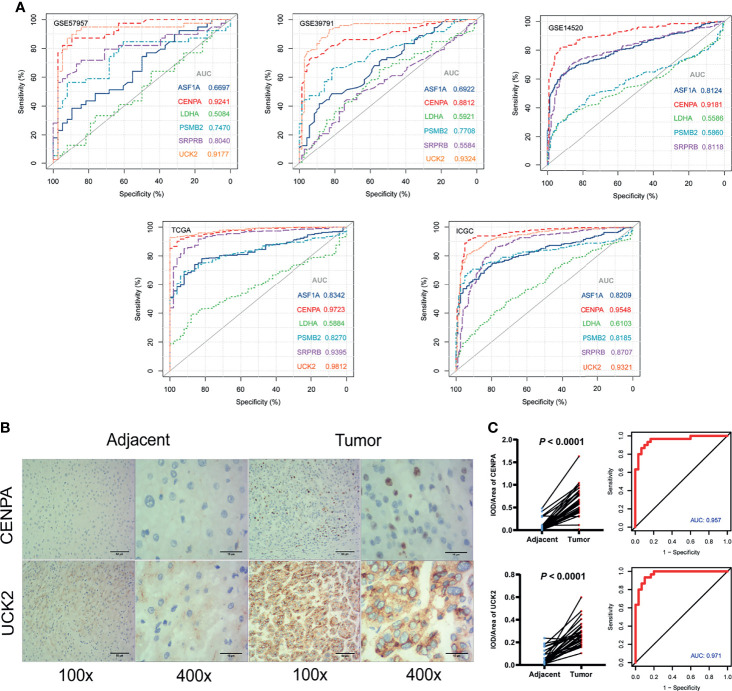
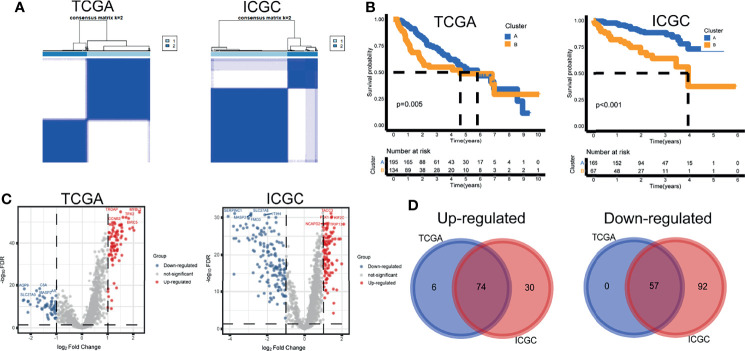
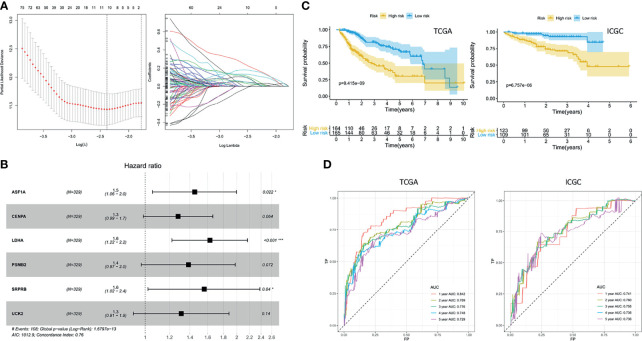
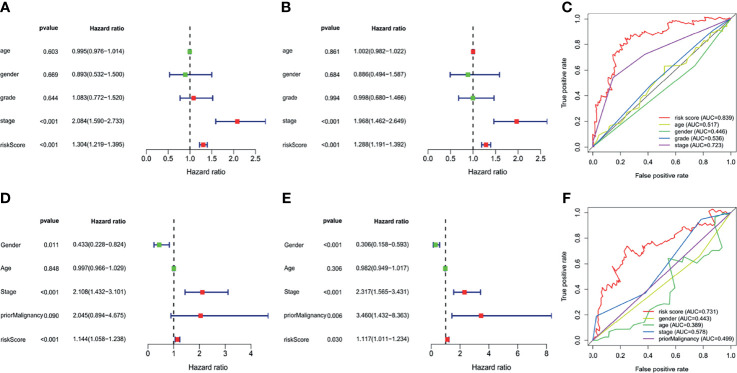
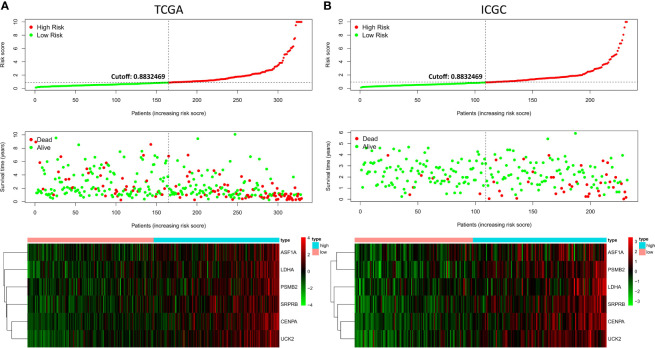
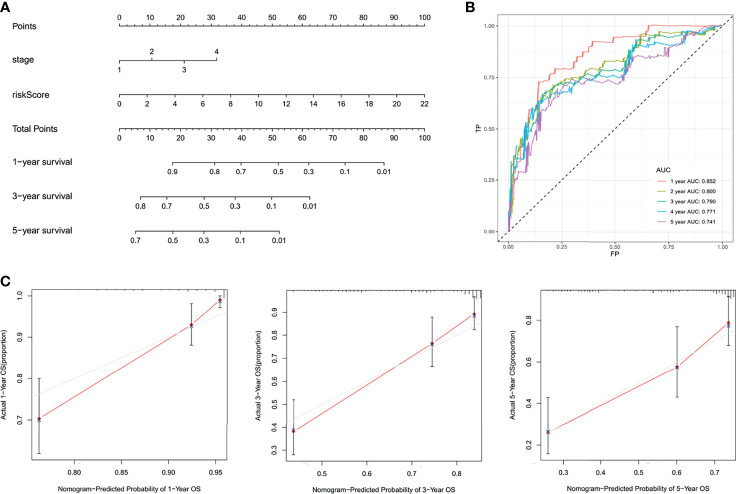
The activities of 50 hallmark pathways were scored in three microarray datasets with paired samples with GSVA, and differential analysis was performed with the limma R package. Unsupervised clustering was conducted to determine subtypes with the ConsensusClusterPlus R package in the TCGA-LIHC ( = 329) and LIRI-JP ( = 232) cohorts. Differentially expressed genes among subtypes were identified as initial variables. Then, we used TCGA-LIHC as the training set and LIRI-JP as the validation set. A six-gene model calculating the risk scores of patients was integrated with the least absolute shrinkage and selection operator (LASSO) and stepwise regression analyses. Kaplan-Meier (KM) and receiver operating characteristic (ROC) curves were performed to assess predictive performances. Multivariate Cox regression analyses were implemented to select independent prognostic factors, and a prognostic nomogram was integrated. Moreover, the diagnostic values of six genes were explored with the ROC curves and immunohistochemistry.
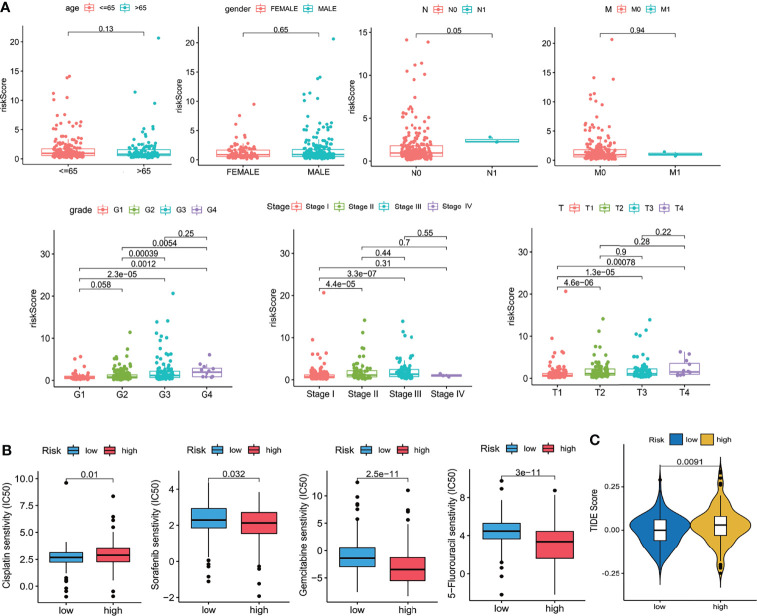
Patients could be separated into two subtypes with different prognoses in both cohorts based on the identified differential hallmark pathways. Six prognostic genes (, , , , , ) were included in the risk score signature, which was demonstrated to be an independent prognostic factor. A nomogram including 540 patients was further integrated and well-calibrated. ROC analyses in the five cohorts and immunohistochemistry experiments in solid tissues indicated that and exhibited high and robust diagnostic values.
Our study explored a promising prognostic nomogram and diagnostic biomarkers in hepatocellular carcinoma.
肿瘤的发生和发展是由于基因集的变异而非单个基因。本研究旨在基于基因集变异分析(GSVA)鉴定肝细胞癌中的新型生物标志物。
使用GSVA对三个具有配对样本的微阵列数据集的50个标志性通路的活性进行评分,并使用limma R包进行差异分析。使用ConsensusClusterPlus R包在TCGA-LIHC(n = 329)和LIRI-JP(n = 232)队列中进行无监督聚类以确定亚型。将亚型间差异表达的基因确定为初始变量。然后,我们将TCGA-LIHC用作训练集,LIRI-JP用作验证集。通过最小绝对收缩和选择算子(LASSO)和逐步回归分析,构建了一个计算患者风险评分的六基因模型。绘制Kaplan-Meier(KM)曲线和受试者工作特征(ROC)曲线以评估预测性能。进行多变量Cox回归分析以选择独立的预后因素,并整合了预后列线图。此外,通过ROC曲线和免疫组织化学探讨了六个基因的诊断价值。
基于鉴定出的差异标志性通路,两个队列中的患者均可分为具有不同预后的两个亚型。风险评分特征中包括六个预后基因(,,,,,),这被证明是一个独立的预后因素。进一步整合并校准了一个包含540名患者的列线图。在五个队列中进行的ROC分析和实体组织中的免疫组织化学实验表明,和具有较高且稳定的诊断价值。
我们的研究探索了一种有前景的肝细胞癌预后列线图和诊断生物标志物。