Wang Xiaodan, Li Tingting, Shu Yun, Zhang Juan, Shan Xiyun, Li Daiying, Ma Dehong, Long Shuying, Pan Yue, Chen Junying, Liu Pinghua, Sun Qiangming
Institute of Medical Biology, Chinese Academy of Medical Sciences, Peking Union Medical College, Kunming, China.
Yunnan Key Laboratory of Vaccine Research & Development on Severe Infectious Diseases, Kunming, China.
Front Microbiol. 2022 Mar 10;13:739970. doi: 10.3389/fmicb.2022.739970. eCollection 2022.
Dengue poses a large burden on the public health systems worldwide. severe dengue (SD) could lead to more serious clinical symptoms and even death. This study aimed to identify the cause of SD in a clinical trial during the dengue outbreak in Xishuangbanna in 2019, and could provide new insights into the pathogenic mechanisms of SD.
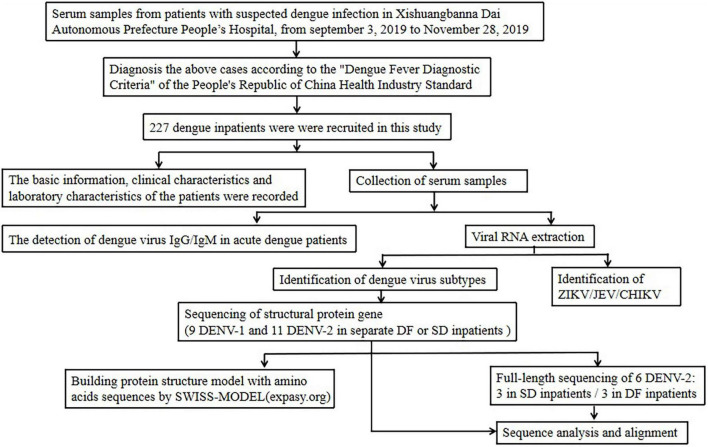
Mosquito-borne viral (DENV, JEV, and CHIKV) infections were identified. The epidemiological factors and clinical symptoms of inpatients in Xishuangbanna were recorded. The IgG and IgM levels in the serum of dengue inpatients were evaluated, and secondary infections were identified. Then, the structural proteins (C/PrM/E) were sequenced and compared with those of the same type of DENV in the same area as before, and their structures were predicted by the SWISS-MODEL (expasy.org). The full-length viral genomes were sequenced and aligned with representative strains by BioEidt or MEGA 5.0.
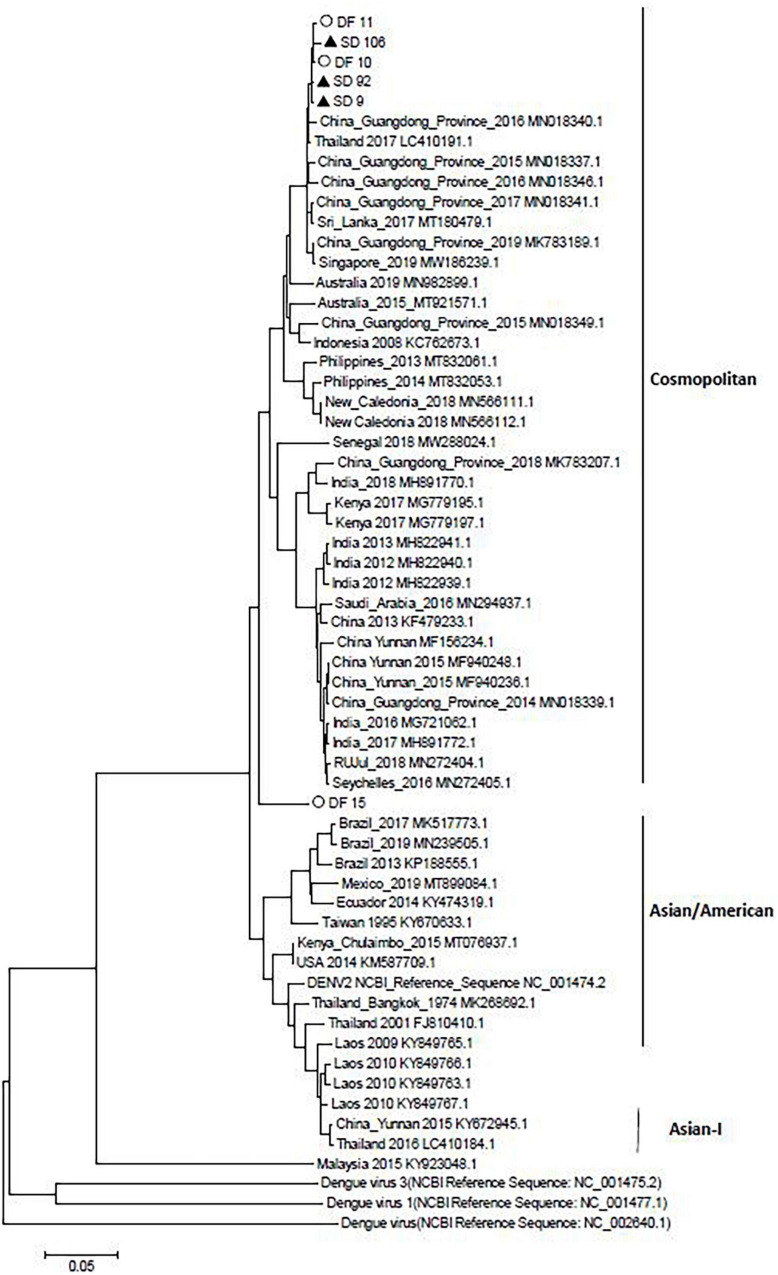
In this outbreak, the clinical symptoms were more serious in SD. The proportion of SD inpatients of male and Han nationality was larger than that of dengue fever (DF) inpatients ( < 0.05). DENV-2 infection was the majority in DF, with 45 inpatients. However, DENV-1 infection was the most common SD, with 54 inpatients. There were 3 DENV-3-positive inpatients in the DF group and 6 ZIKV-positive inpatients in the SD group. A secondary infection accounted for 76.47% (78 cases) of SD inpatients, but secondary infections were only in 20% (17 cases) of DF inpatients. In the three-dimensional structure of protein analysis, the C/PrM/E of DENV-1 and DENV-2 showed more stability than previous epidemic strains, while DENV-3 in 2019 showed a looser spatial structure. After a complete genome sequencing and analysis, all six DENV-2 strains belonged to cosmopolitan, five of which clustered into one branch. The GC/AT of the five strains decreased from 2014 to 2018. Compared with DF strains, SD strains had no mutations of commonness.
SD may related to secondary heteromorphic dengue in Xishuangbanna in 2019. The coinfection of ZIKV could be another related factor for SD. The currently datas were very limited and only suggestive.
登革热给全球公共卫生系统带来了沉重负担。重症登革热(SD)可导致更严重的临床症状甚至死亡。本研究旨在确定2019年西双版纳登革热疫情期间一项临床试验中重症登革热的病因,为重症登革热的致病机制提供新的见解。
对蚊媒病毒(登革病毒、日本脑炎病毒和基孔肯雅病毒)感染进行鉴定。记录西双版纳住院患者的流行病学因素和临床症状。评估登革热住院患者血清中的IgG和IgM水平,并确定继发感染情况。然后,对结构蛋白(C/PrM/E)进行测序,并与该地区之前同一类型的登革病毒进行比较,通过SWISS-MODEL(expasy.org)预测其结构。对全长病毒基因组进行测序,并通过BioEidt或MEGA 5.0与代表性毒株进行比对。
在此次疫情中,重症登革热的临床症状更为严重。重症登革热男性和汉族住院患者的比例高于登革热(DF)住院患者(<0.05)。登革热患者中登革病毒2型感染居多,有45例住院患者。然而,登革病毒1型感染是重症登革热最常见的类型,有54例住院患者。登革热组有3例登革病毒3型阳性住院患者,重症登革热组有6例寨卡病毒阳性住院患者。继发感染占重症登革热住院患者的76.47%(78例),但登革热住院患者中继发感染仅占20%(17例)。在蛋白质三维结构分析中,登革病毒1型和2型的C/PrM/E比以往流行毒株表现出更高的稳定性,而2019年的登革病毒3型呈现出更松散的空间结构。经过全基因组测序和分析,所有6株登革病毒2型均属于世界性毒株,其中5株聚为一个分支。这5株毒株的GC/AT从2014年到2018年有所下降。与登革热毒株相比,重症登革热毒株没有常见突变。
2019年西双版纳的重症登革热可能与继发异型登革热有关。寨卡病毒的合并感染可能是重症登革热的另一个相关因素。目前的数据非常有限,仅具有提示性。