Department of Addictology, First Faculty of Medicine, Charles University and General Teaching Hospital in Prague, Prague, Czechia.
Faculty of Mining, Ecology, Process Control and Geotechnologies, Institute of Earth Resources, Technical University of Košice, Košice, Slovakia.
Front Public Health. 2022 Mar 11;10:859107. doi: 10.3389/fpubh.2022.859107. eCollection 2022.
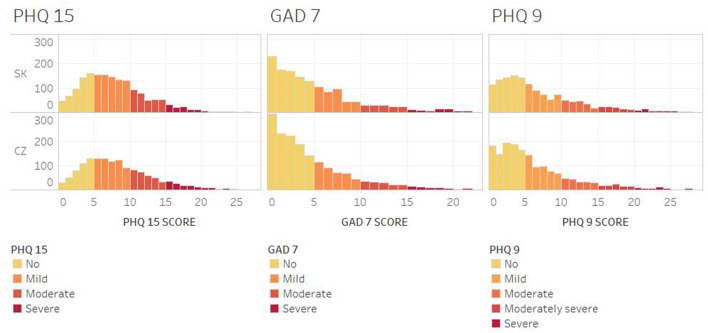
Studying in college can be a challenging time for many students, which can affect their mental health. In addition to academic pressure and stressful tasks, another aggravating factor in student life is the ongoing coronavirus disease 2019 (COVID-19) pandemic. The aim of the study was to examine the prevalence of anxiety, depression, and somatic symptoms in Czech and Slovak college students during the COVID-19 pandemic and to evaluate possible socio-demographic determinants of mental health problems. A total of 3,099 respondents participated in this cross-sectional study (Czech Republic: 1,422, Slovakia: 1,677). The analyzes included the Patient Health Questionnaire for somatic symptoms (PHQ-15), the Generalized Anxiety Disorder instrument (GAD-7), and the Patient Health Questionnaire for depression (PHQ-9). Socio-demographic factors were gender, age, family structure, marital status, form of study, degree of study, year of study, field of study, distance between home and college, residence, and housing during the semester. Among Czech students, prevalence of somatic complaints, anxiety and depression was 72.2, 40.3, and 52%, respectively. Among Slovak students, prevalence of somatic complaints, anxiety and depression was 69.5, 34.6, and 47%, respectively. During the COVID-19 pandemic, the most severe mental health problems were identified in a non-negligible part of the sample (Czech Republic: PHQ-15 = 10.1%, GAD-7 = 4.9%, PHQ-9 = 3.4%; Slovakia: PHQ-15 = 7.4%, GAD-7 = 3.5%, PHQ-9 = 2.7%). Regarding the differences between the analyzed countries, a significantly higher score in somatic symptoms, anxiety, and depression was identified in the Czech Republic. Significant differences in mental disorders were found in most socio-demographic characteristics. The main results of the logistic regression analysis revealed that risk factors for mental health disorders in Czech and Slovak students were female gender, younger age, third degree of study, and study of Informatics, Mathematics, Information and Communication Technologies (ICT). Especially in the case of these high-risk groups of students, public policies should consider a response to impending problems. The findings are an appeal for a proactive approach to improving the mental health of students and for the implementation of effective prevention programs, which are more than necessary in the Czech and Slovak college environment.
在大学学习对于许多学生来说可能是一个具有挑战性的时期,这会影响他们的心理健康。除了学术压力和紧张的任务之外,学生生活中的另一个加剧因素是持续的 2019 年冠状病毒病(COVID-19)大流行。本研究的目的是检查 COVID-19 大流行期间捷克和斯洛伐克大学生中焦虑、抑郁和躯体症状的患病率,并评估心理健康问题的可能社会人口学决定因素。共有 3099 名受访者参加了这项横断面研究(捷克共和国:1422 名,斯洛伐克:1677 名)。分析包括躯体症状患者健康问卷(PHQ-15)、广泛性焦虑症量表(GAD-7)和抑郁患者健康问卷(PHQ-9)。社会人口学因素包括性别、年龄、家庭结构、婚姻状况、学习形式、学习程度、学习年限、学习领域、家庭与大学之间的距离、居住地和学期内的住房。在捷克学生中,躯体症状、焦虑和抑郁的患病率分别为 72.2%、40.3%和 52%。在斯洛伐克学生中,躯体症状、焦虑和抑郁的患病率分别为 69.5%、34.6%和 47%。在 COVID-19 大流行期间,在相当一部分样本中发现了最严重的心理健康问题(捷克共和国:PHQ-15=10.1%,GAD-7=4.9%,PHQ-9=3.4%;斯洛伐克:PHQ-15=7.4%,GAD-7=3.5%,PHQ-9=2.7%)。关于分析国家之间的差异,在捷克共和国发现躯体症状、焦虑和抑郁的评分明显更高。在大多数社会人口学特征方面发现了精神障碍的显著差异。逻辑回归分析的主要结果表明,捷克和斯洛伐克学生心理健康障碍的危险因素是女性、年龄较小、第三学位和信息学、数学、信息和通信技术(ICT)的学习。特别是对于这些高风险学生群体,公共政策应考虑应对即将出现的问题。这些发现呼吁采取积极主动的方法来改善学生的心理健康,并实施有效的预防计划,这在捷克和斯洛伐克的大学校园环境中是非常必要的。