Department of Addictology, First Faculty of Medicine, Charles University and General University Hospital in Prague, Prague, Czechia.
Institute of Earth Resources, Faculty of Mining, Ecology, Process Control and Geotechnologies, Technical University of Košice, Košice, Slovakia.
Front Public Health. 2022 Jun 14;10:893845. doi: 10.3389/fpubh.2022.893845. eCollection 2022.
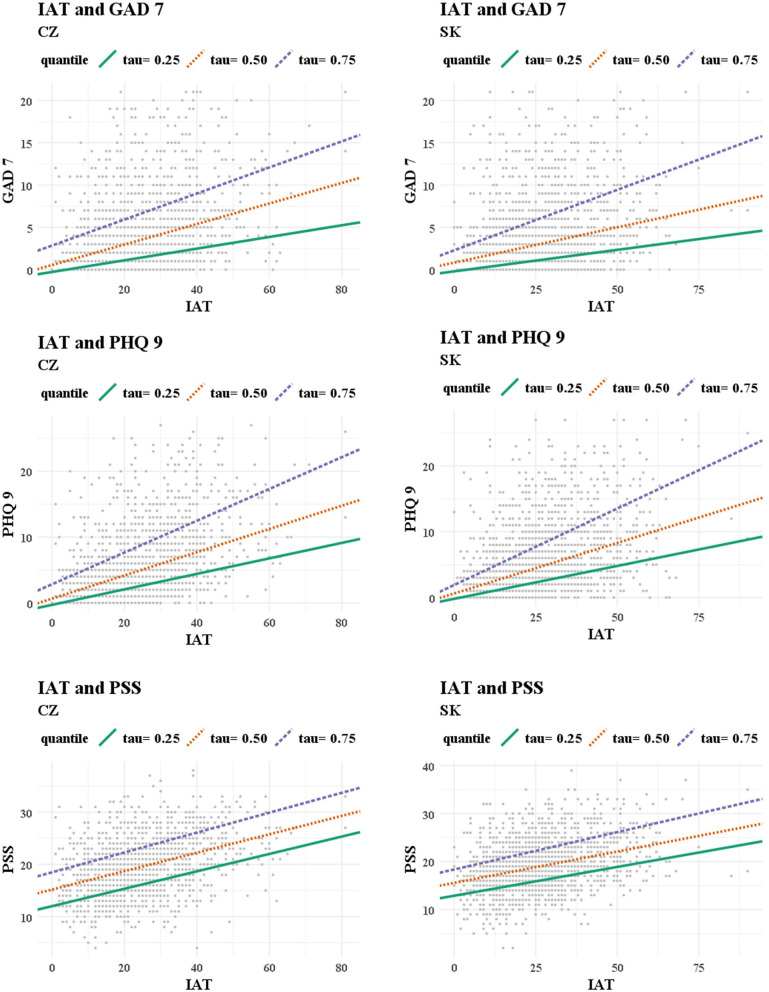
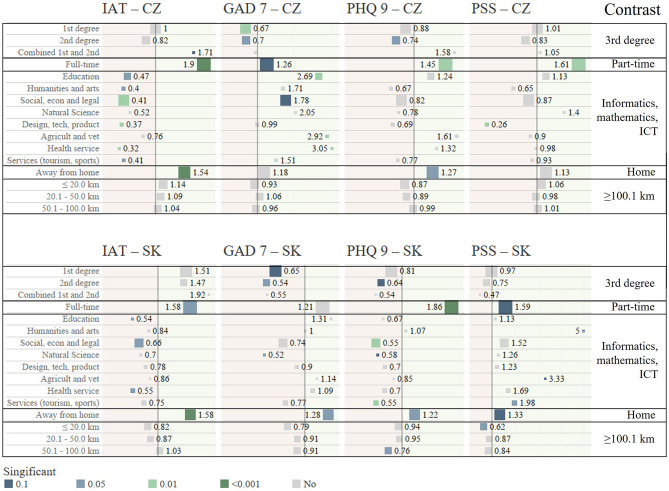
Poor mental health is a growing concern among young people during the coronavirus disease 2019 (COVID-19) pandemic. The aim of this study was to assess the associations of Internet addiction with depressive symptoms, anxiety symptoms, and stress in higher education students during the COVID-19 pandemic, as well as to examine these mental health problems in the context of study-related characteristics. The research sample consisted of 3,099 participants from the Czech Republic (CZ: 1,422) and Slovak Republic (SK: 1,677). The Internet Addiction Test (IAT), the Generalized Anxiety Disorder (GAD-7) scale, the Patient Health Questionnaire for depressive symptoms (PHQ-9), and the Perceived Stress Scale (PSS) were used to measure mental health problems. The analyses also included demographic data (gender and age) and study-related characteristics (form of study, degree of study, field of study, distance between college and home, and housing during the semester). Based on the results of frequency and descriptive analyses, the prevalence of mental health problems was high. The most serious levels of Internet addiction (IAT cut-off point ≥ 50), to which attention should be paid, were found in 3.5% of Czech and 6.2% of Slovak students. Using the standard cut-off point of GAD-7 ≥ 10, 14.1% of Czech and 11.6% of Slovak students were identified with anxiety symptoms. Regarding the PHQ-9 with the cut-off point ≥ 10, 23.4% of Czech and 19.1% of Slovak students had depressive symptoms, which should be addressed. Using the PSS cut-off point ≥ 27, 12.9% of Czech students and 9.1% of Slovak students perceived high stress. The quantile regression analysis showed that Internet addiction was positively associated with anxiety symptoms, depressive symptoms, and stress in all of the analyzed cases (-value < 0.001). In terms of study-related characteristics, the binomial logistic regression analysis revealed that risk factors for mental health problems in Czech and Slovak students were mainly full-time form of study and living away from home during the semester. Internet addiction, anxiety symptoms, depressive symptoms, and stress are issues that require increased attention, and professionals and policy-makers should implement interventions to effectively prevent and help students with psychological problems.
在 2019 冠状病毒病(COVID-19)大流行期间,年轻人的心理健康问题日益受到关注。本研究旨在评估互联网成瘾与高等教育学生在 COVID-19 大流行期间的抑郁症状、焦虑症状和压力之间的关联,并研究这些心理健康问题与学习相关特征之间的关系。研究样本包括来自捷克共和国(CZ:1422)和斯洛伐克共和国(SK:1677)的 3099 名参与者。使用互联网成瘾测试(IAT)、广泛性焦虑症(GAD-7)量表、抑郁症状患者健康问卷(PHQ-9)和感知压力量表(PSS)来衡量心理健康问题。分析还包括人口统计学数据(性别和年龄)和学习相关特征(学习形式、学习程度、学习领域、学院和家之间的距离以及学期期间的住房)。基于频率和描述性分析的结果,心理健康问题的患病率很高。应注意的是,捷克学生中有 3.5%和斯洛伐克学生中有 6.2%的学生存在严重的互联网成瘾(IAT 截断值≥50)。使用 GAD-7 的标准截断值≥10,确定 14.1%的捷克学生和 11.6%的斯洛伐克学生存在焦虑症状。使用 PHQ-9 的截断值≥10,确定 23.4%的捷克学生和 19.1%的斯洛伐克学生存在抑郁症状,这需要引起关注。使用 PSS 的截断值≥27,确定 12.9%的捷克学生和 9.1%的斯洛伐克学生感到压力很大。分位数回归分析表明,在所有分析案例中,互联网成瘾与焦虑症状、抑郁症状和压力呈正相关(-值<0.001)。就学习相关特征而言,二项逻辑回归分析表明,捷克和斯洛伐克学生心理健康问题的风险因素主要是全日制学习形式和学期期间离家居住。互联网成瘾、焦虑症状、抑郁症状和压力是需要引起更多关注的问题,专业人员和政策制定者应实施干预措施,以有效预防和帮助有心理问题的学生。