Gaur Loveleen, Bhandari Mohan, Razdan Tanvi, Mallik Saurav, Zhao Zhongming
Amity International Business School, Amity University, Noida, India.
Nepal College of Information Technology, Lalitpur, Nepal.
Front Genet. 2022 Mar 14;13:822666. doi: 10.3389/fgene.2022.822666. eCollection 2022.
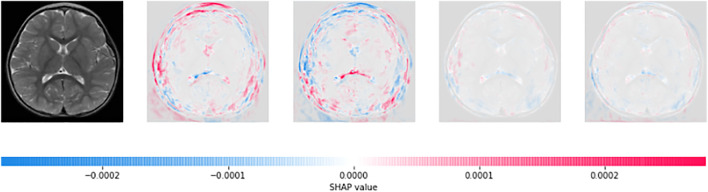
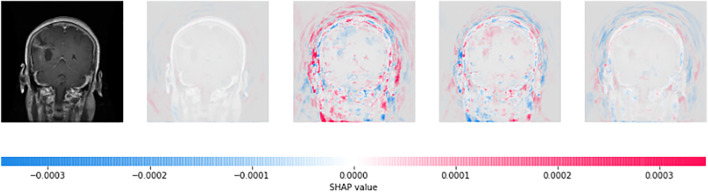
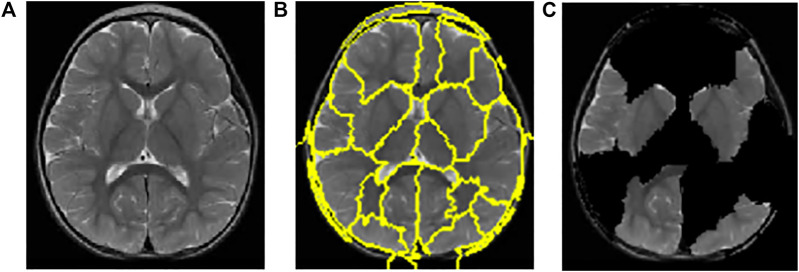
Cancer research has seen explosive development exploring deep learning (DL) techniques for analysing magnetic resonance imaging (MRI) images for predicting brain tumours. We have observed a substantial gap in explanation, interpretability, and high accuracy for DL models. Consequently, we propose an explanation-driven DL model by utilising a convolutional neural network (CNN), local interpretable model-agnostic explanation (LIME), and Shapley additive explanation (SHAP) for the prediction of discrete subtypes of brain tumours (meningioma, glioma, and pituitary) using an MRI image dataset. Unlike previous models, our model used a dual-input CNN approach to prevail over the classification challenge with images of inferior quality in terms of noise and metal artifacts by adding Gaussian noise. Our CNN training results reveal 94.64% accuracy as compared to other state-of-the-art methods. We used SHAP to ensure consistency and local accuracy for interpretation as Shapley values examine all future predictions applying all possible combinations of inputs. In contrast, LIME constructs sparse linear models around each prediction to illustrate how the model operates in the immediate area. Our emphasis for this study is interpretability and high accuracy, which is critical for realising disparities in predictive performance, helpful in developing trust, and essential in integration into clinical practice. The proposed method has a vast clinical application that could potentially be used for mass screening in resource-constraint countries.
癌症研究在探索深度学习(DL)技术以分析磁共振成像(MRI)图像来预测脑肿瘤方面取得了爆炸性发展。我们已经观察到DL模型在解释性、可解释性和高精度方面存在巨大差距。因此,我们提出了一种由解释驱动的DL模型,该模型利用卷积神经网络(CNN)、局部可解释模型无关解释(LIME)和夏普利加法解释(SHAP),通过一个MRI图像数据集来预测脑肿瘤的离散亚型(脑膜瘤、胶质瘤和垂体瘤)。与先前的模型不同,我们的模型采用双输入CNN方法,通过添加高斯噪声来克服低质量图像(在噪声和金属伪影方面)的分类挑战。与其他现有技术方法相比,我们的CNN训练结果显示准确率达到了94.64%。我们使用SHAP来确保解释的一致性和局部准确性,因为夏普利值会检查应用所有可能输入组合的所有未来预测。相比之下,LIME围绕每个预测构建稀疏线性模型,以说明模型在紧邻区域的运行方式。我们这项研究的重点是可解释性和高精度,这对于认识预测性能差异、建立信任以及融入临床实践至关重要。所提出的方法具有广泛的临床应用潜力,可用于资源有限国家的大规模筛查。