Department of Internal Medicine, Seoul National University Hospital, Seoul, South Korea.
Department of Family Medicine, Center for Health Promotion and Optimal Aging, Seoul National University College of Medicine and Hospital, Seoul, South Korea.
J Cachexia Sarcopenia Muscle. 2022 Jun;13(3):1908-1918. doi: 10.1002/jcsm.12993. Epub 2022 Apr 1.
Sarcopenia is an age-related chronic condition that can lead to mobility disabilities. This study aimed to evaluate the risk factors for incident sarcopenia in older Korean adults.
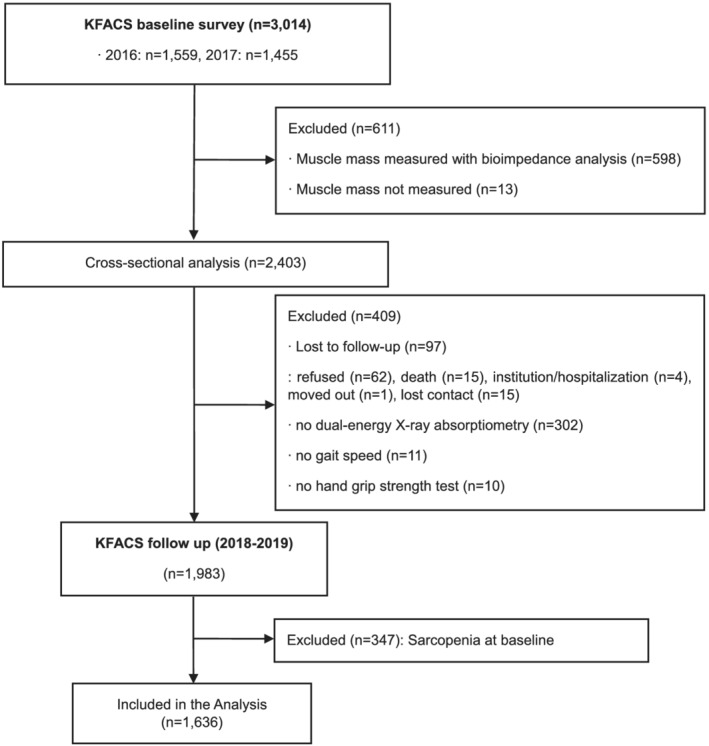
The Korean Frailty and Aging Cohort Study (KFACS) is a multicentre prospective study with a baseline examination in 2016-2017. A prospective follow-up study was conducted in 2018-2019. Changes in muscle-related variables were evaluated for subjects aged 70-84 years lacking sarcopenia at baseline. Sarcopenia was diagnosed according to the 2019 updated Asian Working Group for Sarcopenia consensus.
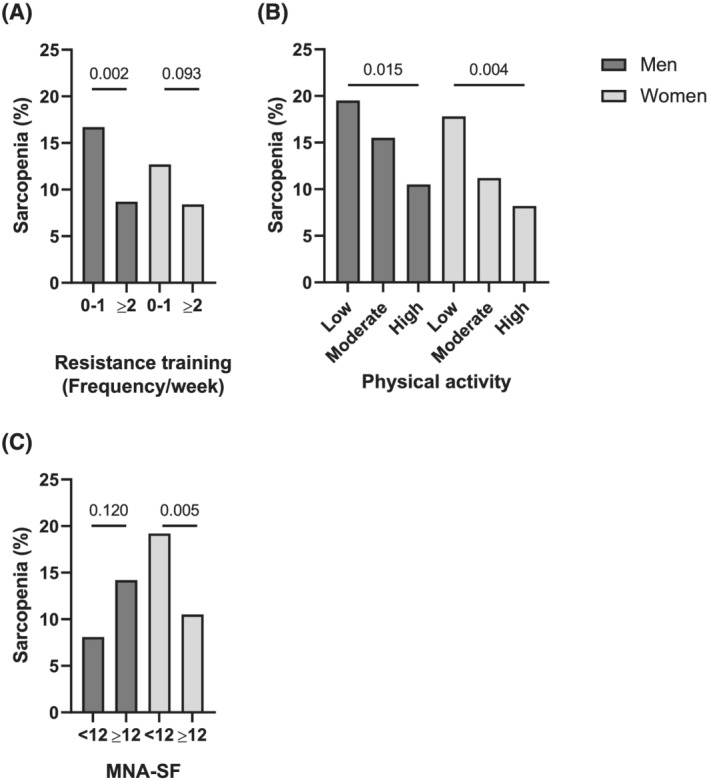
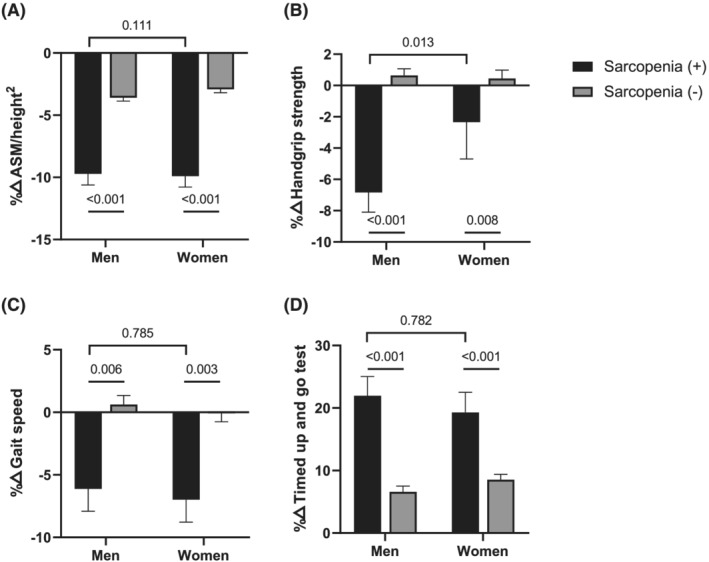
Among the 1636 participants (54.4% women, age 75.9 ± 3.7) who did not have sarcopenia at baseline, 101 men (13.5%) and 104 women (11.7%) developed sarcopenia by the follow-up. Those who developed sarcopenia were older (men, 77.9 ± 3.9 vs. 75.7 ± 3.5, P < 0.001; women, 77.5 ± 4.0 vs. 75.5 ± 3.6, P < 0.001) with a lower body mass index at baseline (men, 23.9 ± 2.4 vs. 24.5 ± 2.9 kg/m , P = 0.025; women, 23.7 ± 2.8 vs. 25.2 ± 2.9 kg/m , P < 0.001) compared with older adults who remained nonsarcopenic; levels of glycated haemoglobin (men, 6.2 ± 1.0% vs. 5.9 ± 0.8%, P = 0.029) and the homeostasis model assessment of insulin resistance (men, 2.0 ± 1.3 vs. 1.7 ± 1.2, P = 0.022) were higher in men who progressed to sarcopenia but not in women. Development of sarcopenia was associated with older age and the frequency of resistance training (≥2 per week) after adjusting for potential risk factors in men [age, odds ratio (OR) 1.17, 95% confidence interval (CI) 1.10-1.25; frequent resistance training, OR 0.50, 95% CI 0.30-0.82]. In women, advanced age, poor nutritional status, and physical inactivity contributed to the development of sarcopenia (age, OR 1.14, 95% CI 1.08-1.21; mini nutritional assessment short form, OR 0.79, 95% CI 0.70-0.90; moderate to high physical activity, OR 0.57, 95% CI 0.34-0.95).
In this 2 year KFACS follow-up, modifiable risk factors for incident sarcopenia differed between genders. Resistance training (≥2 per week) helped to prevent sarcopenia in these community-dwelling older men. In older women, adequate nutritional support and being physically active might play a role in preventing progression to sarcopenia.
肌少症是一种与年龄相关的慢性疾病,可导致行动障碍。本研究旨在评估韩国老年人群中肌少症的发生风险因素。
韩国衰弱与老龄化队列研究(KFACS)是一项多中心前瞻性研究,基线检查于 2016-2017 年进行。2018-2019 年进行了前瞻性随访研究。在基线时无肌少症的 70-84 岁受试者中评估肌肉相关变量的变化。根据 2019 年更新的亚洲肌少症工作组共识,诊断肌少症。
在 1636 名(54.4%为女性,年龄 75.9±3.7)基线时无肌少症的参与者中,101 名男性(13.5%)和 104 名女性(11.7%)在随访时发展为肌少症。发展为肌少症的患者年龄较大(男性,77.9±3.9 岁 vs. 75.7±3.5 岁,P<0.001;女性,77.5±4.0 岁 vs. 75.5±3.6 岁,P<0.001),且基线时的身体质量指数较低(男性,23.9±2.4 千克/平方米 vs. 24.5±2.9 千克/平方米,P=0.025;女性,23.7±2.8 千克/平方米 vs. 25.2±2.9 千克/平方米,P<0.001),与仍未发生肌少症的老年人相比;糖化血红蛋白水平(男性,6.2±1.0% vs. 5.9±0.8%,P=0.029)和胰岛素抵抗稳态模型评估(男性,2.0±1.3 比 1.7±1.2,P=0.022)在进展为肌少症的男性中较高,但在女性中则没有。在男性中,调整潜在风险因素后,肌少症的发生与年龄较大和每周进行抵抗训练的频率(≥2 次)有关(年龄,优势比[OR]1.17,95%置信区间[CI]1.10-1.25;频繁的抵抗训练,OR 0.50,95%CI 0.30-0.82)。在女性中,年龄较大、营养状况较差和身体活动不足是肌少症发生的原因(年龄,OR 1.14,95%CI 1.08-1.21;迷你营养评估简表,OR 0.79,95%CI 0.70-0.90;中度至高度身体活动,OR 0.57,95%CI 0.34-0.95)。
在本项为期 2 年的 KFACS 随访中,肌少症发生的可改变风险因素在性别间存在差异。每周进行 2 次或以上的抵抗训练有助于预防这些社区居住的老年男性发生肌少症。在老年女性中,充足的营养支持和积极的身体活动可能有助于预防肌少症的进展。