Meier Matthias, Hulva Jan, Jakub Zdenek, Kraushofer Florian, Bobić Mislav, Bliem Roland, Setvin Martin, Schmid Michael, Diebold Ulrike, Franchini Cesare, Parkinson Gareth S
Institute of Applied Physics, TU Wien, Vienna, Austria.
Computational Materials Physics, University of Vienna, Vienna, Austria.
Sci Adv. 2022 Apr;8(13):eabn4580. doi: 10.1126/sciadv.abn4580. Epub 2022 Apr 1.
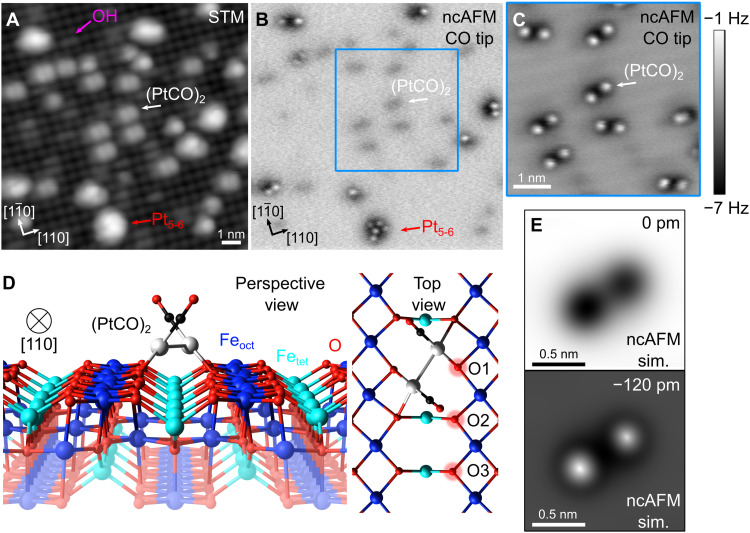
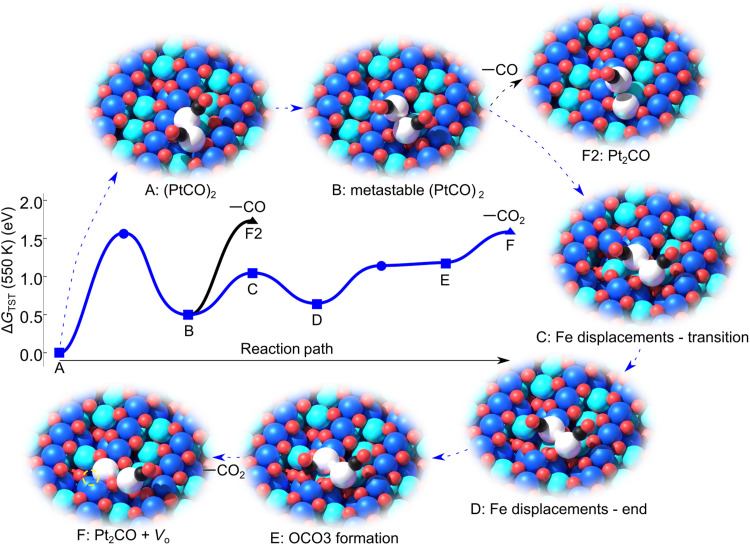
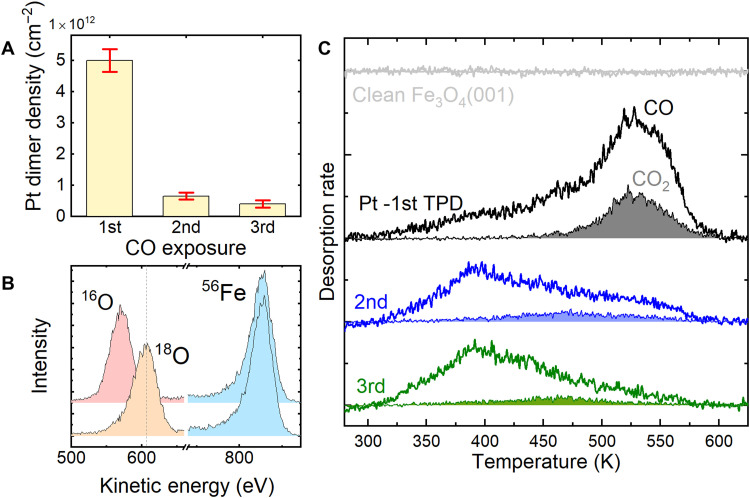
Heterogeneous catalysts based on subnanometer metal clusters often exhibit strongly size-dependent properties, and the addition or removal of a single atom can make all the difference. Identifying the most active species and deciphering the reaction mechanism is extremely difficult, however, because it is often not clear how the catalyst evolves in operando. Here, we use a combination of atomically resolved scanning probe microscopies, spectroscopic techniques, and density functional theory (DFT)-based calculations to study CO oxidation by a model Pt/FeO(001) "single-atom" catalyst. We demonstrate that (PtCO) dimers, formed dynamically through the agglomeration of mobile Pt-carbonyl species, catalyze a reaction involving the oxide support to form CO. Pt dimers produce one CO molecule before falling apart into two adatoms, releasing the second CO. O extraction only becomes facile when both the Pt-dimer and the FeO support can access metastable configurations, suggesting that substantial, concerted rearrangements of both cluster and support must be considered for reactions occurring at elevated temperature.
基于亚纳米金属团簇的多相催化剂通常表现出强烈的尺寸依赖性,添加或去除单个原子可能会产生天壤之别。然而,确定最具活性的物种并解读反应机理极其困难,因为通常不清楚催化剂在实际操作中是如何演变的。在此,我们结合原子分辨扫描探针显微镜、光谱技术以及基于密度泛函理论(DFT)的计算,来研究模型Pt/FeO(001)“单原子”催化剂上的CO氧化反应。我们证明,通过移动的Pt-羰基物种的团聚动态形成的(PtCO)二聚体催化了一个涉及氧化物载体的反应以生成CO。Pt二聚体在分解成两个吸附原子之前产生一个CO分子,释放出第二个CO。只有当Pt二聚体和FeO载体都能达到亚稳构型时,O提取才变得容易,这表明对于在高温下发生的反应,必须考虑团簇和载体的大量协同重排。