Shramko Iuliana, Ageeva Elizaveta, Krutikov Eugene, Maliy Konstantin, Repinskaya Irina, Fomochkina Iryna, Kubishkin Anatolii, Gurtovaya Anna, Tarimov Cyrill, Shekhar Suman
Department of General and Clinical Pathophysiology, S. I. Georgievsky Medical Academy of the Federal State Autonomous Educational Institution of Higher Education, V. I. Vernadsky Crimean Federal University, 295000 Simferopol, Russia.
Department of Medical Biology, S. I. Georgievsky Medical Academy of the Federal State Autonomous Educational Institution of Higher Education, V. I. Vernadsky Crimean Federal University, 295000 Simferopol, Russia.
Pathophysiology. 2022 Feb 28;29(1):81-91. doi: 10.3390/pathophysiology29010008.
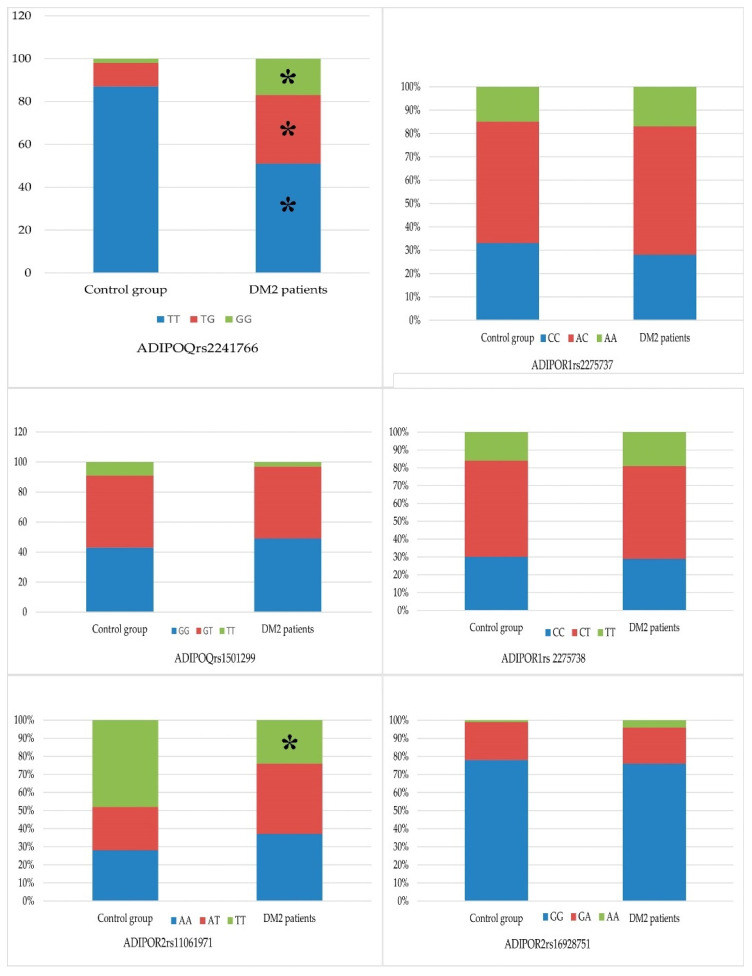
The role played by hereditary factors in the development of diabetes mellitus type 2 (DM2) has not yet been fully established. Therefore, the purpose of our study was to investigate the prevalence of adiponectin and polymorphism in its gene receptors in connection with the primary symptoms of DM2 pathogenesis. Genomic DNA was isolated from the whole blood of 94 patients with an established diagnosis of DM2 using the phenol-chloroform method. Gene polymorphisms were determined using real-time polymerase chain reaction (PCR). The most common polymorphic variants in patients with DM2 were the genotypes AA (rs11061971) and GG (rs16928751) on the ADIPOR2 gene. A strong correlation was found between the rs16928751 polymorphism on the ADIPOR2 gene and increased body mass index (BMI). TG (rs2275737) ADIPOR1 gene genotype carriers were found to have the highest levels of glycosylated hemoglobin (HbA1), whereas TT (rs2275738) caused stable hyperglycemia. In addition, the rs16928751 ADIPOR2 gene polymorphism showed an association with the development of key mechanisms of DM2 in the Russian population, although a number of genomic searches failed to show any association of this gene with DM2. Unique gene variants associated with the risk of developing DM2 in the Crimean population were established.
遗传因素在2型糖尿病(DM2)发病过程中所起的作用尚未完全明确。因此,我们研究的目的是调查脂联素及其基因受体多态性与DM2发病机制主要症状之间的关联。采用酚-氯仿法从94例确诊为DM2的患者全血中提取基因组DNA。使用实时聚合酶链反应(PCR)测定基因多态性。DM2患者中最常见的多态性变体是ADIPOR2基因上的AA(rs11061971)和GG(rs16928751)基因型。发现ADIPOR2基因上的rs16928751多态性与体重指数(BMI)升高之间存在强相关性。发现ADIPOR1基因的TG(rs2275737)基因型携带者糖化血红蛋白(HbA1)水平最高,而TT(rs2275738)导致持续性高血糖。此外,ADIPOR2基因的rs16928751多态性与俄罗斯人群中DM2关键机制的发展有关联,尽管一些基因组研究未能显示该基因与DM2有任何关联。确定了与克里米亚人群发生DM2风险相关的独特基因变体。