Marchand Bertrand, Ponty Yann, Bulteau Laurent
LIX CNRS UMR 7161, Ecole Polytechnique, Institut Polytechnique de Paris, Palaiseau, France.
LIGM, CNRS, Univ Gustave Eiffel, 77454, Marne-la-Vallée, France.
Algorithms Mol Biol. 2022 Apr 2;17(1):8. doi: 10.1186/s13015-022-00213-z.
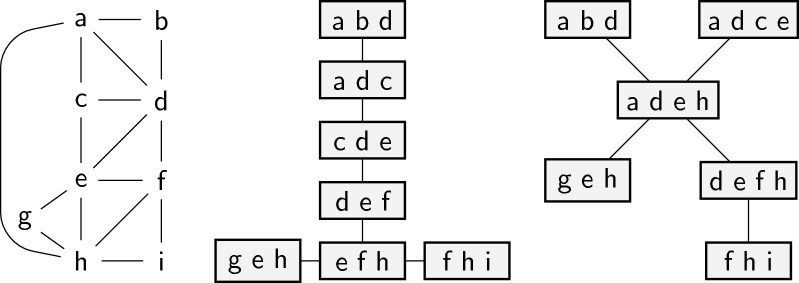
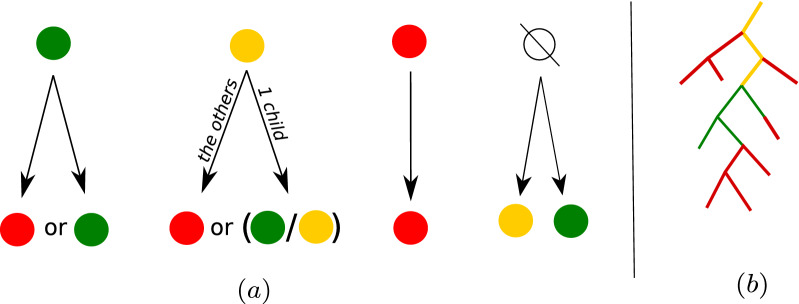
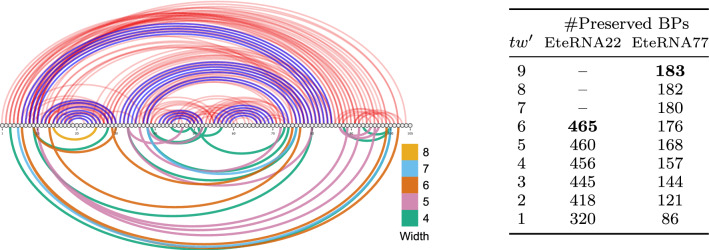
Hard graph problems are ubiquitous in Bioinformatics, inspiring the design of specialized Fixed-Parameter Tractable algorithms, many of which rely on a combination of tree-decomposition and dynamic programming. The time/space complexities of such approaches hinge critically on low values for the treewidth tw of the input graph. In order to extend their scope of applicability, we introduce the TREE-DIET problem, i.e. the removal of a minimal set of edges such that a given tree-decomposition can be slimmed down to a prescribed treewidth [Formula: see text]. Our rationale is that the time gained thanks to a smaller treewidth in a parameterized algorithm compensates the extra post-processing needed to take deleted edges into account. Our core result is an FPT dynamic programming algorithm for TREE-DIET, using [Formula: see text] time and space. We complement this result with parameterized complexity lower-bounds for stronger variants (e.g., NP-hardness when [Formula: see text] or [Formula: see text] is constant). We propose a prototype implementation for our approach which we apply on difficult instances of selected RNA-based problems: RNA design, sequence-structure alignment, and search of pseudoknotted RNAs in genomes, revealing very encouraging results. This work paves the way for a wider adoption of tree-decomposition-based algorithms in Bioinformatics.
困难的图问题在生物信息学中无处不在,这激发了专门的固定参数可处理算法的设计,其中许多算法依赖于树分解和动态规划的结合。此类方法的时间/空间复杂度严重取决于输入图的树宽tw的低值。为了扩展其适用范围,我们引入了树节食(TREE-DIET)问题,即移除最小的边集,以使给定的树分解可以精简到规定的树宽[公式:见正文]。我们的基本原理是,参数化算法中由于较小的树宽而节省的时间补偿了考虑删除边所需的额外后处理。我们的核心结果是一种用于树节食问题的固定参数可处理动态规划算法,使用[公式:见正文]时间和空间。我们用更强变体的参数化复杂度下界(例如,当[公式:见正文]或[公式:见正文]为常数时的NP难性)补充了这一结果。我们为我们的方法提出了一个原型实现,并将其应用于选定的基于RNA问题的困难实例:RNA设计、序列-结构比对以及在基因组中搜索假结RNA,结果非常令人鼓舞。这项工作为基于树分解的算法在生物信息学中的更广泛应用铺平了道路。