
地区贫困与新冠肺炎发病率之间的关联:2020 - 2021年比利时市级时空研究
The association between area deprivation and COVID-19 incidence: a municipality-level spatio-temporal study in Belgium, 2020-2021.
作者信息
Meurisse Marjan, Lajot Adrien, Devleesschauwer Brecht, Van Cauteren Dieter, Van Oyen Herman, Van den Borre Laura, Brondeel Ruben
机构信息
Department of Epidemiology and Public Health, Sciensano, Brussels, Belgium.
Department of Translational Physiology, Infectiology and Public Health, Ghent University, Merelbeke, Belgium.
出版信息
Arch Public Health. 2022 Apr 2;80(1):109. doi: 10.1186/s13690-022-00856-9.
BACKGROUND
In Belgium, current research on socio-economic inequalities in the coronavirus disease 2019 (COVID-19) crisis has mainly focused on excess mortality and data from the first epidemiological wave. The current study adds onto this by examining the association between COVID-19 incidence and area deprivation during the first five wave and interwave periods, thus adding a temporal gradient to the analyses.
METHODS
We use all confirmed COVID-19 cases between March 2020 and June 2021 in Belgium, aggregated at the municipality-level. These data were collected by the national laboratory-based COVID-19 surveillance system. A level of area deprivation was assigned to each Belgian municipality using data of three socio-economic variables: the share of unemployed persons in the active population, the share of households without a car and the share of low-educated persons. The spatio-temporal association between COVID-19 incidence and area deprivation was assessed by performing multivariate negative-binomial regression analyses and computing population attributable fractions.
RESULTS
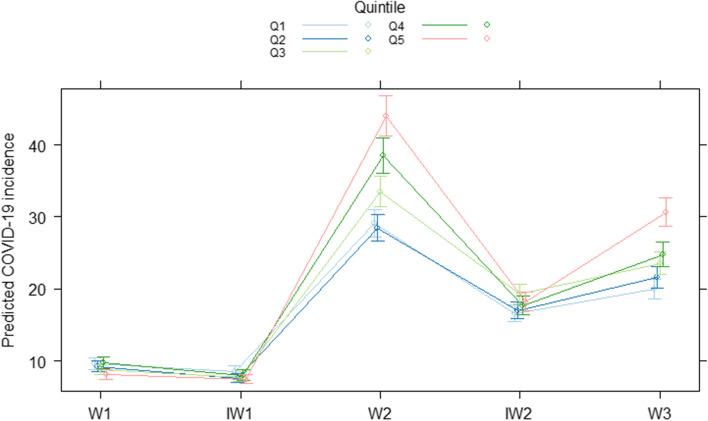
A significant association between COVID-19 incidence and area deprivation was found over the entire study period, with the incidence in the most deprived areas predicted to be 24% higher than in the least deprived areas. This effect was dependent on the period during the COVID-19 crisis. The largest socio-economic inequalities in COVID-19 infections could be observed during wave 2 and wave 3, with a clear disadvantage for deprived areas.
CONCLUSION
Our results provide new insights into spatio-temporal patterns of socio-economic inequalities in COVID-19 incidence in Belgium. They reveal the existence of inequalities and a shift of these patterns over time.
背景
在比利时,目前关于2019冠状病毒病(COVID-19)危机中社会经济不平等的研究主要集中在超额死亡率以及第一波疫情期间的数据。本研究在此基础上进行拓展,通过考察前五波疫情期间及波间期COVID-19发病率与地区贫困程度之间的关联,从而在分析中加入了时间梯度。
方法
我们使用了比利时2020年3月至2021年6月期间所有确诊的COVID-19病例,数据汇总至市镇层面。这些数据由基于国家实验室的COVID-19监测系统收集。利用三个社会经济变量的数据为每个比利时市镇分配一个地区贫困程度等级:活跃人口中的失业人员比例、无车家庭比例以及低学历人员比例。通过进行多变量负二项回归分析和计算人群归因分数,评估COVID-19发病率与地区贫困程度之间的时空关联。
结果
在整个研究期间,发现COVID-19发病率与地区贫困程度之间存在显著关联,预计最贫困地区的发病率比最不贫困地区高24%。这种影响取决于COVID-19危机期间的阶段。在第二波和第三波疫情期间,可以观察到COVID-19感染方面最大的社会经济不平等,贫困地区明显处于劣势。
结论
我们的研究结果为比利时COVID-19发病率的社会经济不平等时空模式提供了新的见解。它们揭示了不平等的存在以及这些模式随时间推移的变化。


 Zotero 插件