Gundelfinger Eckart D, Karpova Anna, Pielot Rainer, Garner Craig C, Kreutz Michael R
Research Group Neuroplasticity, Leibniz Institute for Neurobiology, Magdeburg, Germany.
Institute of Pharmacology and Toxicology, Medical Faculty, Otto von Guericke University, Magdeburg, Germany.
Front Synaptic Neurosci. 2022 Mar 17;14:829354. doi: 10.3389/fnsyn.2022.829354. eCollection 2022.
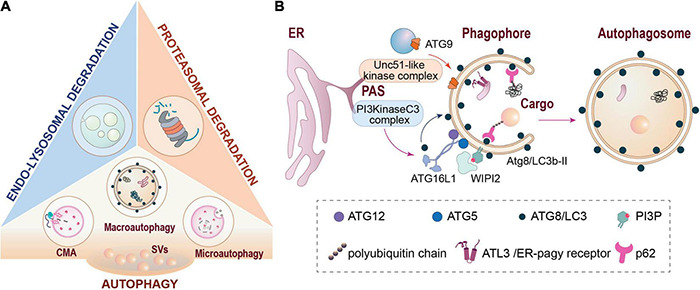
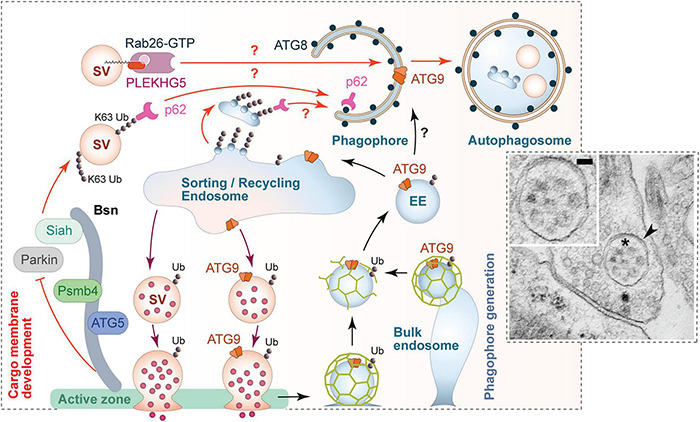
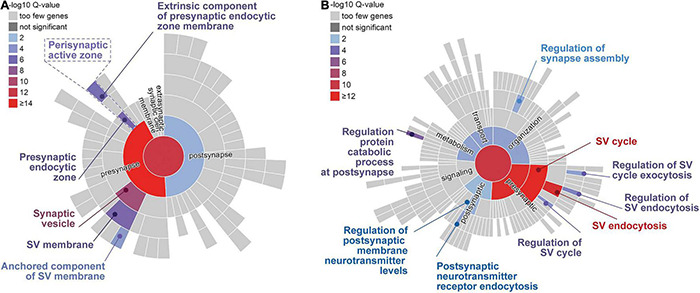
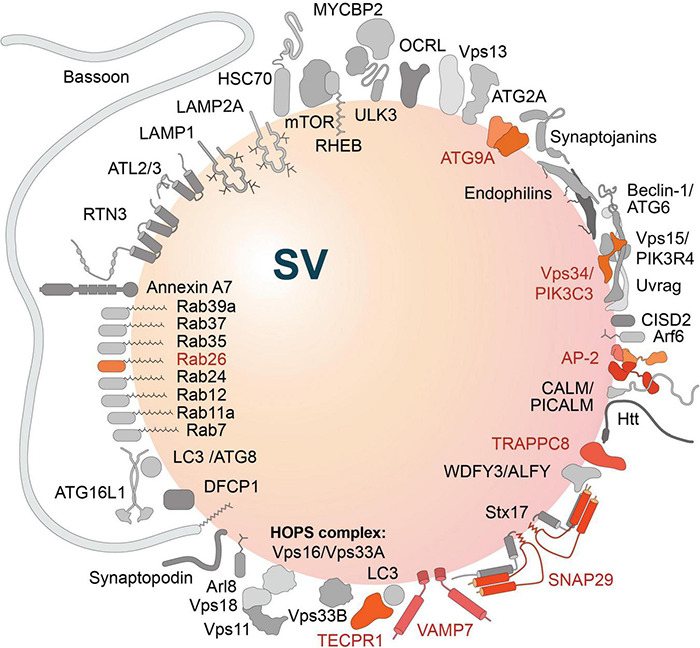
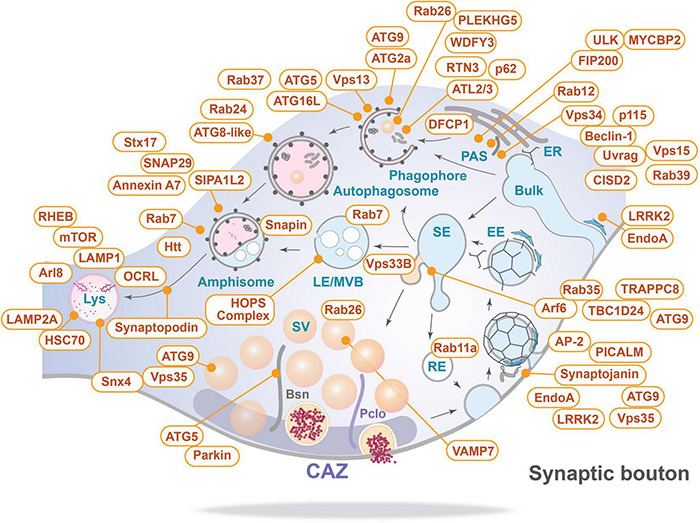
Brain synapses pose special challenges on the quality control of their protein machineries as they are far away from the neuronal soma, display a high potential for plastic adaptation and have a high energy demand to fulfill their physiological tasks. This applies in particular to the presynaptic part where neurotransmitter is released from synaptic vesicles, which in turn have to be recycled and refilled in a complex membrane trafficking cycle. Pathways to remove outdated and damaged proteins include the ubiquitin-proteasome system acting in the cytoplasm as well as membrane-associated endolysosomal and the autophagy systems. Here we focus on the latter systems and review what is known about the spatial organization of autophagy and endolysomal processes within the presynapse. We provide an inventory of which components of these degradative systems were found to be present in presynaptic boutons and where they might be anchored to the presynaptic apparatus. We identify three presynaptic structures reported to interact with known constituents of membrane-based protein-degradation pathways and therefore may serve as docking stations. These are (i) scaffolding proteins of the cytomatrix at the active zone, such as Bassoon or Clarinet, (ii) the endocytic machinery localized mainly at the peri-active zone, and (iii) synaptic vesicles. Finally, we sketch scenarios, how presynaptic autophagic cargos are tagged and recruited and which cellular mechanisms may govern membrane-associated protein turnover in the presynapse.
脑突触对其蛋白质机制的质量控制提出了特殊挑战,因为它们距离神经元胞体很远,具有高度的可塑性适应潜力,并且为完成其生理任务需要大量能量。这尤其适用于突触前部分,神经递质从突触小泡中释放出来,而突触小泡又必须在复杂的膜运输循环中进行回收和重新填充。清除过时和受损蛋白质的途径包括在细胞质中起作用的泛素-蛋白酶体系统以及与膜相关的内溶酶体和自噬系统。在这里,我们重点关注后一种系统,并综述关于突触前自噬和内溶酶体过程的空间组织的已知情况。我们列出了这些降解系统的哪些成分在突触前终扣中被发现,以及它们可能锚定在突触前装置的何处。我们确定了三个据报道与基于膜的蛋白质降解途径的已知成分相互作用、因此可能作为停靠站的突触前结构。它们是:(i)活性区细胞基质的支架蛋白,如巴松管蛋白或单簧管蛋白;(ii)主要位于活性区周围的内吞机制;(iii)突触小泡。最后,我们勾勒出突触前自噬货物如何被标记和募集的情景,以及哪些细胞机制可能控制突触前与膜相关的蛋白质周转。