Division of Nephrology, Department of Medicine, University of Alabama at Birmingham, Birmingham, Alabama.
Department of Medicine, Nephrology Research and Training Center, University of Alabama at Birmingham, Birmingham, Alabama.
Kidney360. 2021 Nov 5;3(1):28-36. doi: 10.34067/KID.0005522021. eCollection 2022 Jan 27.
AKI is a common sequela of infection with SARS-CoV-2 and contributes to the severity and mortality from COVID-19. Here, we tested the hypothesis that kidney alterations induced by COVID-19-associated AKI could be detected in cells collected from urine.
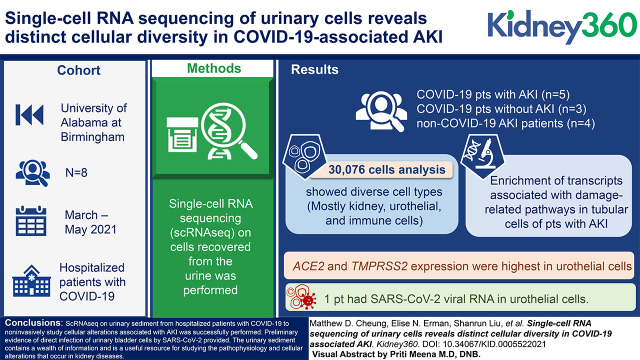
We performed single-cell RNA sequencing (scRNAseq) on cells recovered from the urine of eight hospitalized patients with COVID-19 with (=5) or without AKI (=3) as well as four patients with non-COVID-19 AKI (=4) to assess differences in cellular composition and gene expression during AKI.
Analysis of 30,076 cells revealed a diverse array of cell types, most of which were kidney, urothelial, and immune cells. Pathway analysis of tubular cells from patients with AKI showed enrichment of transcripts associated with damage-related pathways compared with those without AKI. and expression was highest in urothelial cells among cell types recovered. Notably, in one patient, we detected SARS-CoV-2 viral RNA in urothelial cells. These same cells were enriched for transcripts associated with antiviral and anti-inflammatory pathways.
We successfully performed scRNAseq on urinary sediment from hospitalized patients with COVID-19 to noninvasively study cellular alterations associated with AKI and established a dataset that includes both injured and uninjured kidney cells. Additionally, we provide preliminary evidence of direct infection of urinary bladder cells by SARS-CoV-2. The urinary sediment contains a wealth of information and is a useful resource for studying the pathophysiology and cellular alterations that occur in kidney diseases.
急性肾损伤(AKI)是感染 SARS-CoV-2 的常见后遗症,也是导致 COVID-19 严重程度和死亡率升高的原因之一。在此,我们通过检测 COVID-19 相关 AKI 诱导的肾脏改变是否可在尿液中收集的细胞中检测到,以验证假设。
我们对 8 名住院 COVID-19 患者(AKI 组=5 例,非 AKI 组=3 例)和 4 名非 COVID-19 AKI 患者(AKI 组=4 例)尿液中回收的细胞进行单细胞 RNA 测序(scRNAseq),以评估 AKI 期间细胞组成和基因表达的差异。
分析 30076 个细胞揭示了一系列多样化的细胞类型,其中大多数为肾脏、尿路上皮和免疫细胞。与非 AKI 患者相比,AKI 患者肾小管细胞的通路分析显示与损伤相关通路的转录本富集。在所有检测到的细胞类型中,尿路上皮细胞中 和 的表达最高。值得注意的是,在一名患者中,我们在尿路上皮细胞中检测到 SARS-CoV-2 病毒 RNA。这些相同的细胞富集了与抗病毒和抗炎通路相关的转录本。
我们成功地对住院 COVID-19 患者的尿液沉淀物进行了 scRNAseq,以非侵入性地研究与 AKI 相关的细胞改变,并建立了一个包含受损和未受损肾脏细胞的数据集。此外,我们提供了 SARS-CoV-2 直接感染膀胱细胞的初步证据。尿液沉淀物包含丰富的信息,是研究肾脏疾病中发生的病理生理学和细胞改变的有用资源。