Orlova Ekaterina, Smirnova Lyudmila, Nesvizhsky Yuri, Kosenkov Dmitrii, Zykova Elena
Department of Dermatology and Venereology, I. M. Sechenov First Moscow State Medical University, Sechenov University, Moscow, Russia.
Postepy Dermatol Alergol. 2022 Feb;39(1):164-170. doi: 10.5114/ada.2022.113808. Epub 2022 Feb 28.
Quantitative and qualitative changes in the microbiome of the skin affect the emergence and course of allergic diseases, in particular, of acute urticaria.
To investigate the taxonomic composition of the skin microbiota in children with acute urticaria and to study its effect on the course of the disease.
In total, 75 children with diagnosed acute urticaria at the age of 7--14 years were examined. The average age of children was 10.83 ±0.95, of which 44 (58.7%) were boys, and 31 (41.3%) were girls. The control group consisted of 30 virtually healthy children of the appropriate age, of whom 16 (53.3%) were boys, and 13 (46.7%) were girls.
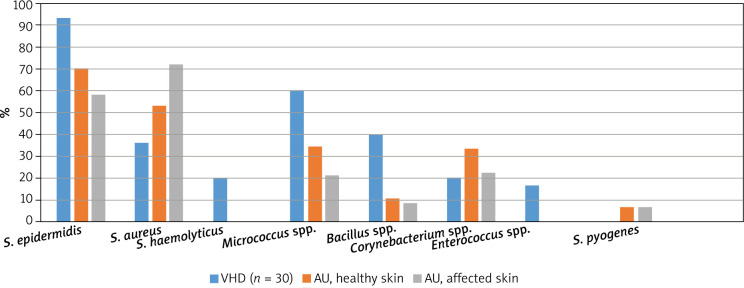
Regardless of the severity of the disease, the examined children suffering from acute urticaria had sensitization in history with a significant prevalence of food sensitization ( < 0.05). The occurrence of a severe episode of acute urticaria is associated with allergens of drug origin in 52.6% of cases and the action of unidentified triggers in 47.4% of cases. In children with acute urticaria, , bacteria of the genus , and dominated on a non-affected skin area, while for the affected skin area, the , bacteria of the genus , and were denoted as dominating.
High frequency of detection on affected and non- affected skin areas in children with acute urticaria is a predictor of the disease severity.
皮肤微生物群的定量和定性变化会影响过敏性疾病的发生和发展过程,尤其是急性荨麻疹。
研究急性荨麻疹患儿皮肤微生物群的分类组成,并探讨其对疾病进程的影响。
共检查了75名7至14岁被诊断为急性荨麻疹的儿童。儿童的平均年龄为10.83±0.95岁,其中44名(58.7%)为男孩,31名(41.3%)为女孩。对照组由30名年龄相仿的健康儿童组成,其中16名(53.3%)为男孩,13名(46.7%)为女孩。
无论疾病的严重程度如何,患有急性荨麻疹的受检儿童既往均有过敏反应,食物过敏的发生率显著较高(<0.05)。52.6%的严重急性荨麻疹发作病例与药物源性过敏原有关,47.4%的病例与不明诱因有关。在急性荨麻疹患儿中,在未受影响的皮肤区域,属、属和属的细菌占主导地位,而在受影响的皮肤区域,属、属的细菌和属被认为占主导地位。
急性荨麻疹患儿在受影响和未受影响的皮肤区域检测到的频率较高是疾病严重程度的一个预测指标。