Department of Biomedical Engineering, Gil Medical Center, Gachon University College of Medicine, Incheon 21565, Republic of Korea.
Department of Ophthalmology, Seoul National University Bundang Hospital, Seoul National University College of Medicine, Seoul 03080, Republic of Korea.
Biomed Res Int. 2022 Mar 24;2022:9840494. doi: 10.1155/2022/9840494. eCollection 2022.
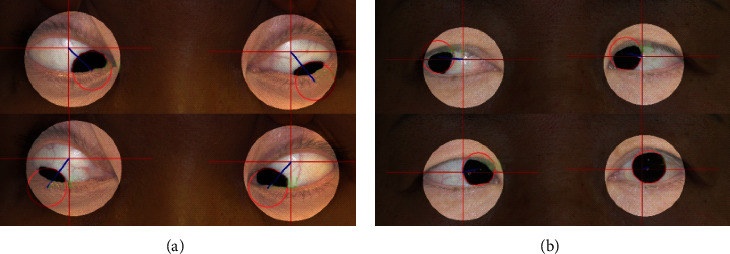
This study presents an automated algorithm that measures ocular deviation quantitatively using photographs of the nine cardinal points of gaze by means of deep learning (DL) and image processing techniques. Photographs were collected from patients with strabismus. The images were used as inputs for the DL segmentation models that segmented the sclerae and limbi. Subsequently, the images were registered for the mathematical algorithm. Two-dimensional sclera and limbus were modeled, and the corneal light reflex points of the primary gaze images were determined. Limbus recognition was performed to measure the pixel-wise distance between the corneal reflex point and limbus center. The segmentation models exhibited high performance, with 96.88% dice similarity coefficient (DSC) for the sclera segmentation and 95.71% DSC for the limbus segmentation. The mathematical algorithm was tested on two cranial nerve palsy patients to evaluate its ability to measure and compare ocular deviation in different directions. These results were consistent with the symptoms of such disorders. This algorithm successfully measured the distance of ocular deviation in patients with strabismus. With complementation in the dimension calculations, we expect that this algorithm can be used further in clinical settings to diagnose and measure strabismus at a low cost.
本研究提出了一种使用深度学习(DL)和图像处理技术通过拍摄眼球的九个方位的照片来定量测量眼球偏斜的自动算法。这些照片是从斜视患者身上采集的。这些图像被用作 DL 分割模型的输入,用于分割巩膜和角膜缘。然后,对图像进行配准以进行数学算法。建立二维巩膜和角膜缘模型,并确定原发性注视图像的角膜光反射点。进行角膜缘识别以测量角膜反射点和角膜缘中心之间的像素级距离。分割模型表现出很高的性能,巩膜分割的 Dice 相似系数(DSC)为 96.88%,角膜缘分割的 DSC 为 95.71%。该数学算法在两名颅神经麻痹患者身上进行了测试,以评估其测量和比较不同方向眼球偏斜的能力。这些结果与这些疾病的症状一致。该算法成功地测量了斜视患者的眼球偏斜距离。通过在维度计算方面的补充,我们期望该算法能够进一步在临床环境中用于以低成本诊断和测量斜视。