Division of Kidney and Pancreas Transplantation, Department of Surgery, Vanderbilt University Medical Center, Nashville, Tennessee.
Division of Nephrology and Hypertension, Department of Medicine, Vanderbilt University Medical Center, Nashville, Tennessee.
Kidney360. 2020 Oct 30;1(12):1419-1425. doi: 10.34067/KID.0003212020. eCollection 2020 Dec 31.
As the organ-shortage crisis continues to worsen, many patients in need of a kidney transplant have turned to social media to find a living donor. The effect of social media on living kidney donation is not known. The goal of this study is to investigate the influence of social media on those interested in donating a kidney.
Self-referrals for living kidney donation from December 2016 to March 2019 were retrospectively reviewed. Age, sex, race, and relationship of individuals petitioned through social media (SM) were compared with those petitioned through verbal communication (VC). Data were analyzed using chi-squared tests, with z tests of column proportions, and multivariable logistic regression.
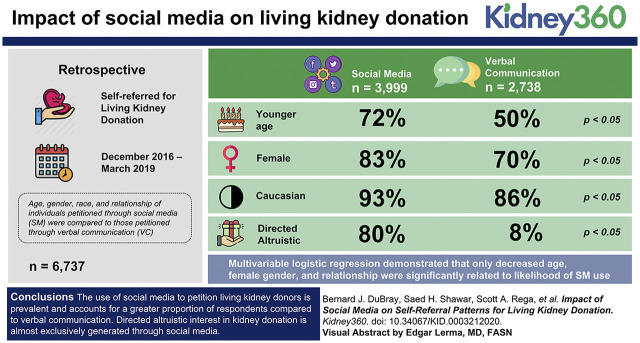
A total of 7817 individuals (53% SM, 36% VC, and 10% other) were self-referred for living kidney donation. The analysis sample included 6737 adults petitioned through SM (=3999) or VC (=2738). Half (=3933) of the individuals reported an altruistic relationship, and 94% of these respondents were petitioned through SM. Although univariate analyses indicated that SM respondents were younger, more likely female, more likely White, and more likely to have directed altruistic intent than those petitioned through VC (all <0.05), multivariable logistic regression demonstrated that only decreased age, female sex, and relationship were significantly related to likelihood of SM use (all <0.001).
The use of SM to petition living kidney donors is prevalent and accounts for a greater proportion of respondents compared with VC. SM respondents tend to be younger, female, and altruistic compared with VC. Directed altruistic interest in kidney donation is almost exclusively generated through SM.
随着器官短缺危机的持续恶化,许多需要肾移植的患者已经转向社交媒体寻找活体捐献者。社交媒体对活体肾脏捐献的影响尚不清楚。本研究的目的是调查社交媒体对有兴趣捐献肾脏的人的影响。
回顾性分析 2016 年 12 月至 2019 年 3 月期间的活体肾脏捐献自我推荐。通过社交媒体(SM)和口头交流(VC)申请的个体的年龄、性别、种族和关系进行比较。采用卡方检验、列比例 z 检验和多变量逻辑回归进行数据分析。
共有 7817 人(53%SM、36%VC 和 10%其他)自我推荐接受活体肾脏捐献。分析样本包括通过 SM(=3999)或 VC(=2738)申请的 6737 名成年人。一半(=3933)的人报告了利他关系,其中 94%的人是通过 SM 申请的。虽然单变量分析表明,SM 受访者更年轻、更可能是女性、更可能是白人、更可能有明确的利他意向,但多变量逻辑回归表明,只有年龄减小、女性和关系与 SM 的使用显著相关(均<0.001)。
使用 SM 来请求活体肾脏捐献者很普遍,并且与 VC 相比,SM 的回复者比例更高。与 VC 相比,SM 受访者往往更年轻、女性化且更利他。对肾脏捐献的定向利他兴趣几乎完全通过 SM 产生。