Department of Kidney Disease and Hypertension, Osaka General Medical Center, Osaka, Japan.
KAGAMI Project, National Institutes of Biomedical Innovation, Health and Nutrition (NIBIOHN), Ibaraki, Japan.
Kidney360. 2021 Sep 9;2(11):1734-1742. doi: 10.34067/KID.0004282021. eCollection 2021 Nov 25.
The diagnosis of diabetic nephropathy (DN), the major cause of ESKD, requires kidney biopsy. d-Serine, present only in trace amounts in humans, is a biomarker for kidney diseases and shows potential to distinguish the origin of kidney diseases, whose diagnoses usually require kidney biopsy. We extended this concept and examined the potential of d-serine in the diagnosis of DN.
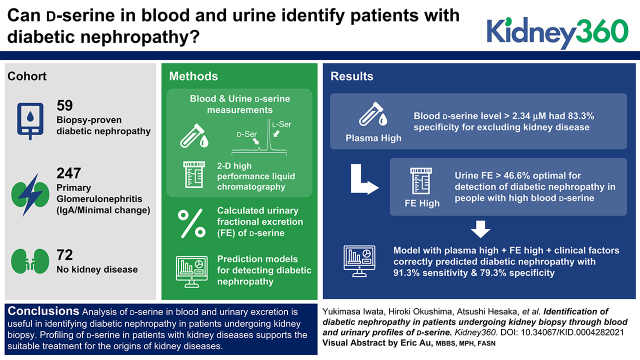
We enrolled patients with biopsy sample-proven DN and primary GN (minimal change disease and IgA nephropathy) and participants without kidney disease. A total of 388 participants were included in this study, and d-serine levels in blood and urine were measured using two-dimensional high-performance liquid chromatography, and urinary fractional excretion (FE) of d-serine was calculated. Using data from 259 participants, we developed prediction models for detecting DN by logistic regression analyses, and the models were validated in 129 participants.
A d-serine blood level of >2.34 M demonstrated a high specificity of 83% (95% CI, 70% to 93%) for excluding participants without kidney diseases. In participants with a d-serine blood level >2.34 M, the threshold of 47% in FE of d-serine provided an optimal threshold for the detection of DN (AUC, 0.85 [95% CI, 0.76 to 0.95]; sensitivity, 79% [95% CI, 61% to 91%]; specificity, 83% [95% CI, 67% to 94%]). This plasma-high and FE-high profile of d-serine in combination with clinical factors (age, sex, eGFR, and albuminuria) correctly predicted DN with a sensitivity of 91% (95% CI, 72% to 99%) and a specificity of 79% (95% CI, 63% to 80%), and outperformed the model based on clinical factors alone in the validation dataset (<0.02).
Analysis of d-serine in blood and urinary excretion is useful in identifying DN in patients undergoing kidney biopsy. Profiling of d-serine in patients with kidney diseases supports the suitable treatment through the auxial diagnosis of the origins of kidney diseases.
糖尿病肾病(DN)是终末期肾病(ESKD)的主要病因,其诊断需要进行肾活检。d-丝氨酸在人类体内仅以痕量存在,是一种肾脏疾病的生物标志物,具有区分肾脏疾病起源的潜力,而这些疾病的诊断通常需要进行肾活检。我们扩展了这一概念,并研究了 d-丝氨酸在 DN 诊断中的应用。
我们纳入了经活检证实的 DN 和原发性肾小球肾炎(微小病变性肾病和 IgA 肾病)患者以及无肾脏疾病的参与者。本研究共纳入 388 名参与者,使用二维高效液相色谱法测量血液和尿液中的 d-丝氨酸水平,并计算尿液中 d-丝氨酸的分数排泄率(FE)。使用 259 名参与者的数据,我们通过逻辑回归分析建立了用于检测 DN 的预测模型,并在 129 名参与者中进行了验证。
d-丝氨酸血水平>2.34μM 对排除无肾脏疾病的参与者具有 83%(95%CI,70%至 93%)的高特异性。在 d-丝氨酸血水平>2.34μM 的参与者中,d-丝氨酸 FE 的 47%阈值为 DN 的最佳检测阈值(AUC,0.85[95%CI,0.76 至 0.95];敏感性,79%[95%CI,61%至 91%];特异性,83%[95%CI,67%至 94%])。这种血浆高和 FE 高的 d-丝氨酸谱与临床因素(年龄、性别、eGFR 和蛋白尿)相结合,可正确预测 DN,其敏感性为 91%(95%CI,72%至 99%),特异性为 79%(95%CI,63%至 80%),在验证数据集中优于基于临床因素的模型(<0.02)。
分析血液和尿液中 d-丝氨酸的水平有助于在进行肾活检的患者中识别 DN。对肾脏疾病患者的 d-丝氨酸谱进行分析,通过辅助诊断肾脏疾病的起源,支持对肾脏疾病进行适当的治疗。