Kellerman John K, Hamilton Jessica L, Selby Edward A, Kleiman Evan M
Department of Psychology, Rutgers, The State University of New Jersey, Piscataway, NJ, United States.
JMIR Ment Health. 2022 May 25;9(5):e36966. doi: 10.2196/36966.
Consumption of distressing news media, which substantially increased during the COVID-19 pandemic, has demonstrable negative effects on mental health.
This study examines the proximal impact of daily exposure to news about COVID-19 on mental health in the first year of the pandemic.
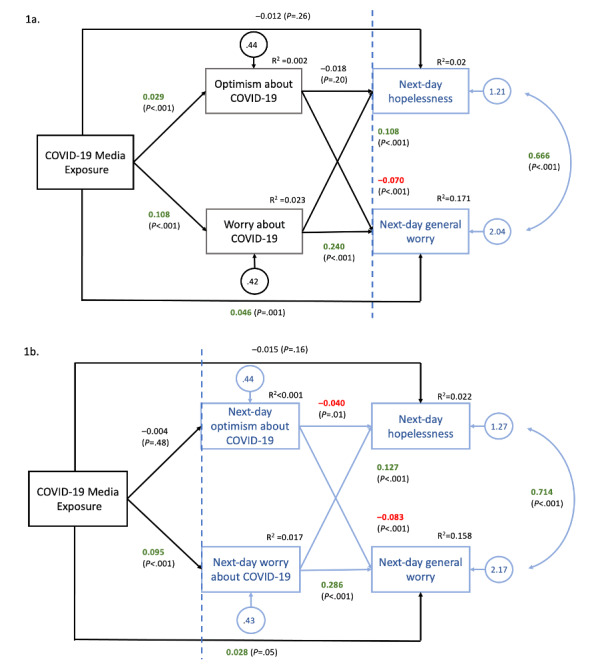
A sample of 546 college students completed daily ecological momentary assessments (EMAs) for 8 weeks, measuring exposure to news about COVID-19, worry and optimism specifically related to COVID-19, hopelessness, and general worry.
Participants completed >80,000 surveys. Multilevel mediation models indicated that greater daily exposure to news about COVID-19 is associated with higher same-day and next-day worry about the pandemic. Elevations in worry specifically about COVID-19 were in turn associated with greater next-day hopelessness and general worry. Optimism about COVID-19 mediated the relationship between daily exposure to COVID-19 news and next-day general worry but was not related to hopelessness.
This study demonstrates the mental health impact of daily exposure to COVID-19 news and highlights how worry about the pandemic contributes over time to hopelessness and general worry.
在新冠疫情期间大幅增加的令人痛苦的新闻媒体消费,已被证明会对心理健康产生负面影响。
本研究考察了在疫情第一年中,每日接触新冠疫情新闻对心理健康的近期影响。
546名大学生样本连续8周完成了每日生态瞬时评估(EMA),测量其接触新冠疫情新闻的情况、与新冠疫情具体相关的担忧和乐观情绪、绝望感以及总体担忧程度。
参与者完成了超过80000份调查。多层次中介模型表明,每日更多地接触新冠疫情新闻与当天及次日对疫情的更高担忧相关。对新冠疫情的担忧加剧反过来又与次日更强烈的绝望感和总体担忧相关。对新冠疫情的乐观情绪在每日接触新冠疫情新闻与次日总体担忧之间起到了中介作用,但与绝望感无关。
本研究证明了每日接触新冠疫情新闻对心理健康的影响,并突出了对疫情的担忧如何随着时间推移导致绝望感和总体担忧。