Kleiman Evan M, Yeager April L, Grove Jeremy L, Kellerman John K, Kim Joanne S
Rutgers, The State University of New Jersey, Piscataway, NJ, United States.
JMIR Ment Health. 2020 Dec 15;7(12):e24815. doi: 10.2196/24815.
College students' mental health may be disproportionally affected by the COVID-19 pandemic because of the abrupt shift off campus and subsequent loss of a social network and potential long-term impact on job prospects.
We sought to assess the nature of COVID-19's mental health impact among a sample of undergraduates who were experiencing the pandemic as it occurred in real time.
In total, 140 college students completed smartphone-based ecological momentary assessments of anxiety and optimism related to COVID-19 and other generic mental health variables 6 times daily.
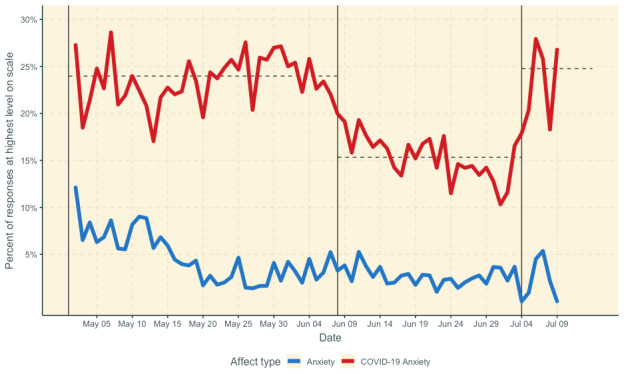
Participants completed >23,750 surveys. Overall, >75% of these surveys indicated at least some level of anxiety about COVID-19. On average, the proportion of responses each day at the highest levels of anxiety about COVID-19 was 7 times greater than the proportion of responses at the highest levels of non-COVID-19-specific anxiety. Structural change analyses indicated a significant downward trend in COVID-19 anxiety after the first week of June, but even at the lowest point, >15% of the participants in the sample still reported high levels of COVID-19 anxiety each day. Participants felt more anxious about COVID-19 on days when the number of new cases and deaths due to COVID-19 were higher. When participants felt anxious about COVID-19, they also felt sad, anxious (in general), and had a greater desire to drink and use drugs. Participants felt more optimistic about COVID-19 when they received more support from others and from their university.
This study demonstrated the widespread mental health impact that COVID-19 has had on college students.
由于突然离开校园,随后失去社交网络以及对就业前景可能产生的长期影响,大学生的心理健康可能受到新冠疫情的不成比例的影响。
我们试图评估新冠疫情对实时经历该疫情的本科生样本心理健康影响的性质。
共有140名大学生每天6次完成基于智能手机的与新冠疫情相关的焦虑和乐观情绪以及其他一般心理健康变量的生态瞬时评估。
参与者完成了超过23750份调查。总体而言,这些调查中超过75%表明对新冠疫情至少有一定程度的焦虑。平均而言,每天对新冠疫情最高焦虑水平的回复比例比非新冠疫情特定最高焦虑水平的回复比例高7倍。结构变化分析表明,6月的第一周后,新冠疫情焦虑呈显著下降趋势,但即使在最低点,样本中仍有超过15%的参与者每天报告高水平的新冠疫情焦虑。当新冠疫情的新增病例数和死亡数较高时,参与者对新冠疫情感到更焦虑。当参与者对新冠疫情感到焦虑时,他们也会感到悲伤、焦虑(总体上),并且有更大的饮酒和吸毒欲望。当参与者从他人和大学获得更多支持时,他们对新冠疫情感到更乐观。
本研究证明了新冠疫情对大学生心理健康的广泛影响。