School of Medicine, Hawassa University, Hawassa, Ethiopia.
School of Medical Laboratory Sciences, Jimma University, Jimma, Ethiopia.
PLoS Negl Trop Dis. 2022 Apr 4;16(4):e0010307. doi: 10.1371/journal.pntd.0010307. eCollection 2022 Apr.
It remains largely unknown where and how infections with soil-transmitted helminths (STHs; Ascaris, Trichuris, Necator and Ancylostoma) occur. We therefore aimed to identify possible sources of infection by assessing the environmental contamination in an STH-endemic area.
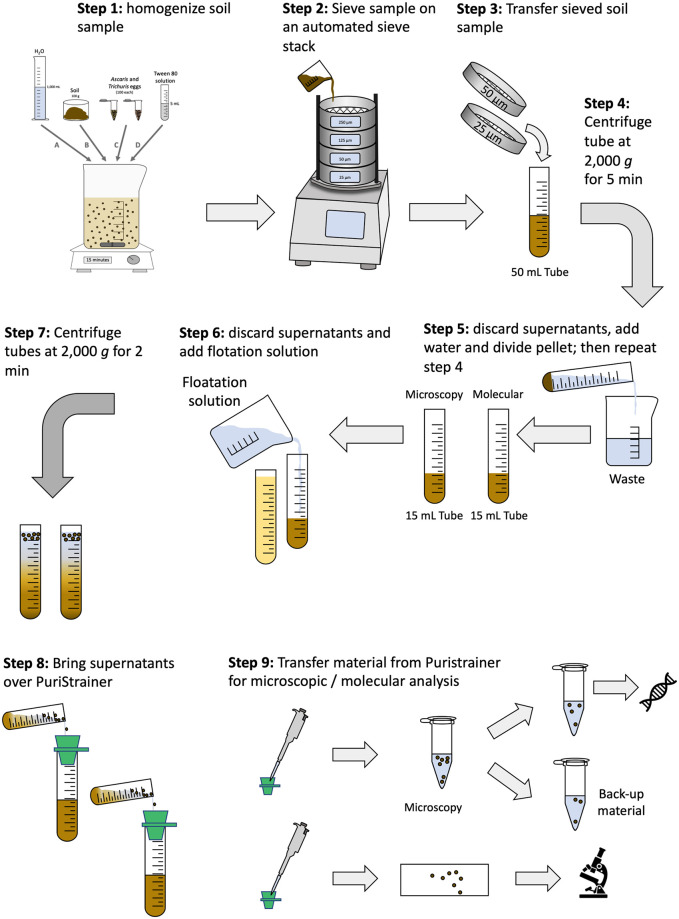
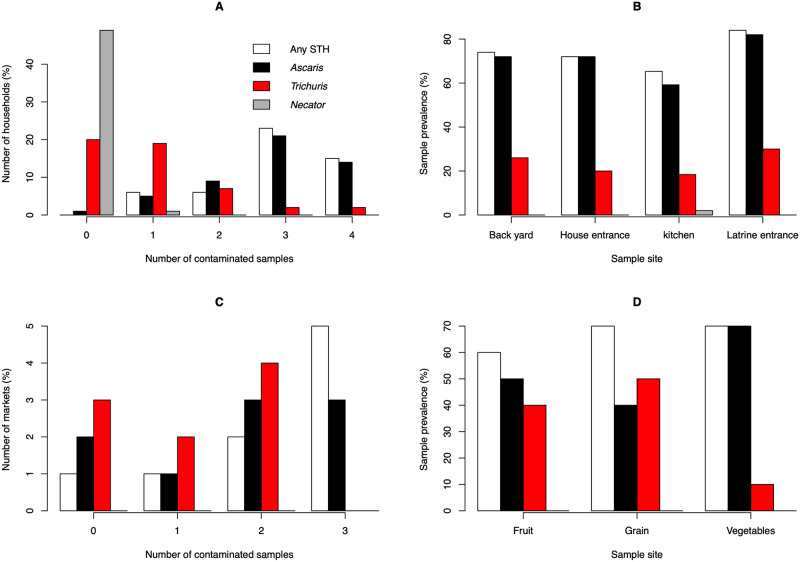
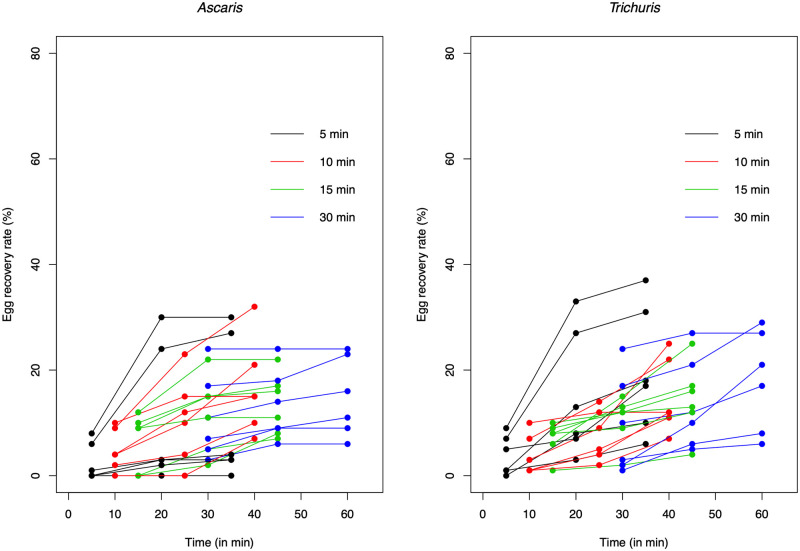
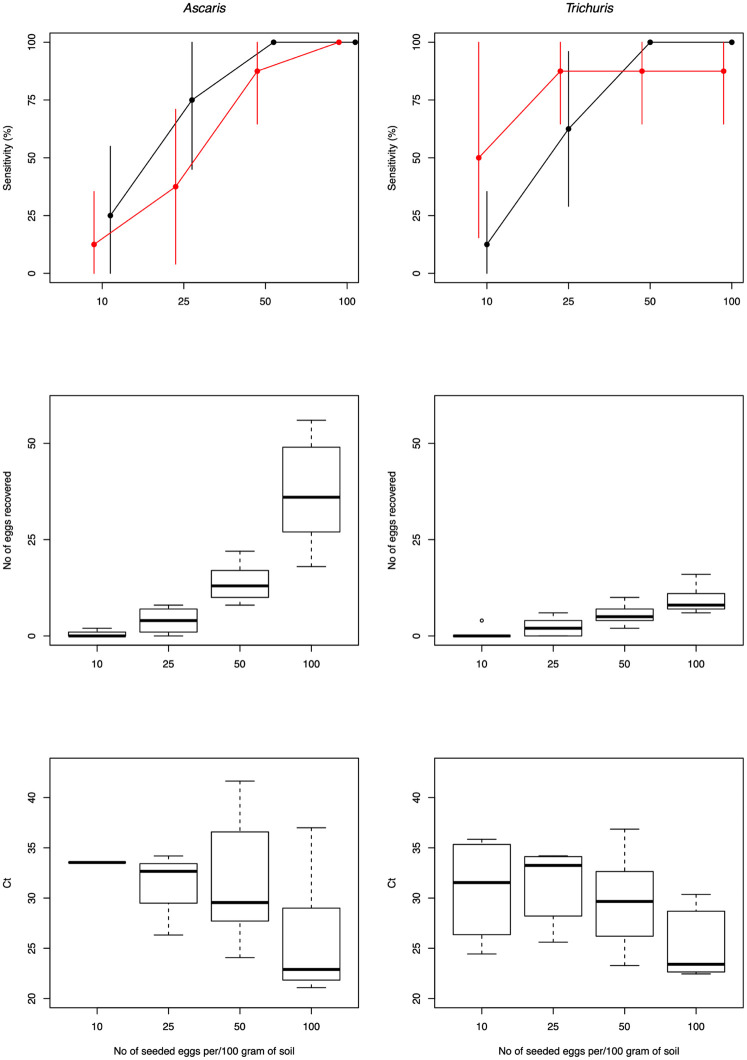
We first performed a series of laboratory experiments designed to optimize a soil straining-flotation method to detect and quantify Ascaris and Trichuris eggs in soil, and to validate the diagnostic performance of the optimized method when followed by microscopy and qPCR. In a second phase, we applied this method to assess the level of STH contamination in 399 environmental samples collected from 10 school compounds, 50 households and 9 open markets in Jimma Town (Ethiopia). Subsequently, we explored associations between the environmental contamination and both the corresponding STH epidemiology at the level of the schools and the household characteristics. Finally, we assessed the knowledge, attitude and practice (KAP) towards STHs in school children.
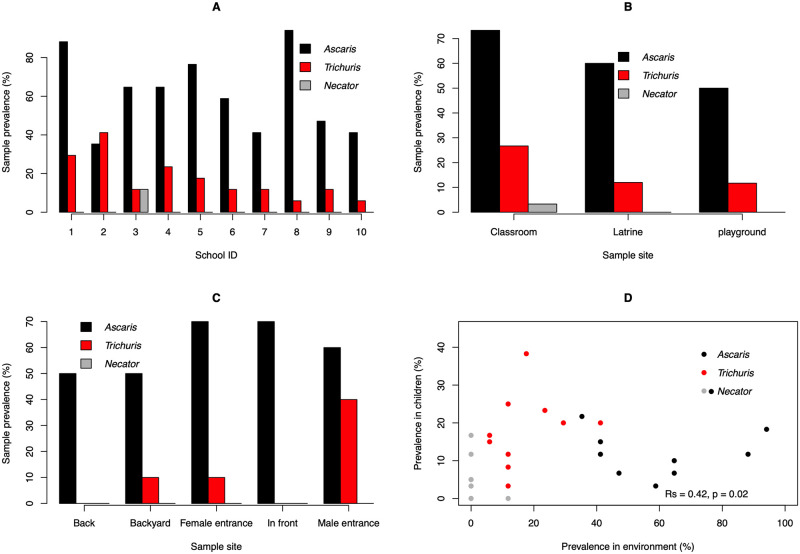
Our soil straining-flotation method has an analytical sensitivity of 50 eggs per 100 grams of soil and egg recovery rate of 36.0% (Ascaris) and 8.0% (Trichuris). The analysis of field samples with both microscopy and qPCR revealed the presence of 8 different helminth species of medical importance, including but not limited to the human STHs. There was a significant association between the environmental contamination and prevalence of any STH infections at the school level only. The KAP indicated a lack of knowledge and awareness of STHs.
CONCLUSIONS/SIGNIFICANCE: Our optimized straining-flotation method has a moderate diagnostic performance and revealed that life stages of helminths are ubiquitous in the environment, which might be due to the poor sanitary facilities at both the schools and the households, and a poor level of KAP towards STHs. Further research is required to gain more insights into the contribution of these life stages to transmission.
土壤传播性蠕虫(STHs;蛔虫、鞭虫、钩虫和十二指肠钩虫)的感染来源和途径在很大程度上仍不清楚。因此,我们旨在通过评估 STH 流行地区的环境污染来确定可能的感染源。
我们首先进行了一系列实验室实验,旨在优化一种土壤过滤浮选法,以检测和量化土壤中的蛔虫和鞭虫卵,并验证优化方法在显微镜和 qPCR 检测后的诊断性能。在第二阶段,我们应用该方法评估了从吉姆马镇(埃塞俄比亚)的 10 所学校场地、50 户家庭和 9 个露天市场收集的 399 个环境样本中 STH 的污染水平。随后,我们探索了环境污染与学校层面的 STH 流行病学以及家庭特征之间的关联。最后,我们评估了在校儿童对 STH 的知识、态度和实践(KAP)。
我们的土壤过滤浮选法具有 50 个虫卵/100 克土壤的分析灵敏度和 36.0%(蛔虫)和 8.0%(鞭虫)的卵回收率。通过显微镜和 qPCR 分析现场样本显示,存在 8 种不同的具有医学重要性的寄生虫,包括但不限于人类 STH。仅在学校层面上,环境污染与任何 STH 感染的流行率之间存在显著关联。KAP 表明对 STH 缺乏了解和认识。
结论/意义:我们优化的过滤浮选法具有中等的诊断性能,表明寄生虫的生活阶段在环境中普遍存在,这可能是由于学校和家庭的卫生设施较差,以及对 STH 的 KAP 水平较低。需要进一步研究以更深入了解这些生活阶段对传播的贡献。