University of Iowa, Department of Psychological and Brain Sciences, G60 Psychological and Brain Sciences Building, 340 Iowa Avenue, Iowa City, IA, 52246, USA.
University of Iowa, Department of Psychological and Brain Sciences, G60 Psychological and Brain Sciences Building, 340 Iowa Avenue, Iowa City, IA, 52246, USA.
J Psychiatr Res. 2022 Jun;150:142-146. doi: 10.1016/j.jpsychires.2022.03.030. Epub 2022 Mar 28.
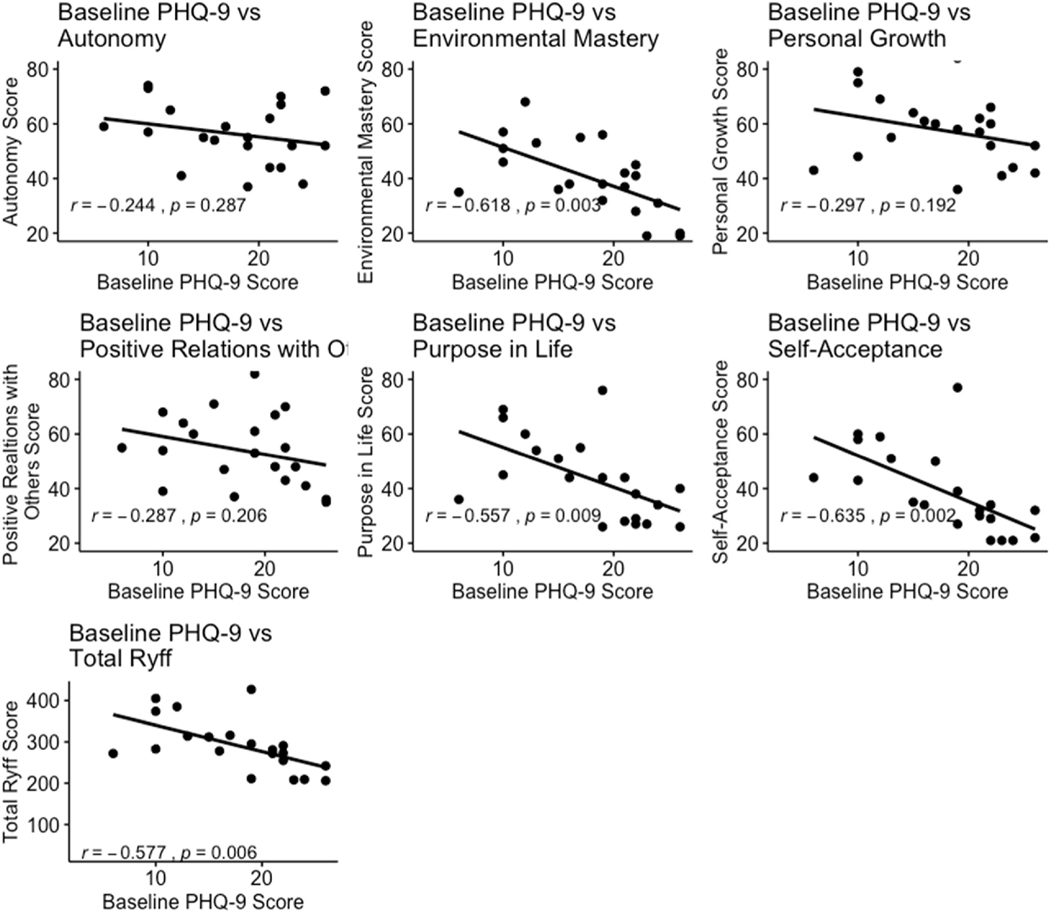
Treatment resistant depression (TRD) is a complex condition associated with a great deal of disability and suffering. The relationship between TRD and psychological well-being (PWB) appears to be more complex than a simple antithesis. Transcranial magnetic stimulation (TMS) is a well-tolerated treatment for TRD. However successful, a drawback for TMS is that it has a lack of predictive biomarkers for treatment response. Our study focuses on the relationship between PWB and treatment resistant depression, and how PWB relates to TMS treatment response. We hypothesized that TMS treatment responders would have higher levels of PWB at baseline. In this study of 21 patients with TRD, we used the Ryff Scales of Psychological Well-Being and Patient Health Questionnaire-9 (PHQ-9). We found a significant relationship between environmental mastery, purpose in life, self-acceptance, and total PWB with baseline depression but no significant correlation between autonomy, personal growth, and positive relations with others and baseline PHQ-9 scores. No Ryff domain of PWB significantly predicted change in PHQ-9 score. Interestingly, however, we found that TMS responders had higher levels of autonomy (M(SD) = 62.10(10.46), p = 0.022) and personal growth (M(SD) = 65.00(11.04), p = 0.007) than non-responders at baseline. These specific aspects of well-being appear to be distinct from depression and particularly important in treatment response. This discovery suggests that assessing PWB might prove clinically useful when assessing future candidates for TMS treatment of TRD. Further research is necessary to evaluate the effects of TMS on PWB since these may be distinct from its effect on depression symptomology.
治疗抵抗性抑郁症(TRD)是一种与大量残疾和痛苦相关的复杂疾病。TRD 与心理幸福感(PWB)之间的关系似乎比简单的对立更为复杂。经颅磁刺激(TMS)是一种治疗 TRD 的耐受性良好的方法。然而,TMS 的一个缺点是它缺乏治疗反应的预测生物标志物。我们的研究重点是 PWB 与治疗抵抗性抑郁症之间的关系,以及 PWB 如何与 TMS 治疗反应相关。我们假设 TMS 治疗反应者在基线时会有更高水平的 PWB。在这项对 21 名 TRD 患者的研究中,我们使用了 Ryff 心理幸福感量表和患者健康问卷-9(PHQ-9)。我们发现,环境掌控、生活目的、自我接纳和总体 PWB 与基线抑郁之间存在显著关系,但自主性、个人成长和与他人的积极关系与基线 PHQ-9 评分之间没有显著相关性。PWB 的 Ryff 没有一个领域能够显著预测 PHQ-9 评分的变化。有趣的是,然而,我们发现 TMS 反应者在基线时的自主性(M(SD)=62.10(10.46),p=0.022)和个人成长(M(SD)=65.00(11.04),p=0.007)水平高于非反应者。这些幸福感的具体方面似乎与抑郁不同,在治疗反应中尤为重要。这一发现表明,在评估未来接受 TMS 治疗 TRD 的候选者时,评估 PWB 可能具有临床意义。需要进一步研究来评估 TMS 对 PWB 的影响,因为这可能与它对抑郁症状学的影响不同。