Department of Pediatrics, Michigan Medicine, 1500 E. Medical Center Dr, Ann Arbor, MI, 48109, USA.
C.S. Mott Children's Hospital, University of Michigan Congenital Heart Center, Ann Arbor, MI, USA.
Pediatr Cardiol. 2022 Oct;43(7):1568-1577. doi: 10.1007/s00246-022-02884-2. Epub 2022 Apr 4.
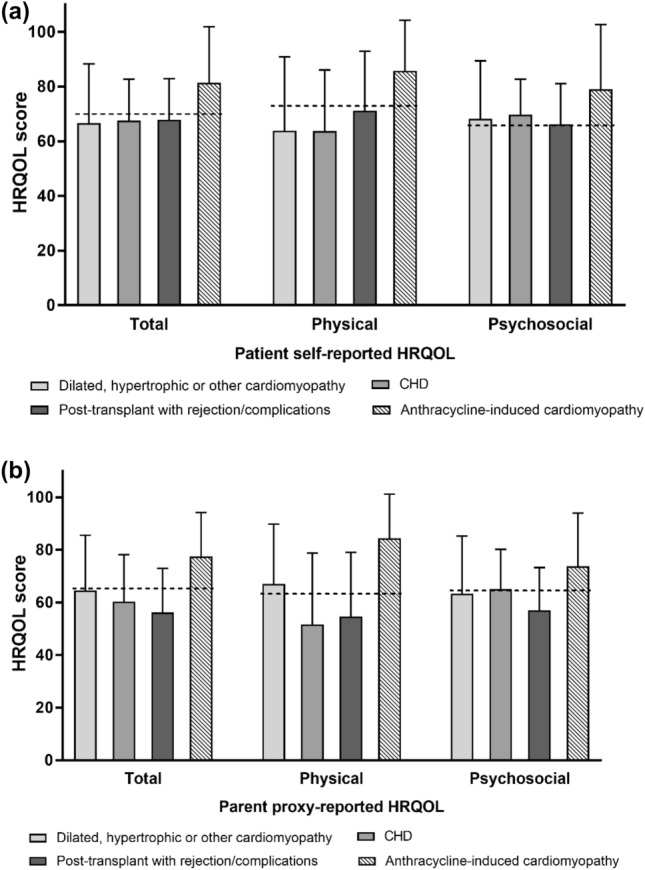
Health-related quality of life (HRQOL) is an important clinical and research trial endpoint in adult heart failure and has been shown to predict mortality and hospitalizations in adult heart failure populations. HRQOL has not been adequately studied in the growing pediatric and young adult heart failure population. This study described HRQOL in adolescents and young adults (AYAs) with heart failure and examined primary disease, sex, race, and other correlates of HRQOL in this sample. Participants in this cross-sectional, single-center study included adolescent and young adults with heart failure and a parent/guardian. Patients and their parent/proxies completed the PedsQL, a well-established measure of HRQOL in pediatric chronic illness populations. HRQOL is impaired in AYAs with heart failure resulting from dilated, hypertrophic, or other cardiomyopathy, congenital heart disease, or post-transplant with rejection/complications. Patients identifying as white endorsed poorer total HRQOL than non-white patients (p = 0.002). Subscale analysis revealed significant correlations between female sex (p = 0.01) and white race (p = 0.01) with poorer self-reported physical functioning. Family income was unrelated to HRQOL. Functional status was strongly associated with total (p = 0.0003) and physical HRQOL (p < 0.0001). Sociodemographic and disease-specific risk and resilience factors specific to HRQOL in AYAs with heart failure include primary cardiac disease, race, sex, and functional status. Building upon extensive work in adult heart failure, utilization, and study of HRQOL as a clinical and research trial outcome is necessary in pediatric heart failure. Developing targeted interventions for those at greatest risk of impaired HRQOL is an important next step.
健康相关生活质量(HRQOL)是成人心力衰竭的重要临床和研究试验终点,并已被证明可预测成人心力衰竭人群的死亡率和住院率。HRQOL 在不断增长的儿科和年轻成年心力衰竭人群中尚未得到充分研究。本研究描述了心力衰竭青少年和年轻成人(AYAs)的 HRQOL,并检查了该样本中主要疾病、性别、种族和其他 HRQOL 相关因素。这项横断面、单中心研究的参与者包括心力衰竭的青少年和年轻成人以及他们的父母/监护人。患者及其父母/代理人完成了 PedsQL,这是一种在儿科慢性疾病人群中广泛使用的 HRQOL 测量工具。由于扩张型、肥厚型或其他心肌病、先天性心脏病或移植后排斥/并发症导致心力衰竭的 AYAs 的 HRQOL 受损。自认为是白人的患者的总 HRQOL 评分低于非白人患者(p=0.002)。亚量表分析显示,女性性别(p=0.01)和白人种族(p=0.01)与自我报告的身体机能较差之间存在显著相关性。家庭收入与 HRQOL 无关。功能状态与总 HRQOL(p=0.0003)和身体 HRQOL(p<0.0001)密切相关。与心力衰竭 AYAs 的 HRQOL 相关的特定于特定于疾病的风险和复原力因素包括主要心脏疾病、种族、性别和功能状态。在成人心力衰竭的广泛工作基础上,将 HRQOL 作为临床和研究试验结果的利用和研究是小儿心力衰竭的必要步骤。为那些 HRQOL 受损风险最大的人制定有针对性的干预措施是下一步的重要步骤。