Hengkrawit Kitchawan, Tangjade Chidchanok
Pediatric Infectious Disease Unit, Department of Pediatrics, Panyananthaphikkhu Chonprathan Medical Center, Srinakarinwirot University, Nonthaburi, Thailand.
Pediatrics Gastroenterology and Hepatology Unit, Department of Pediatrics, Panyananthaphikkhu Chonprathan Medical Center, Srinakarinwirot University, Nonthaburi, Thailand.
Infect Drug Resist. 2022 Mar 29;15:1305-1315. doi: 10.2147/IDR.S355213. eCollection 2022.
Multi-drug resistance of non-typhoidal (MDR-NTS) is an increasing threat worldwide. In Thailand, data for the past decade is limited. This research is to determine the prevalence and trends of nonsusceptibility patterns of the bacteria, especially to ciprofloxacin and ceftriaxone.
This retrospective study was extracted data of patients who had non-typhoidal (NTS) infection, from 10 hospitals between June 2011 and June 2020. Demographic data, culture reports, and antimicrobial susceptibility were included in the analysis.
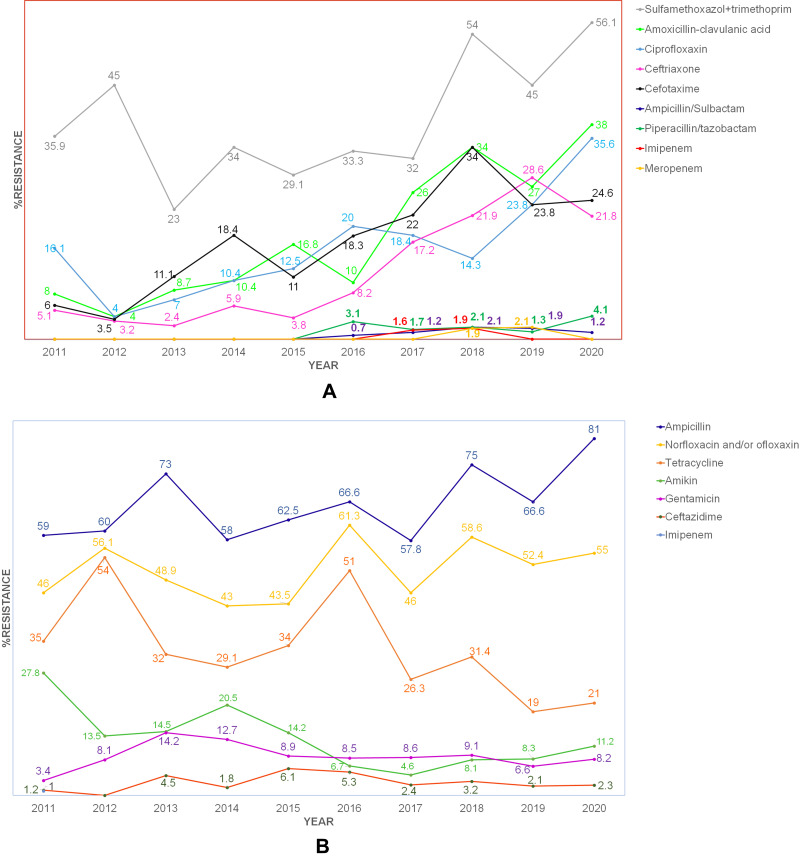
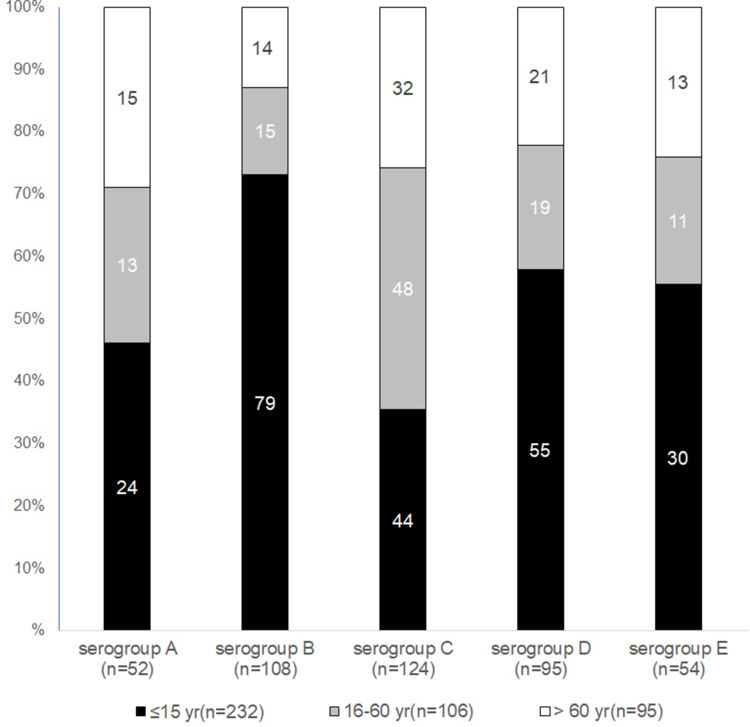
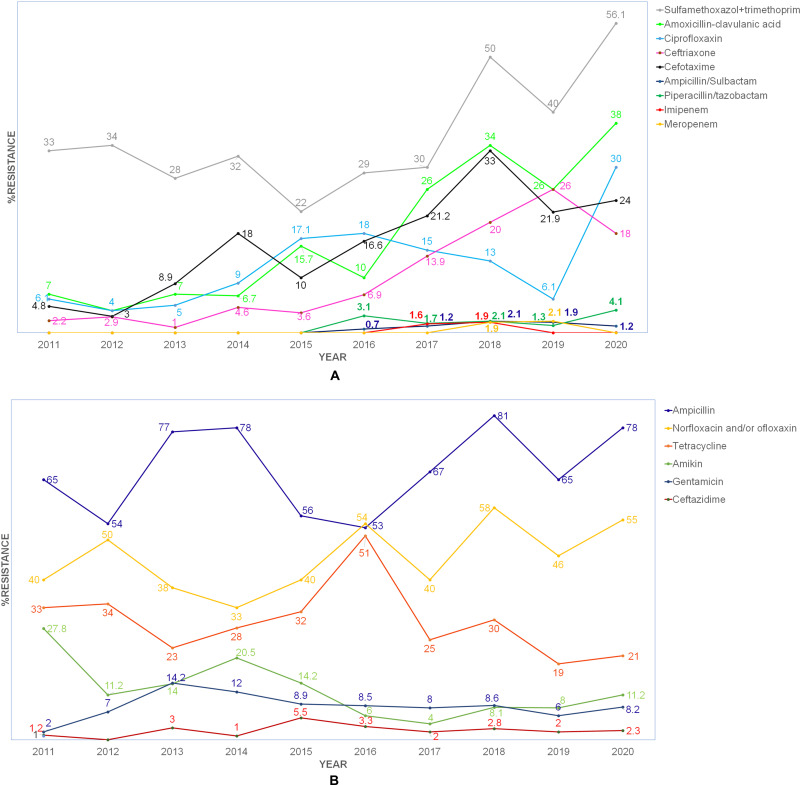
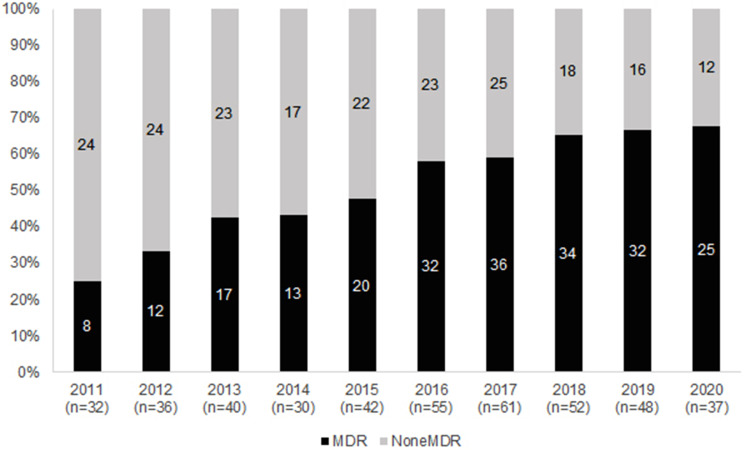
A total of 433 patients were identified. The most common age group was less than 15 years old (53.6%), with a median age of 12 years (IQR 57-4). Of these people, 61.1% had gastroenteritis and 36.7% had bacteremia. The most prevalent serogroups was C (28.6%). MDR-NTS rate was 52.8% (95% CI 39-44). The resistant rates were 43%, 32.8%, 22.8%, 6.7%, 4%, 0.45%, 0.45% for sulfamethoxazole/trimethoprim, amoxicillin-clavulanic acid, cefotaxime, ampicillin/sulbactam, piperacillin/tazobactam, imipenem and meropenem retrospectively. Resistant rates have been increasing, especially for ciprofloxacin (30%), which rose from 16.6% in 2011-2015 to 39.5% in 2016-2020 (prevalence rate ratio (PRR) 2.4,95% CI 1.51-3.72) and for ceftriaxone 25.4% which rose from 16.1% to 32% (PRR 2 95% CI 1.24-3.16). Ampicillin, norfloxacin, tetracycline, amikacin, gentamicin, and ceftazidime remained static at 62.3%, 49.5%, 33.2%, 15.2%, 8.8%, 2.8%, respectively.
The prevalence of MDR-NTS has been increasing over the past decade, particularly those strains which demonstrate resistance to ciprofloxacin and ceftriaxone. Finding successful treatment requires a comprehensive selection of proper antimicrobials as well as close monitoring, especially in cases with severe infection.
非伤寒型多重耐药菌(MDR-NTS)在全球范围内构成的威胁日益增加。在泰国,过去十年的数据有限。本研究旨在确定该细菌不敏感模式的流行情况和趋势,尤其是对环丙沙星和头孢曲松的不敏感情况。
这项回顾性研究提取了2011年6月至2020年6月期间10家医院非伤寒型(NTS)感染患者的数据。分析包括人口统计学数据、培养报告和抗菌药物敏感性。
共识别出433例患者。最常见的年龄组为15岁以下(53.6%),中位年龄为12岁(四分位间距5-7岁)。其中,61.1%患有肠胃炎,36.7%患有菌血症。最常见的血清群是C群(28.6%)。MDR-NTS率为52.8%(95%置信区间39-44)。回顾性分析显示,磺胺甲恶唑/甲氧苄啶、阿莫西林/克拉维酸、头孢噻肟、氨苄西林/舒巴坦、哌拉西林/他唑巴坦、亚胺培南和美罗培南的耐药率分别为43%、32.8%、22.8%、6.7%、4%、0.45%、0.45%。耐药率一直在上升,尤其是环丙沙星(30%),从2011-2015年的16.6%升至2016-2020年的39.5%(患病率比(PRR)2.4,95%置信区间1.51-3.72),头孢曲松为25.4%,从16.1%升至32%(PRR 2,95%置信区间1.24-3.16)。氨苄西林、诺氟沙星、四环素、阿米卡星、庆大霉素和头孢他啶的耐药率分别保持在62.3%、49.5%、33.2%、15.2%、8.8%、2.8%。
在过去十年中,MDR-NTS的患病率一直在上升,尤其是对环丙沙星和头孢曲松耐药的菌株。要找到成功的治疗方法,需要全面选择合适的抗菌药物并密切监测,尤其是在严重感染病例中。