Department of Environmental Health, 334285Haramaya University College of Health and Medical Sciences, Harar, Ethiopia.
Inquiry. 2022 Jan-Dec;59:469580221090394. doi: 10.1177/00469580221090394.
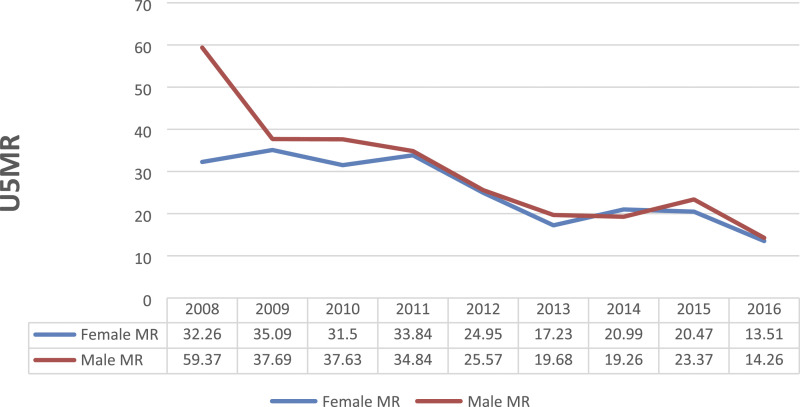
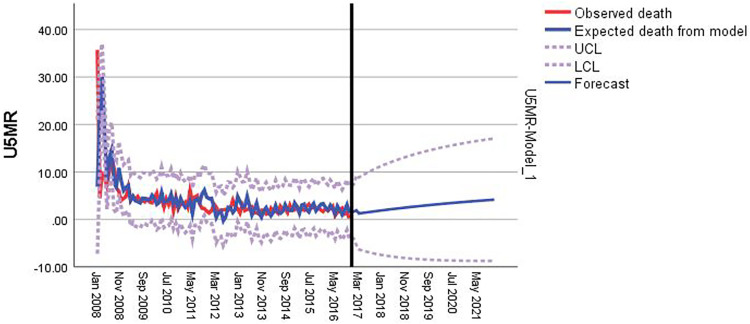
: Of the 6.2 million estimated deaths of children under 15 years of age globally, the death toll of children under 5 years of age accounted for 5.3 million. In Ethiopia, even though significant progress has been made, facility-based research shows that the mortality rate of children under 5 is still high. In the country, particularly in the eastern part, evidence on trends in under-five mortality and associated factors from population-based longitudinal data is limited. : The objective of the study was to assess under-five mortality focusing on the trends and associated factors based on 2008-2016 data in Kersa Health and Demographic Surveillance Site, Eastern Ethiopia. : The study was based on 9 years of surveillance data. The surveillance site was founded in 2007 with the aim of producing community-based health and demographic data in the eastern Ethiopia. Data were collected from the surveillance site and analyzed with STATA version 15 (for factor analysis) and/or Statistical Package for Social Sciences (SPSS) version 26 (for trend analysis) and Microsoft (MS) Excel software. The autoregressive integrated moving average (ARIMA) model and Mann-Kendall were used to analyze mortality trends. Multi-level logistic regression was used to assess the associated factors. : There were a total of 18 759 newborns in the surveillance sites, of which 1602 died of children under 5 years of age, and the total mortality rate for children under 5 years of age was 85 per 1000 live births. Trend analysis shows that the mortality rate of children under 5 has been steadily declining during the study period. Multi-level logistic regression shows that the variance of the random component model related to the intercept term is statistically significant, which means that there is a change in the mortality rate of children under 5 between the survey years, which is explained by the random intercept term. Antenatal care visits by mothers (AOR = .61, 95% CI = .49, .74), primary education (AOR = .58, 95% CI = .49, .68), normal birth weight (AOR = .78, 95% CI = .64, .95), and having 2 or fewer total births (AOR = .37, 95% CI = .22, .37) were all associated with child death. : Despite the downward trend, the mortality rate of children under 5 years old at the surveillance sites is high. Effective intervention measures should be implemented.
在全球估计的 620 万 15 岁以下儿童死亡中,5 岁以下儿童死亡人数占 530 万。在埃塞俄比亚,尽管已经取得了重大进展,但基于机构的研究表明,5 岁以下儿童的死亡率仍然很高。在该国,特别是在东部地区,基于人口纵向数据的 5 岁以下儿童死亡率趋势和相关因素的证据有限。
本研究旨在评估基于 2008-2016 年数据的以五岁以下儿童死亡率为重点的趋势和相关因素,研究地点为埃塞俄比亚东部的克尔萨健康和人口监测点。
该研究基于 9 年的监测数据。该监测点成立于 2007 年,旨在提供埃塞俄比亚东部基于社区的健康和人口数据。数据来自监测点,并使用 STATA 版本 15(用于因素分析)和/或统计软件包(用于趋势分析)和 Microsoft(MS)Excel 软件进行分析。自回归综合移动平均(ARIMA)模型和曼-肯德尔用于分析死亡率趋势。多水平逻辑回归用于评估相关因素。
在监测点共有 18759 名新生儿,其中 1602 名儿童在 5 岁以下死亡,5 岁以下儿童总死亡率为每 1000 例活产 85 例。趋势分析表明,在研究期间,5 岁以下儿童的死亡率一直在稳步下降。多水平逻辑回归显示,与截距项相关的随机分量模型的方差具有统计学意义,这意味着在调查年份之间,5 岁以下儿童的死亡率发生了变化,这可以用随机截距项来解释。母亲的产前保健就诊(AOR=0.61,95%CI=0.49,0.74)、小学教育(AOR=0.58,95%CI=0.49,0.68)、正常出生体重(AOR=0.78,95%CI=0.64,0.95)和总生育次数为 2 次或更少(AOR=0.37,95%CI=0.22,0.37)均与儿童死亡相关。
尽管死亡率呈下降趋势,但监测点 5 岁以下儿童的死亡率仍然很高。应采取有效的干预措施。