Tigchelaar Celien, van Zuylen Mark L, Hulst Abraham H, Preckel Benedikt, van Beek André P, Kema Ido P, Hermanides Jeroen, Absalom Anthony R
Department of Anaesthesiology, University Medical Center Groningen, University of Groningen, Groningen, the Netherlands.
Department of Anaesthesiology, Amsterdam UMC - Location AMC, University of Amsterdam, Amsterdam, the Netherlands.
Diabetologia. 2022 Jul;65(7):1098-1107. doi: 10.1007/s00125-022-05693-7. Epub 2022 Apr 5.
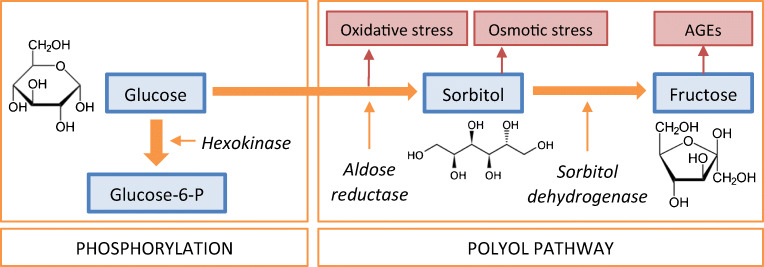
AIMS/HYPOTHESIS: During hyperglycaemia, some glucose bypasses glycolysis and is metabolised via the potentially neurotoxic polyol pathway, in which glucose is metabolised to sorbitol and fructose. Increased polyol concentrations have been demonstrated in the cerebrospinal fluid (CSF) of neurological patients with and without diabetes mellitus. However, polyol levels in patients without evident neurological abnormalities have not been investigated so far. The aim of this study was to determine CSF polyol concentrations in patients without major neurological disease with normal or elevated CSF glucose concentrations.
This observational cohort study used CSF and plasma analyses, as well as clinical data, from 30 participants of the Anaesthetic Biobank of Cerebrospinal Fluid study. Biomaterial was collected from adult patients scheduled for elective surgery under spinal anaesthesia. CSF polyol concentrations were measured by GC/flame ionisation detector in ten patients with normal CSF glucose levels (group 1), ten patients with elevated CSF glucose levels (group 2) and ten patients with elevated CSF glucose levels and type 2 diabetes (group 3). We compared the concentrations of plasma glucose, CSF glucose, sorbitol and fructose, and CSF polyol/glucose ratios between the three groups, and determined the correlation between plasma glucose levels and CSF glucose, sorbitol and fructose levels.
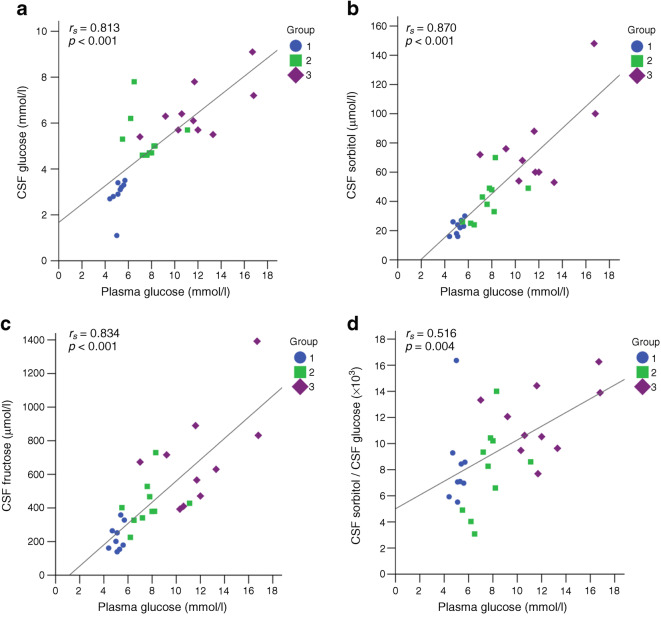
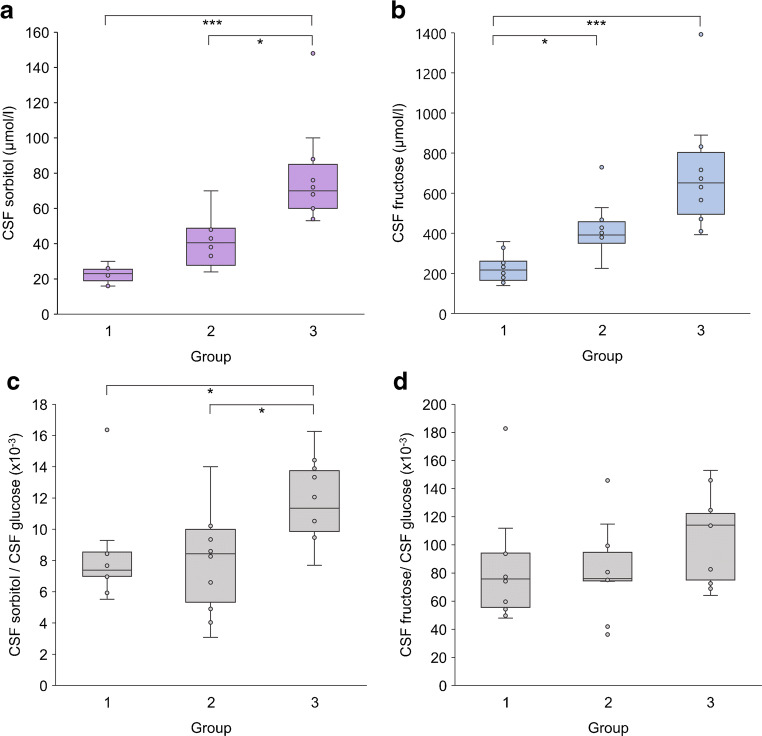
Groups 2 and 3 had significantly higher CSF fructose levels compared with group 1 (p=0.036 and p<0.001, respectively). Group 3 showed significant differences compared with groups 1 and 2 for CSF sorbitol (p<0.001 and 0.036, respectively). Moreover, patients with diabetes had a significantly higher CSF sorbitol/glucose ratio compared with patients without diabetes. There was a strong positive correlation between plasma glucose and CSF glucose, sorbitol and fructose. Finally, age, sex, CSF/plasma albumin ratio and preoperative cognitive function scores were significantly correlated with plasma glucose and CSF glucose, sorbitol and fructose levels.
CONCLUSIONS/INTERPRETATION: Hyperglycaemia causes a proportional increase in polyol concentrations in CSF of patients without major neurological disease. Furthermore, this study provides the first indication of upregulation of the cerebral polyol pathway in patients with diabetes without evident neurological abnormalities.
目的/假设:在高血糖期间,一些葡萄糖绕过糖酵解,通过潜在的神经毒性多元醇途径代谢,在该途径中葡萄糖被代谢为山梨醇和果糖。在患有和未患有糖尿病的神经系统疾病患者的脑脊液(CSF)中已证实多元醇浓度升高。然而,迄今为止尚未对无明显神经异常的患者的多元醇水平进行研究。本研究的目的是确定脑脊液葡萄糖浓度正常或升高的无重大神经系统疾病患者的脑脊液多元醇浓度。
这项观察性队列研究使用了脑脊液研究麻醉生物样本库中30名参与者的脑脊液和血浆分析以及临床数据。生物材料取自计划接受脊髓麻醉下择期手术的成年患者。通过气相色谱/火焰离子化检测器测量了10名脑脊液葡萄糖水平正常的患者(第1组)、10名脑脊液葡萄糖水平升高的患者(第2组)和10名脑脊液葡萄糖水平升高且患有2型糖尿病的患者(第3组)的脑脊液多元醇浓度。我们比较了三组之间的血浆葡萄糖、脑脊液葡萄糖、山梨醇和果糖浓度以及脑脊液多元醇/葡萄糖比值,并确定了血浆葡萄糖水平与脑脊液葡萄糖、山梨醇和果糖水平之间的相关性。
与第1组相比,第2组和第3组的脑脊液果糖水平显著更高(分别为p = 0.036和p < 0.001)。第3组与第1组和第2组相比,脑脊液山梨醇存在显著差异(分别为p < 0.001和0.036)。此外,患有糖尿病的患者与未患糖尿病的患者相比,脑脊液山梨醇/葡萄糖比值显著更高。血浆葡萄糖与脑脊液葡萄糖、山梨醇和果糖之间存在强烈的正相关。最后,年龄、性别、脑脊液/血浆白蛋白比值和术前认知功能评分与血浆葡萄糖以及脑脊液葡萄糖、山梨醇和果糖水平显著相关。
结论/解读:高血糖导致无重大神经系统疾病患者脑脊液中多元醇浓度成比例增加。此外,本研究首次表明在无明显神经异常的糖尿病患者中脑多元醇途径上调。