Chi Zengjie, Lin Yanyun, Huang Juanni, Lv Min-Yi, Chen Junguo, Chen Xijie, Zhang Bin, Chen Yufeng, Hu Jiancong, He Xiaosheng, Lan Ping
Department of Colorectal Surgery, Guangdong Provincial Key Laboratory of Colorectal and Pelvic Floor Diseases, Guangdong Institute of Gastroenterology, the Sixth Affiliated Hospital of Sun Yat-sen University, Guangzhou, Guangdong, P. R. China.
Department of Geriatrics, The First Affiliated Hospital, Guangzhou Medical University, Guangzhou, Guangdong, P. R. China.
Gastroenterol Rep (Oxf). 2021 Sep 16;10:goab038. doi: 10.1093/gastro/goab038. eCollection 2022.
Removal of colorectal polyps during screening could reduce the incidence of colorectal cancer (CRC). However, there is a lack of data on risk factors associated with recurrence of polyps, including conventional adenomas and serrated polyps (SPs). This study aimed to determine risk factors for recurrence of colorectal polyps and their subtypes based on the characteristics of the patients and polyps.
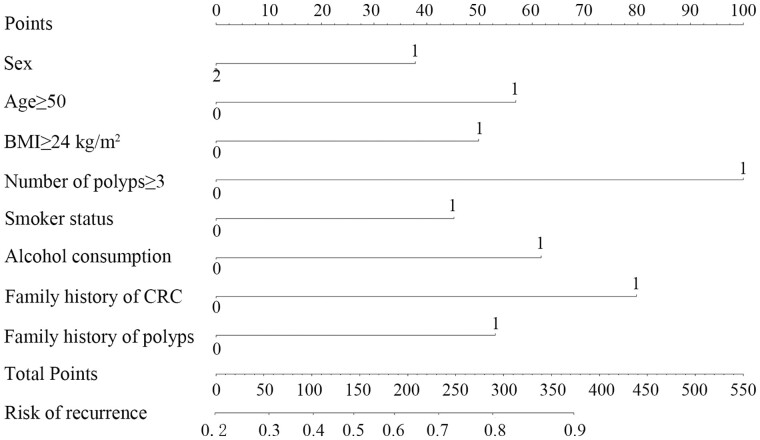
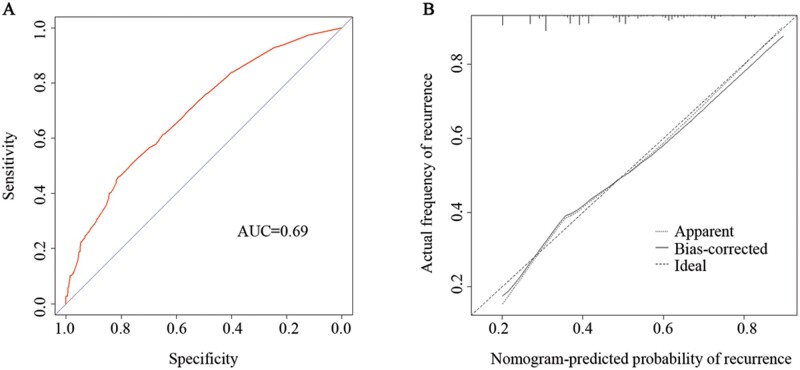
A total of 1,165 patients diagnosed with conventional adenoma or SP in the Sixth Affiliated Hospital of Sun Yat-sen University between January 2013 and December 2019 were enrolled in this study, including 668 cases with conventional adenomas, 385 with SPs, and 112 with coexistence of adenomas and SPs. Univariate analysis and multivariate logistic regression were used to identify potential risk factors for polyp recurrence. A nomogram was established according to risk factors and the performance was evaluated using calibration plots.
During a median follow-up of 24 months, recurrent polyps were observed in 531 (45.6%) cases. Male, age ≥50 years, body mass index (BMI) ≥24 kg/m, at least three polyps, smoking, alcohol consumption, family history of polyps, and family history of CRC were independent risk factors for polyp recurrence. The Harrell's C-index of the nomogram developed with these parameters was 0.69 and the calibration plots showed good agreement between actual polyp recurrence and nomogram-predicted recurrence probability. In the subtype analyses, conventional adenomas had the same risk factors for recurrence as all polyps, while smoking, alcohol consumption, family history of polyps, and family history of CRC were not risk factors for SP recurrence.
We identified several risk factors for recurrence of colorectal polyps and found that some of them could increase the risk of adenoma recurrence but not SP recurrence, including smoking, alcohol consumption, and family history of polyps/CRC, which might help us to understand different etiology and biology between conventional adenomas and SPs.
在筛查过程中切除大肠息肉可降低结直肠癌(CRC)的发病率。然而,关于息肉复发相关危险因素的数据较少,包括传统腺瘤和锯齿状息肉(SPs)。本研究旨在根据患者和息肉的特征确定大肠息肉及其亚型复发的危险因素。
本研究纳入了2013年1月至2019年12月期间在中山大学附属第六医院诊断为传统腺瘤或SP的1165例患者,其中包括668例传统腺瘤患者、385例SP患者和112例腺瘤与SP共存患者。采用单因素分析和多因素logistic回归来识别息肉复发的潜在危险因素。根据危险因素建立列线图,并使用校准图评估其性能。
在中位随访24个月期间,531例(45.6%)患者出现息肉复发。男性、年龄≥50岁、体重指数(BMI)≥24kg/m²、至少三个息肉、吸烟、饮酒、息肉家族史和CRC家族史是息肉复发的独立危险因素。用这些参数构建的列线图的Harrell's C指数为0.69,校准图显示实际息肉复发与列线图预测的复发概率之间具有良好的一致性。在亚型分析中,传统腺瘤的复发危险因素与所有息肉相同,而吸烟、饮酒、息肉家族史和CRC家族史不是SP复发的危险因素。
我们确定了几种大肠息肉复发的危险因素,发现其中一些因素可增加腺瘤复发风险,但不增加SP复发风险,包括吸烟、饮酒和息肉/CRC家族史,这可能有助于我们理解传统腺瘤和SP之间不同的病因和生物学特性。