Leicester School of Pharmacy, Hawthorn Building, De Montfort University, Leicester, UK.
School of Biosciences, University of Sheffield, Sheffield, UK.
J Appl Microbiol. 2022 Aug;133(2):830-841. doi: 10.1111/jam.15564. Epub 2022 May 16.
To investigate the priming effects of sub-inhibitory concentrations of biocides on antibiotic resistance in bacteria.
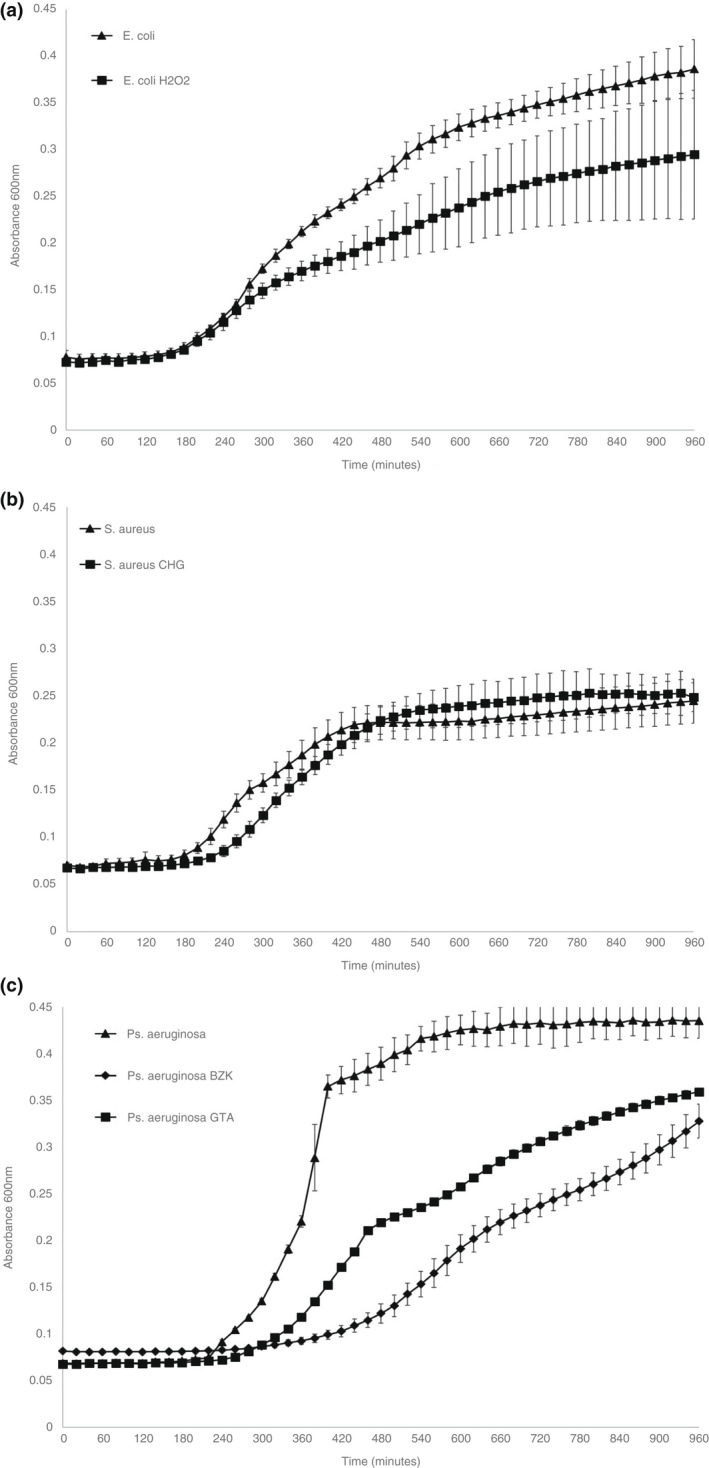
Escherichia coli, Pseudomonas aeruginosa and Staphylococcus aureus were exposed to sub-inhibitory concentrations of biocides via a gradient plate method. Minimum inhibitory concentration (MIC) and antibiotic susceptibility were determined, and efflux pump inhibitors (thioridazine and chlorpromazine) were used to investigate antibiotic resistance mechanism(s). Escherichia coli displayed a twofold increase in MIC (32-64 mg l ) to H O which was stable after 15 passages, but lost after 6 weeks, and P. aeruginosa displayed a twofold increase in MIC (64-128 mg l ) to BZK which was also stable for 15 passages. There were no other tolerances observed to biocides in E. coli, P. aeruginosa or S. aureus; however, stable cross-resistance to antibiotics was observed in the absence of a stable increased tolerance to biocides. Sixfold increases in MIC to cephalothin and fourfold to ceftriaxone and ampicillin were observed in hydrogen peroxide primed E. coli. Chlorhexidine primed S. aureus showed a fourfold increase in MIC to oxacillin, and glutaraldehyde-primed P. aeruginosa showed fourfold (sulphatriad) and eightfold (ciprofloxacin) increases in MIC. Thioridazine increased the susceptibility of E. coli to cephalothin and cefoxitin by fourfold and twofold, respectively, and both thioridazine and chlorpromazine increased the susceptibility S. aureus to oxacillin by eightfold and fourfold, respectively.
These findings demonstrate that sub-inhibitory concentrations of biocides can prime bacteria to become resistant to antibiotics even in the absence of stable biocide tolerance and suggests activation of efflux mechanisms may be a contributory factor.
This study demonstrates the effects of low-level exposure of biocides (priming) on antibiotic resistance even in the absence of obvious increased biocidal tolerance.
研究亚抑菌浓度的消毒剂对细菌抗生素耐药性的启动作用。
通过梯度平板法使大肠杆菌、铜绿假单胞菌和金黄色葡萄球菌暴露于亚抑菌浓度的消毒剂。测定最小抑菌浓度(MIC)和抗生素敏感性,并使用外排泵抑制剂(硫利哒嗪和氯丙嗪)来研究抗生素耐药机制。大肠杆菌对 H₂O₂的 MIC(32-64mg/L)增加了两倍,这种增加在 15 次传代后是稳定的,但在 6 周后丢失,铜绿假单胞菌对 BZK 的 MIC(64-128mg/L)增加了两倍,这种增加在 15 次传代后也是稳定的。在大肠杆菌、铜绿假单胞菌或金黄色葡萄球菌中没有观察到对消毒剂的其他耐受性;然而,在没有稳定增加对消毒剂的耐受性的情况下,观察到了对抗生素的稳定交叉耐药性。经过氧化氢预处理的大肠杆菌对头孢噻吩的 MIC 增加了 6 倍,对头孢曲松和氨苄西林的 MIC 增加了 4 倍。氯己定预处理的金黄色葡萄球菌对苯唑西林的 MIC 增加了 4 倍,戊二醛预处理的铜绿假单胞菌对磺胺嘧啶的 MIC 增加了 4 倍,对环丙沙星的 MIC 增加了 8 倍。硫利哒嗪使大肠杆菌对头孢噻肟和头孢西丁的敏感性分别增加了 4 倍和 2 倍,硫利哒嗪和氯丙嗪使金黄色葡萄球菌对苯唑西林的敏感性分别增加了 8 倍和 4 倍。
这些发现表明,亚抑菌浓度的消毒剂可以使细菌对抗生素产生耐药性,即使在没有稳定的消毒剂耐受性的情况下也是如此,并表明外排机制的激活可能是一个促成因素。
本研究表明,即使在明显增加的杀菌耐受性不存在的情况下,低水平接触消毒剂(启动)也会对抗生素耐药性产生影响。