National Perinatal Epidemiology Unit, Nuffield Department of Population Health, University of Oxford, Oxford, UK.
Université de Paris, CRESS U1153, INSERM, Obstetrical, Perinatal and Pediatric Epidemiology (EPOPé) Research Team, Paris, France.
BJOG. 2022 Sep;129(10):1676-1685. doi: 10.1111/1471-0528.17169. Epub 2022 Apr 29.
To compare the management and outcomes of women with placenta accreta spectrum (PAS) in France and the UK.
Two population-based cohorts.
All obstetrician-led hospitals in the UK and maternity hospitals in eight French regions.
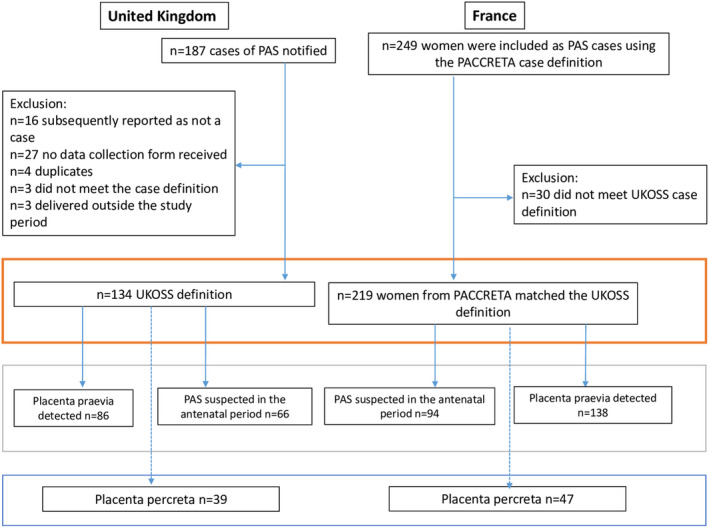
A cohort of 219 women with PAS in France and a cohort of 154 women with PAS in the UK.
The management and outcomes of women with PAS were compared between the UK and France.
Median blood loss, severe postpartum haemorrhage (≥3 l), postpartum infection and damage to surrounding organs.
The management of PAS differed between the two countries: a larger proportion of women with PAS in the UK had a caesarean hysterectomy compared with France (43% vs 26%, p < 0.001), whereas in France a larger proportion of women with PAS received a uterus-preserving approach compared with the UK (36% vs 19%, p < 0.001). The total median blood loss in the UK was 3 l (IQR 1.7-6.5 l), compared with 1 l (IQR 0.5-2.5 l) in France; more women with PAS had a severe postpartum haemorrhage (PPH) in the UK compared with women with PAS in France (58% vs 21%, p < 0.001) [Correction added on 06 May 2022, after first online publication: '24 hour' has been changed to 'total' in the preceding sentence]. There was no difference between the UK and French populations for postpartum infection or organ damage.
The UK and France have very different approaches to managing PAS, with more women in France receiving a uterine-conserving approach and more women in the UK undergoing caesarean hysterectomy. A life-threatening haemorrhage was more common in the UK than in France, which may be the result of differential management and/or the organisation of the healthcare systems. In women with placenta accreta spectrum, severe haemorrhage was more common in the UK than in France.
In women with placenta accreta spectrum, severe haemorrhage was more common in the UK than in France.
比较法国和英国胎盘部位滋养细胞肿瘤(PAS)患者的管理和结局。
两项基于人群的队列研究。
英国所有产科医生主导的医院和法国 8 个地区的产科医院。
法国 PAS 患者队列中有 219 例,英国 PAS 患者队列中有 154 例。
比较英国和法国 PAS 患者的管理和结局。
中位出血量、严重产后出血(≥3 升)、产后感染和周围器官损伤。
两国 PAS 的管理方式不同:英国 PAS 患者行剖宫产子宫切除术的比例明显高于法国(43%比 26%,p<0.001),而法国 PAS 患者保留子宫的比例明显高于英国(36%比 19%,p<0.001)。英国 PAS 患者总中位出血量为 3 升(IQR 1.7-6.5 升),法国为 1 升(IQR 0.5-2.5 升);英国 PAS 患者发生严重产后出血的比例明显高于法国(58%比 21%,p<0.001)。英国和法国 PAS 患者的产后感染或器官损伤无差异。
英国和法国在 PAS 的管理上有很大的不同,法国有更多的患者接受保留子宫的方法,而英国有更多的患者行剖宫产子宫切除术。英国危及生命的出血比法国更常见,这可能是管理和/或医疗保健系统组织的差异所致。在胎盘部位滋养细胞肿瘤患者中,英国严重出血的比例高于法国。