Department of Anesthesiology, The Affiliated Hospital of Xuzhou Medical University, Xuzhou, Jiangsu, People's Republic of China.
Jiangsu Province Key Laboratory of Anesthesiology, Xuzhou Medical University, Xuzhou, Jiangsu, People's Republic of China.
Clin Interv Aging. 2022 Mar 31;17:317-330. doi: 10.2147/CIA.S349978. eCollection 2022.
There has been a worldwide increment in acute kidney injury (AKI) incidence among elderly orthopedic operative patients. The AKI prediction model provides patients' early detection a possibility at risk of AKI; most of the AKI prediction models derive, however, from the cardiothoracic operation. The purpose of this study is to predict the risk of AKI in elderly patients after orthopedic surgery based on machine learning algorithm models.
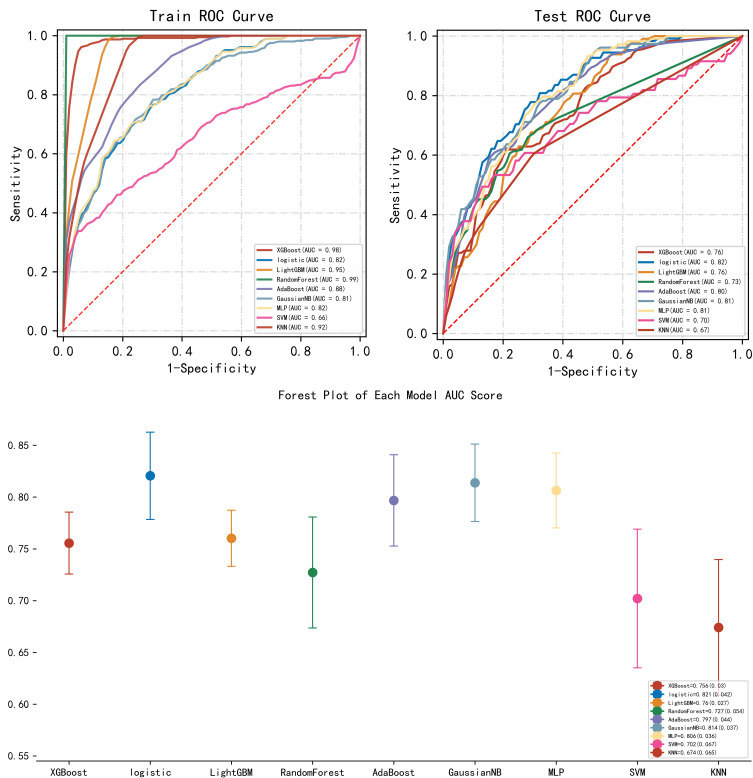
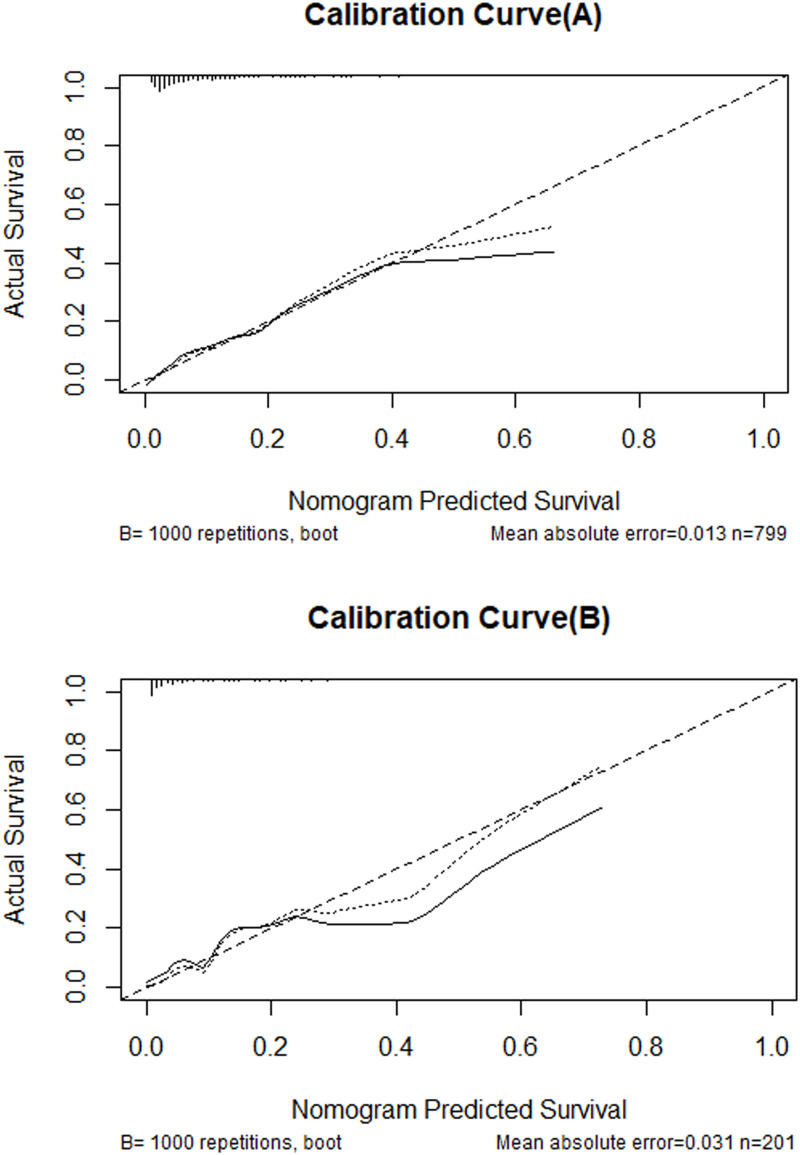
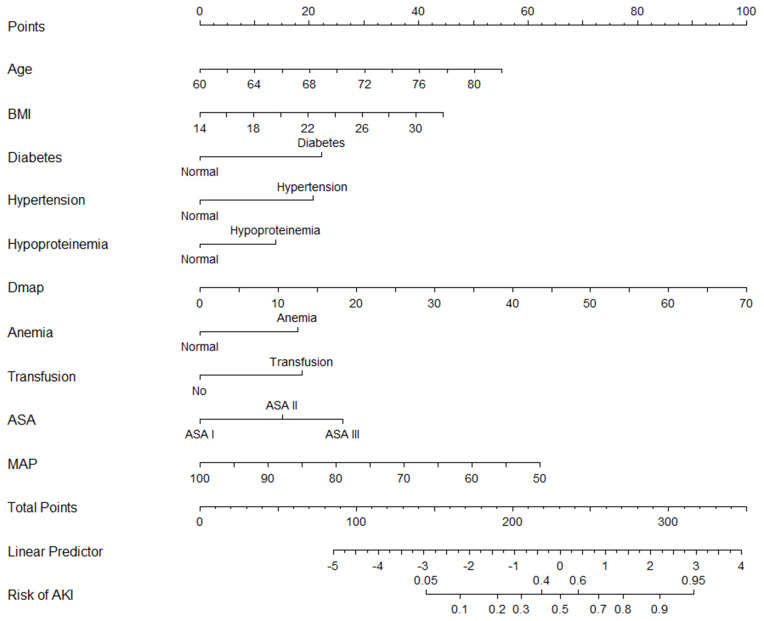
We organized a retrospective study being comprised of 1000 patients with postoperative AKI undergoing orthopedic surgery from September 2016, to June, 2021. They were divided into training (80%;n=799) and test (20%;n=201) sets.We utilized nine machine learning (ML) algorithms and used intraoperative information and preoperative clinical features to acquire models to predict AKI. The performance of the model was evaluated according to the area under the receiver operating characteristic (AUC), sensitivity, specificity and accuracy. Select the optimal model and establish the nomogram to make the prediction model visualization. The concordance statistic (C-statistic) and calibration curve were used to discriminate and calibrate the nomogram respectively.
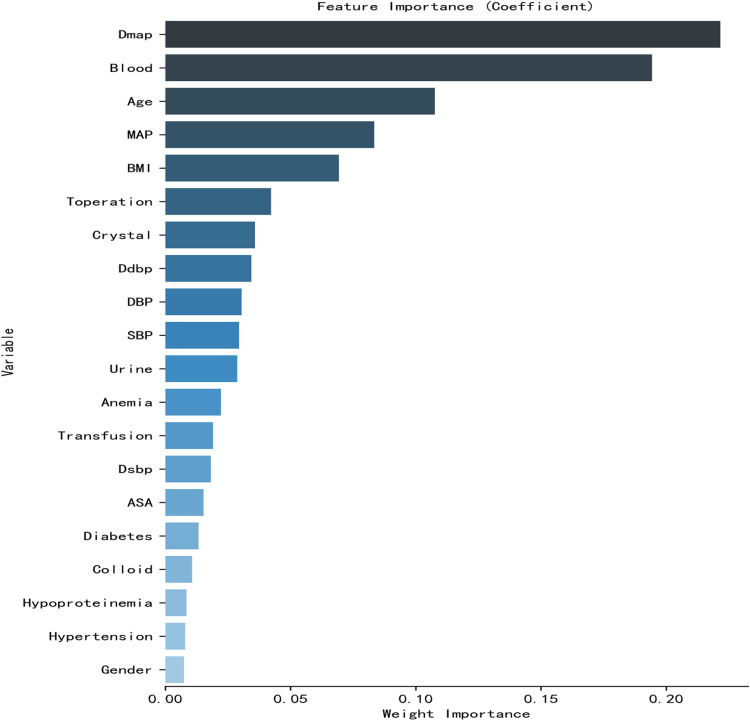
In predicting AKI, nine ML algorithms posted AUC of 0.656-1.000 in the training cohort, with the randomforest standing out and AUC of 0.674-0.821 in the test cohort, with the logistic regression model standing out. Thus, we applied the logistic regression model to establish nomogram. The nomogram was comprised of ten variables: age, body mass index, American Society of Anesthesiologists, hypoproteinemia, hypertension, diabetes, anemia, duration of low mean arterial pressure, mean arterial pressure, transfusion.The calibration curves showed good agreement between prediction and observation in both the training and test sets.
By including intraoperative and preoperative risk factors, ML algorithm can predict AKI and logistic regression model performing the best. Our prediction model and nomogram that are based on this ML algorithm can help lead decision-making for strategies to inhibit AKI over the perioperative duration.
全球老年骨科手术患者急性肾损伤(AKI)的发病率有所增加。AKI 预测模型为患者提供了早期发现 AKI 风险的可能性;然而,大多数 AKI 预测模型都是从心胸手术中得出的。本研究旨在基于机器学习算法模型预测老年骨科手术后 AKI 的风险。
我们组织了一项回顾性研究,纳入了 2016 年 9 月至 2021 年 6 月期间接受骨科手术后发生 AKI 的 1000 例患者。他们分为训练集(80%;n=799)和测试集(20%;n=201)。我们利用九种机器学习(ML)算法,利用术中信息和术前临床特征来获取预测 AKI 的模型。根据接收者操作特征曲线下的面积(AUC)、灵敏度、特异性和准确性来评估模型的性能。选择最佳模型并建立列线图,使预测模型可视化。分别使用一致性统计量(C 统计量)和校准曲线来区分和校准列线图。
在预测 AKI 方面,九种 ML 算法在训练队列中的 AUC 为 0.656-1.000,其中随机森林算法表现突出,在测试队列中的 AUC 为 0.674-0.821,其中逻辑回归模型表现突出。因此,我们应用逻辑回归模型建立了列线图。该列线图由 10 个变量组成:年龄、体重指数、美国麻醉师协会、低蛋白血症、高血压、糖尿病、贫血、低血压持续时间、平均动脉压、输血。校准曲线显示,在训练集和测试集中,预测和观察之间均具有良好的一致性。
通过纳入术中及术前危险因素,机器学习算法可以预测 AKI,其中逻辑回归模型表现最佳。我们基于该机器学习算法的预测模型和列线图可以帮助在围手术期决策策略,以抑制 AKI。