Chen Huan, Gong Guo-Qing, Ding Mei, Dong Xiang, Sun Yuan-Li, Wan Lang, Gao Ya-Dong
Department of Otolaryngology and Allergology, Central Hospital of Huangshi, Huangshi, China.
Department of Allergology, Zhongnan Hospital of Wuhan University, Wuhan, China.
Front Allergy. 2022 Jan 5;2:810133. doi: 10.3389/falgy.2021.810133. eCollection 2021.
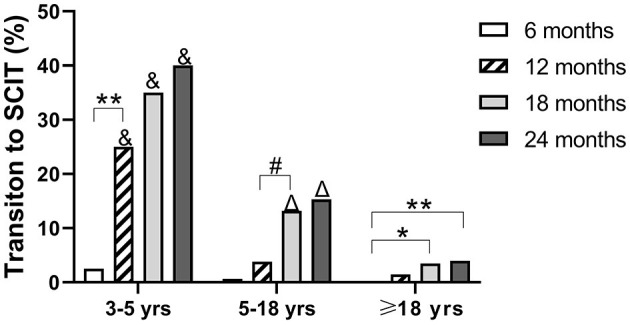
Both subcutaneous immunotherapy (SCIT) and sublingual immunotherapy (SLIT) are effective in reducing symptoms and medication scores and inducing long-term efficacy in patients with allergic rhinitis (AR). However, SLIT has been associated with poor patient adherence. This study investigates the factors impacting dropout rates from SLIT in house dust mite (HDM)-sensitized AR patients. A retrospective study was performed to analyze dropout rates and reasons in AR patients receiving () SLIT with a follow-up period of 2 years. A total of 719 HDM-sensitized AR patients received -SLIT. Dropout rates increased with time and most occurred after 1 year of SLIT. By month 24, 654 (91%) patients had discontinued SLIT. The dropout rates by month 24 were 100, 90.1, and 91.1% in children <5 years old, children aged 5-18 years old, and adults ≥ 18 years old, respectively. Combination with allergic asthma and mono- or multi-sensitization to other aeroallergens did not affect the dropout rates. The most common self-reported reasons for dropouts were refusal of continuation, dissatisfaction with the efficacy, transition to SCIT, and adverse effects. Refusal of continuation increased with age, whereas transition to SCIT decreased with age. Ninety-seven cases transitioned from SLIT to SCIT, and the transition rates increased with time. Comorbid allergic asthma did not affect the transition rates. However, multi-sensitization was associated with a slightly higher rate of transition to SCIT. The most common reason for the transition was dissatisfaction with the efficacy (54.6%), which was only reported by patients older than 5 years. For children who began SLIT at younger than 5 years old, the most common reason (81.2%) for transition was age reaching 5 years. HDM-SLIT has a very high dropout rate, which is mainly due to refusal of continuation and dissatisfaction with the efficacy. Transitioning from SLIT to SCIT may help keep these patients on AIT and thus increase adherence and long-term efficacy.
皮下免疫疗法(SCIT)和舌下免疫疗法(SLIT)在减轻变应性鼻炎(AR)患者的症状和药物评分以及诱导长期疗效方面均有效。然而,SLIT与患者依从性差有关。本研究调查了影响屋尘螨(HDM)致敏的AR患者SLIT停药率的因素。进行了一项回顾性研究,以分析接受()SLIT且随访期为2年的AR患者的停药率及原因。共有719例HDM致敏的AR患者接受了-SLIT。停药率随时间增加,且大多数发生在SLIT治疗1年后。到第24个月时,654例(91%)患者停止了SLIT治疗。在<5岁儿童、5 - 18岁儿童和≥18岁成人中,第24个月时的停药率分别为100%、90.1%和91.1%。合并变应性哮喘以及对其他空气变应原的单敏或多敏状态并不影响停药率。最常见的自我报告的停药原因是拒绝继续治疗、对疗效不满意、转为SCIT以及不良反应。拒绝继续治疗随年龄增加,而转为SCIT则随年龄降低。97例患者从SLIT转为SCIT,且转换率随时间增加。合并变应性哮喘并不影响转换率。然而,多敏状态与转为SCIT的比率略高有关。转换的最常见原因是对疗效不满意(54.6%),这仅由5岁以上患者报告。对于<5岁开始SLIT治疗的儿童,转换的最常见原因(81.2%)是年龄达到5岁。HDM - SLIT的停药率非常高,这主要是由于拒绝继续治疗和对疗效不满意。从SLIT转为SCIT可能有助于使这些患者继续接受变应原免疫治疗(AIT),从而提高依从性和长期疗效。