Tran Thierry, Billet Kevin, Torres-Cobos Berta, Vichi Stefania, Verdier François, Martin Antoine, Alexandre Hervé, Grandvalet Cosette, Tourdot-Maréchal Raphaëlle
UMR Procédés Alimentaires et Microbiologiques, Institut Agro Dijon, Equipe Vin Alimentation Micro-Organismes Stress (VAlMiS), Université de Bourgogne Franche-Comté, Dijon, France.
Departament de Nutrició, Ciències de l'Alimentació i Gastronomia, Institut de Recerca en Nutrició i Seguretat Alimentària (INSA), Universitat de Barcelona, Barcelona, Spain.
Front Microbiol. 2022 Mar 21;13:836617. doi: 10.3389/fmicb.2022.836617. eCollection 2022.
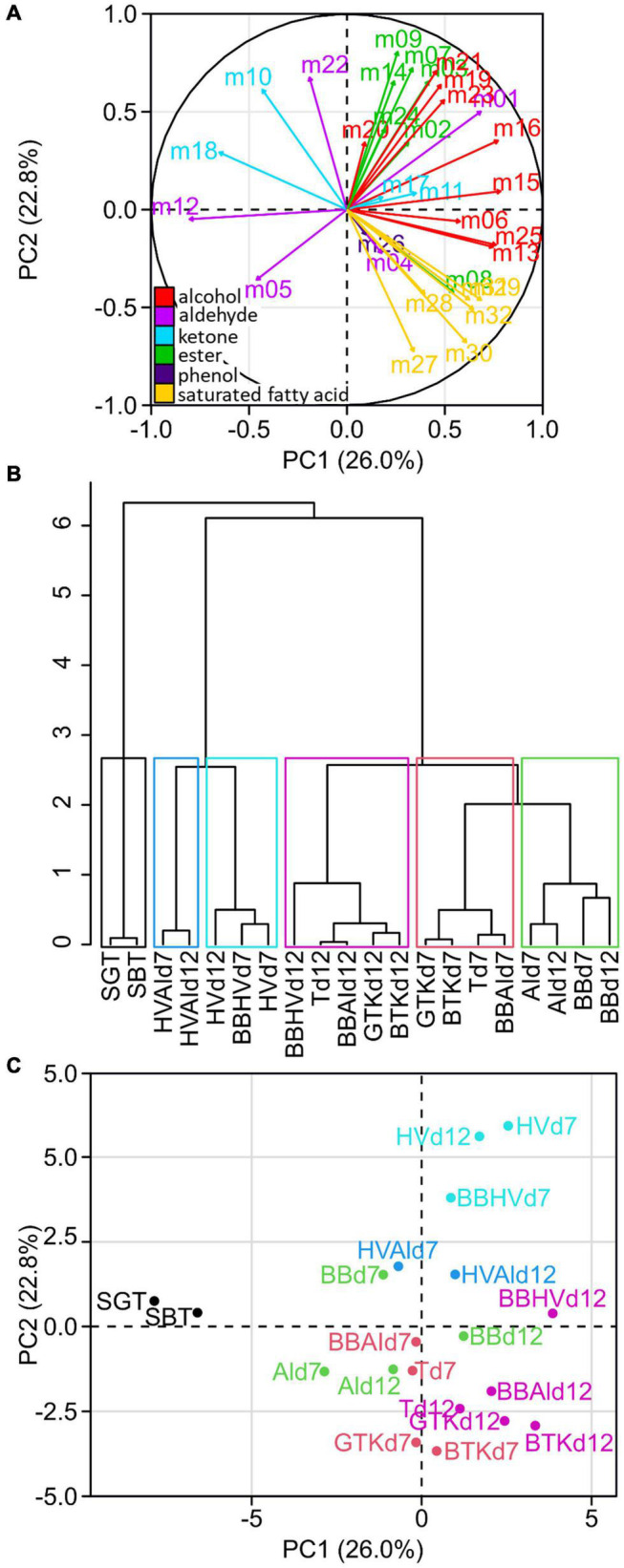
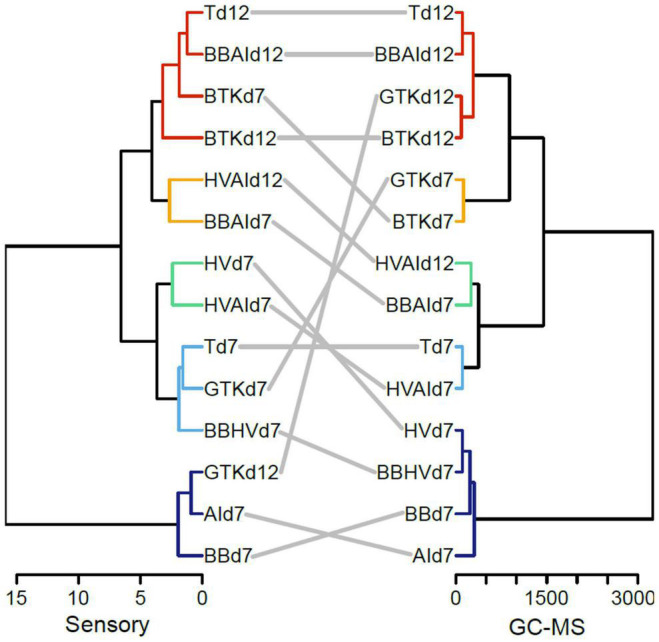
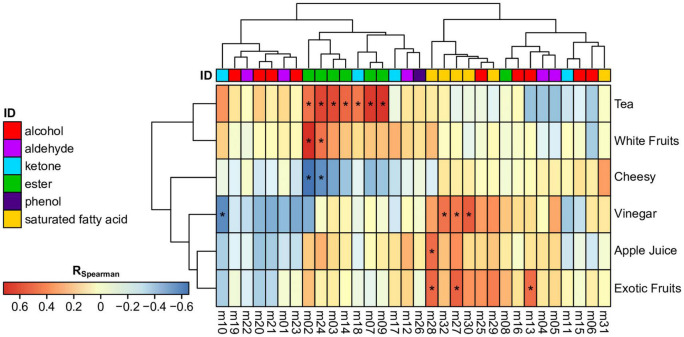
Microbiological, chemical, and sensory analyses were coupled to understand the origins of kombucha organoleptic compounds and their implication in the flavor of the kombucha beverage. By isolating microorganisms from an original kombucha and comparing it to monocultures and cocultures of two yeasts ( and ) and an acetic acid bacterium (), interaction effects were investigated during the two phases of production. 32 volatile compounds identified and quantified by Headspace-Solid Phase-MicroExtraction-Gas Chromatography/Mass Spectrometry (HS-SPME-GC/MS) were classified according to their origin from tea or microorganisms. Many esters were associated to , while alcohols were associated to both yeasts, acetic acid to , and saturated fatty acids to all microorganisms. Concentration of metabolites were dependent on microbial activity, yeast composition, and phase of production. Sensory analysis showed that tea type influenced the olfactive perception, although microbial composition remained the strongest factor. Association of and induced characteristic apple juice aroma.
进行了微生物学、化学和感官分析,以了解康普茶感官化合物的来源及其对康普茶饮料风味的影响。通过从原始康普茶中分离微生物,并将其与两种酵母(和)和一种醋酸菌()的单一培养物和共培养物进行比较,研究了生产两个阶段中的相互作用效应。通过顶空-固相微萃取-气相色谱/质谱联用仪(HS-SPME-GC/MS)鉴定和定量的32种挥发性化合物,根据其来源于茶叶或微生物进行了分类。许多酯类与相关,而醇类与两种酵母都有关,醋酸与有关,饱和脂肪酸与所有微生物有关。代谢物的浓度取决于微生物活性、酵母组成和生产阶段。感官分析表明,茶的类型会影响嗅觉感受,尽管微生物组成仍然是最强的影响因素。和的组合产生了典型的苹果汁香气。